"Men do not look into running water as a mirror, but into still water." The image explains Wang Thai's attraction without his doing anything: people come because he does not move. Legge's parenthesis "(in the contemplation of their real selves)" is his addition and narrows the point to self-knowledge; the text says only that still water arrests all who look, which is a claim about stillness, not introspection.
The Tâo Teh King — Sacred Books of China Part I, SBE Vol. 39 (trans. James Legge, 1891)
Open to all
page 225
No image is selected for this page; its own page image is shown.
page 225
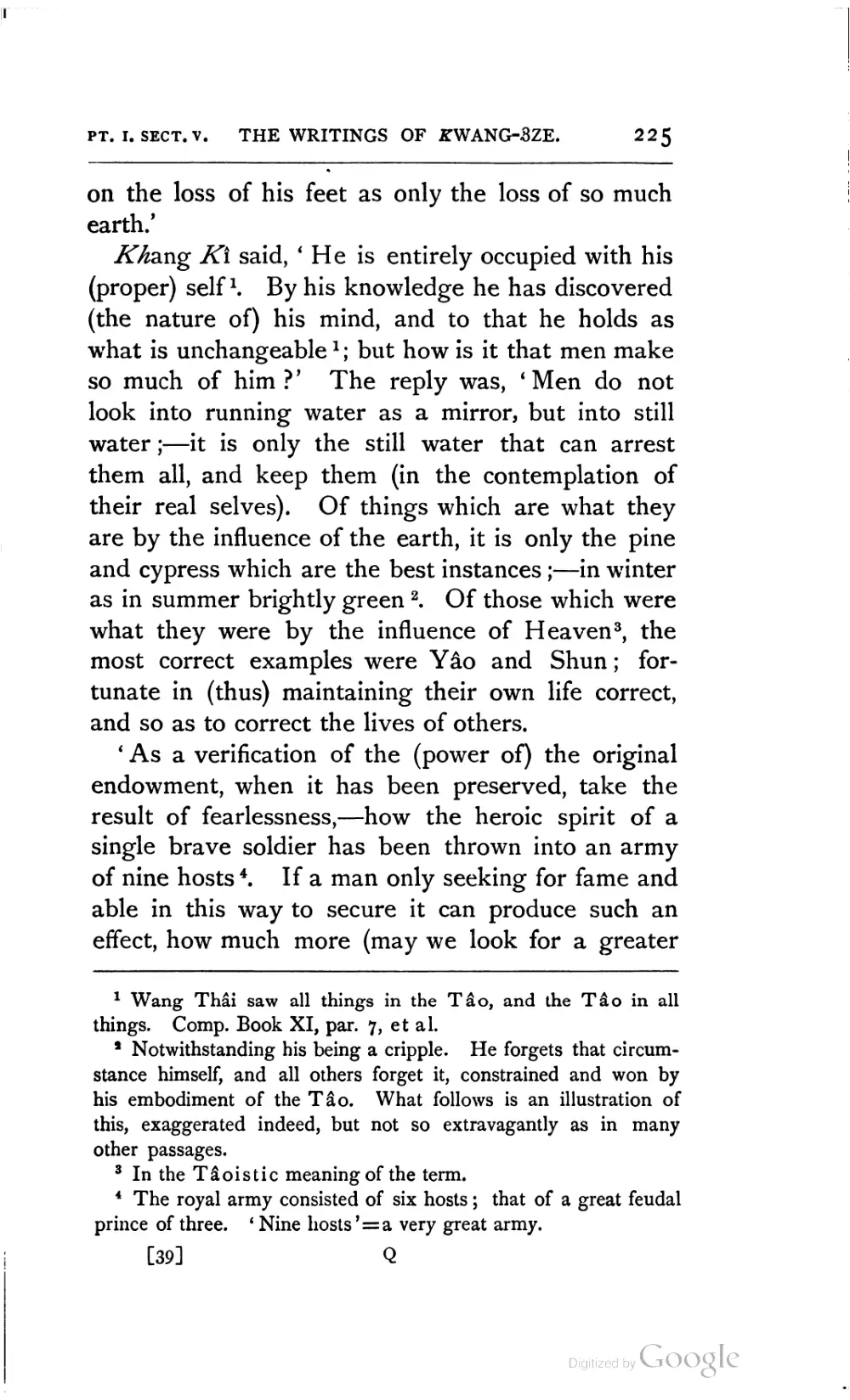
Khang Ki said, ‘He is entirely occupied with his (proper) self¹. By his knowledge he has discovered (the nature of) his mind, and to that he holds as what is unchangeable; but how is it that men make so much of him?’ The reply was, ‘Men do not look into running water as a mirror, but into still water;—only still water can arrest them all, and keep them (in the contemplation of their real selves). Of things that are what they are by the influence of the earth, the pine and cypress are the best instances;—in winter as in summer brightly green*. Of those that were what they were by the influence of Heaven³, the most correct examples were Yao and Shun; fortunate in (thus) keeping their own lives correct, and so correcting the lives of others.
‘As a proof of (the power of) the original endowment, when it has been preserved, take the result of fearlessness—how the heroic spirit of a single brave soldier has been hurled against an army of nine hosts⁴. If a man who is only seeking fame, and is able to secure it in this way, can produce such an effect, how much more (may we look for a greater result) from one whose rule is over heaven and earth and who holds all things in his treasury, who simply lodges in the six members¹ of his body, whom his ears and eyes serve only to convey emblematic images of things, who comprehends all his knowledge in a unity, and whose mind never dies! If such a man were to choose a day on which he would ascend far on high, men would (seek to) follow him there. But how should he be willing to occupy himself with other men?’
1 Wang Thai saw all things in the Tao, and the Tao in all things. Compare Book XI, par. 7, and elsewhere.
2 Notwithstanding his being a cripple. He forgets that circumstance himself, and all others forget it, constrained and won over by his embodiment of the Tao. What follows is an illustration of this, exaggerated indeed, but not so extravagantly as in many other passages.
3 In the Tâoistic sense of the term.
4 The royal army consisted of six hosts; that of a great feudal prince, of three. ‘Nine hosts’ = a very great army.