Legge is right that the character 兀 "does not say that he had lost both his feet," and he names his inference: he borrows "both" from Toeless walking on his heels in a later story. He adds that Kwang-ȝze "wished to say nothing" on the cause of the mutilation. That silence is the argument: whether the loss was punishment, just or unjust, is exactly what the Book says should not count against the man.
The Tâo Teh King — Sacred Books of China Part I, SBE Vol. 39 (trans. James Legge, 1891)
Open to all
page 223
No image is selected for this page; its own page image is shown.
page 223
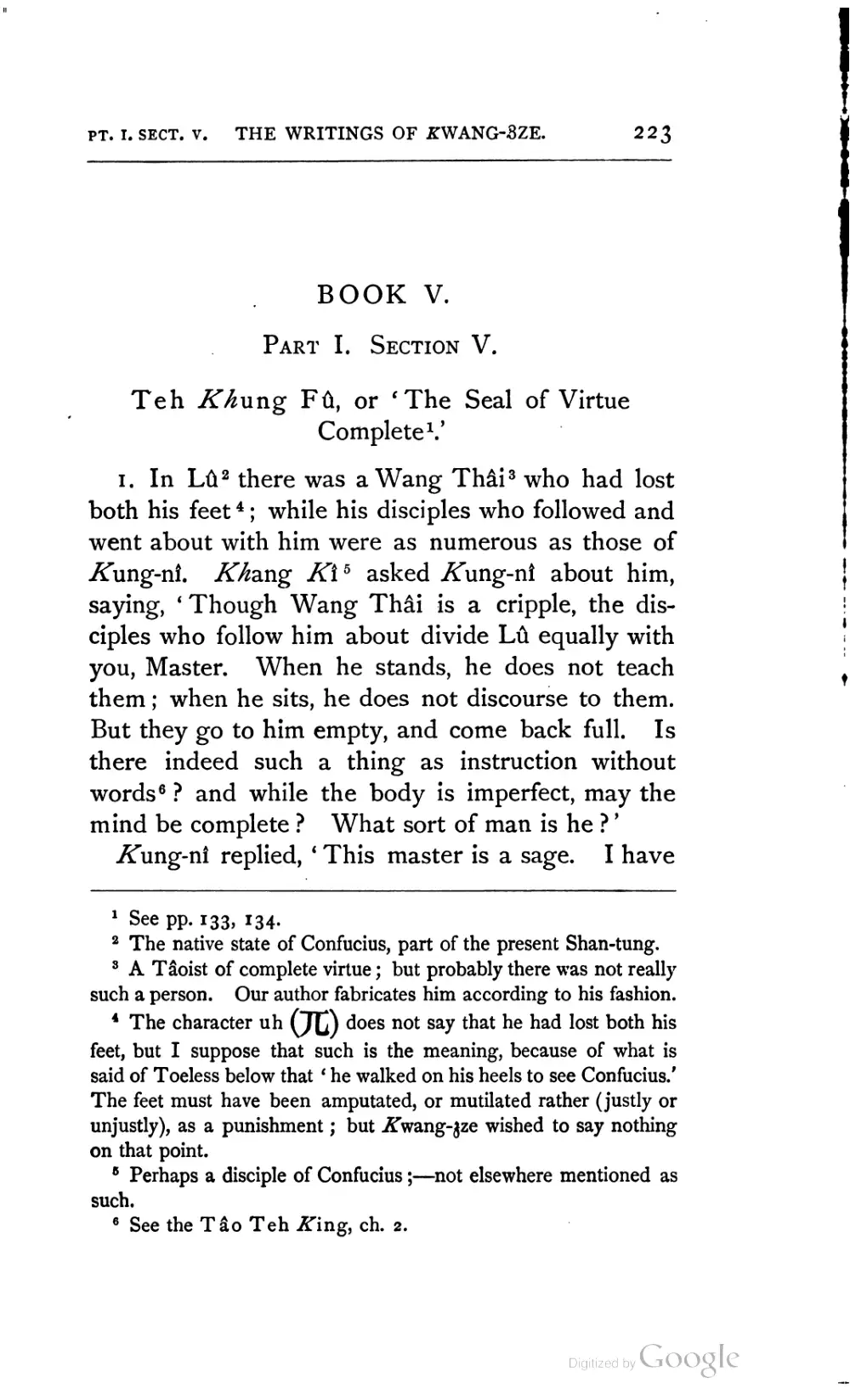
p. 223BOOK V.
Part I. Section V.
Teh Khung Fû, or ‘The Seal of Virtue Complete¹.’
1. In Lû² there was a Wang Thai³ who had lost both his feet⁴, while the disciples who followed him and went about with him were as numerous as those of Kung-ni. Khang Ki⁵ asked Kung-ni about him, saying, ‘Though Wang Thai is a cripple, the disciples who follow him about divide Lû equally with you, Master. When he stands, he does not teach them; when he sits, he does not discourse to them. But they go to him empty and come back full. Is there indeed such a thing as instruction without words⁶? and while the body is imperfect, may the mind be complete? What sort of man is he?’
Kung-ni replied, ‘This master is a sage. I have only been too late in going to him. I will make him my teacher; and how much more should those do so who are not equal to me! Why should only the state of Lû follow him? I will lead all under heaven with me to do so.’
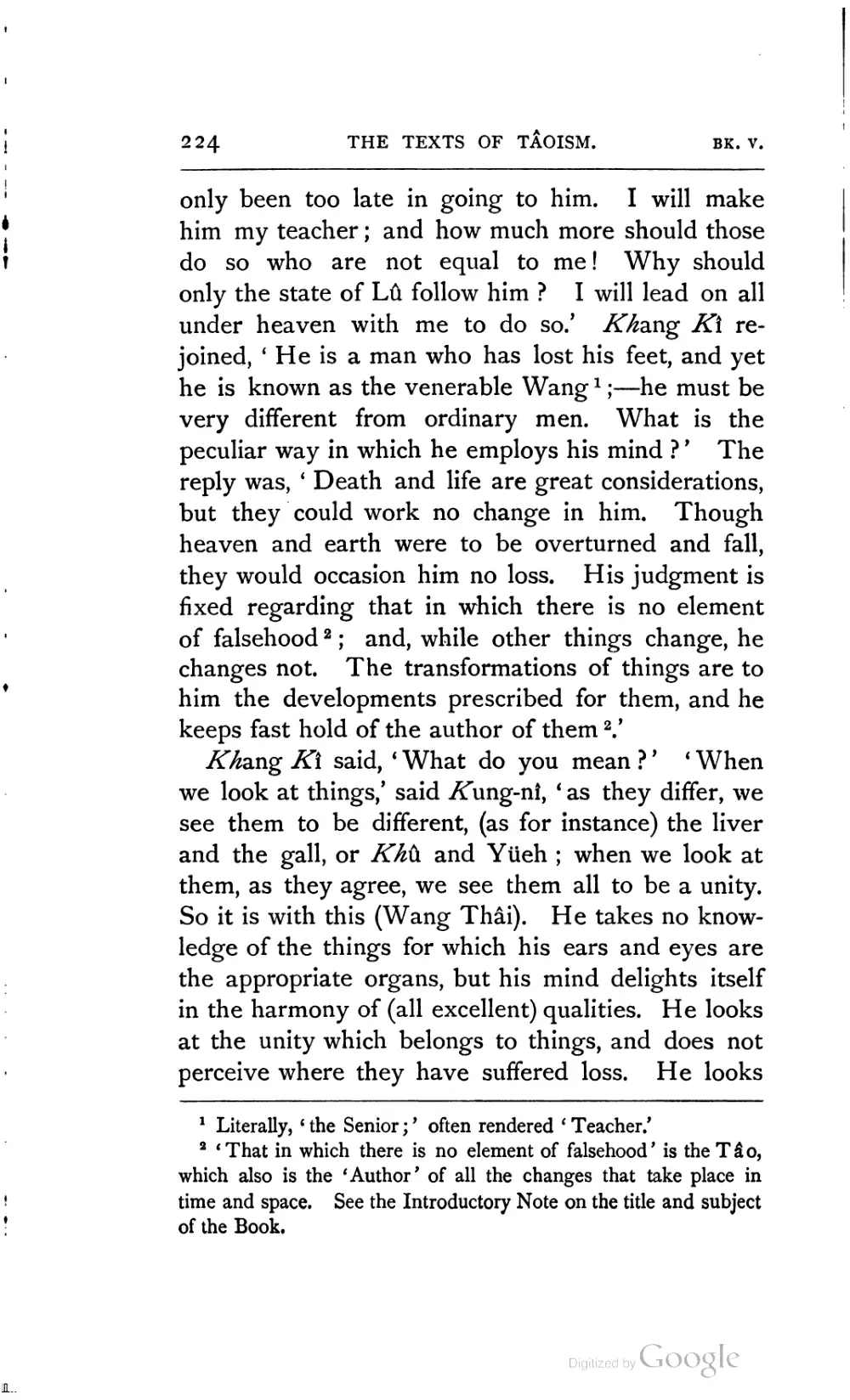
Khang Ki rejoined, ‘He is a man who has lost his feet, and yet he is known as the venerable Wang¹;—he must be very different from ordinary men. What is the particular way in which he uses his mind?’ The reply was, ‘Death and life are great considerations, but they could work no change in him. Though heaven and earth were to be overturned and fall, they would cause him no loss. His judgment is fixed regarding that in which there is no element of falsehood²; and, while other things change, he does not change. The transformations of things are to him the developments prescribed for them, and he keeps fast hold of the author of them².’
* See pp. 133, 134.
2 Confucius’s native state, part of the present Shan-tung.
3 A Tâoist of complete virtue; but probably there was not really such a person. Our author invents him after his fashion.
4 The character uh (兀 [Press: one whose feet have been cut off]) does not say that he had lost both his feet, but I suppose that this is the meaning, because of what is said below of Toeless, that ‘he walked on his heels to see Confucius.’ The feet must have been amputated, or rather mutilated (justly or unjustly), as a punishment; but Kwang-ȝze wished to say nothing on that point.
5 Perhaps a disciple of Confucius;—not mentioned as such elsewhere.
6 See chapter 2 of the Tao Teh King.
Khang Ki asks whether there is "instruction without words," and Legge points to chapter 2 of the Tâo Teh King, earlier in this same volume, where the sage teaches without speaking. Kwang-ȝze turns Lâo-ȝze's maxim into a person: Wang Thai neither teaches standing nor discourses sitting, yet his followers "go to him empty, and come back full." The phrase becomes a portrait.