Legge takes 宗 in this title as a verb, “The Master who is Honoured”, and notes that some read it “Originator”, as at Tao Teh King lxx, 2. His own handling of that chapter favours them: there he translated “an originating” and all-comprehending principle in Lâo-ȝze's words, and glossed 宗 as the first father of a clan in whose loins all its members were. The sense he sets aside here is the one he had already given the same character.
The Tâo Teh King — Sacred Books of China Part I, SBE Vol. 39 (trans. James Legge, 1891)
Open to all
page 134
No image is selected for this page; its own page image is shown.
page 134
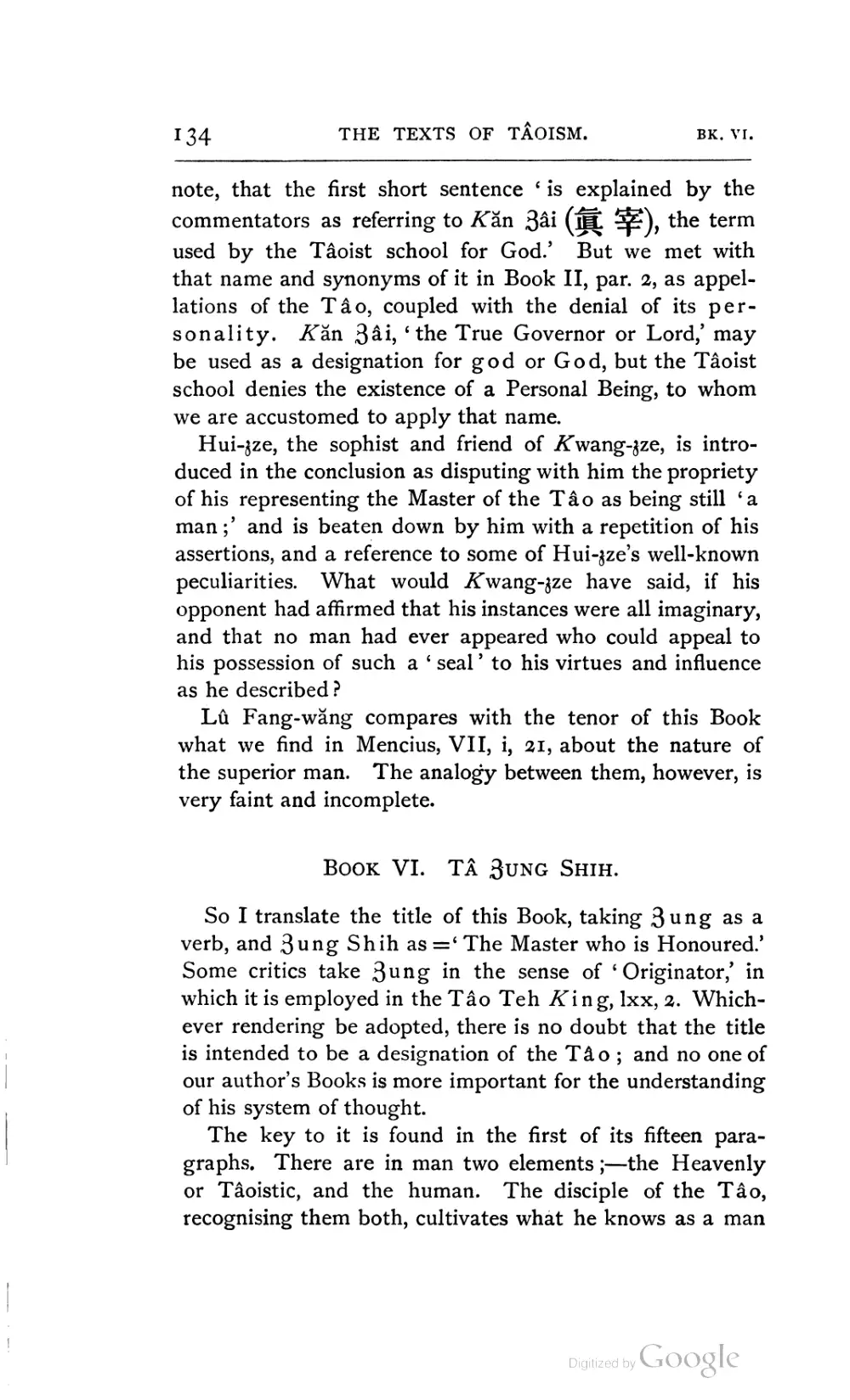
we are accustomed to apply that name.
Hui-ȝze, the sophist and friend of Kwang-ȝze, is brought in at the conclusion disputing with him the propriety of his representing the Master of the Tao as still being ‘a man;’ and he is beaten down by him with a repetition of his assertions and a reference to some of Hui-ȝze’s well-known peculiarities. What would Kwang-ȝze have said if his opponent had maintained that his instances were all imaginary, and that no man had ever appeared who could appeal to his possession of such a ‘seal’ of his virtues and influence as he described?
La Fang-wang compares with the tenor of this Book what we find in Mencius, VII, i, 21, about the nature of the superior man. The analogy between them, however, is very faint and incomplete.
Book VI. TA 3uNG SHIH.
So I translate the title of this Book, taking Ȝung as a verb, and Ȝung Shih as ‘The Master who is Honoured.’ Some critics take Ȝung in the sense of ‘Originator,’ in which it is used in the Tao Teh King, lxx, 2. Whichever rendering is adopted, there is no doubt that the title is intended as a designation of the Tao; and none of our author’s Books is more important for understanding his system of thought.
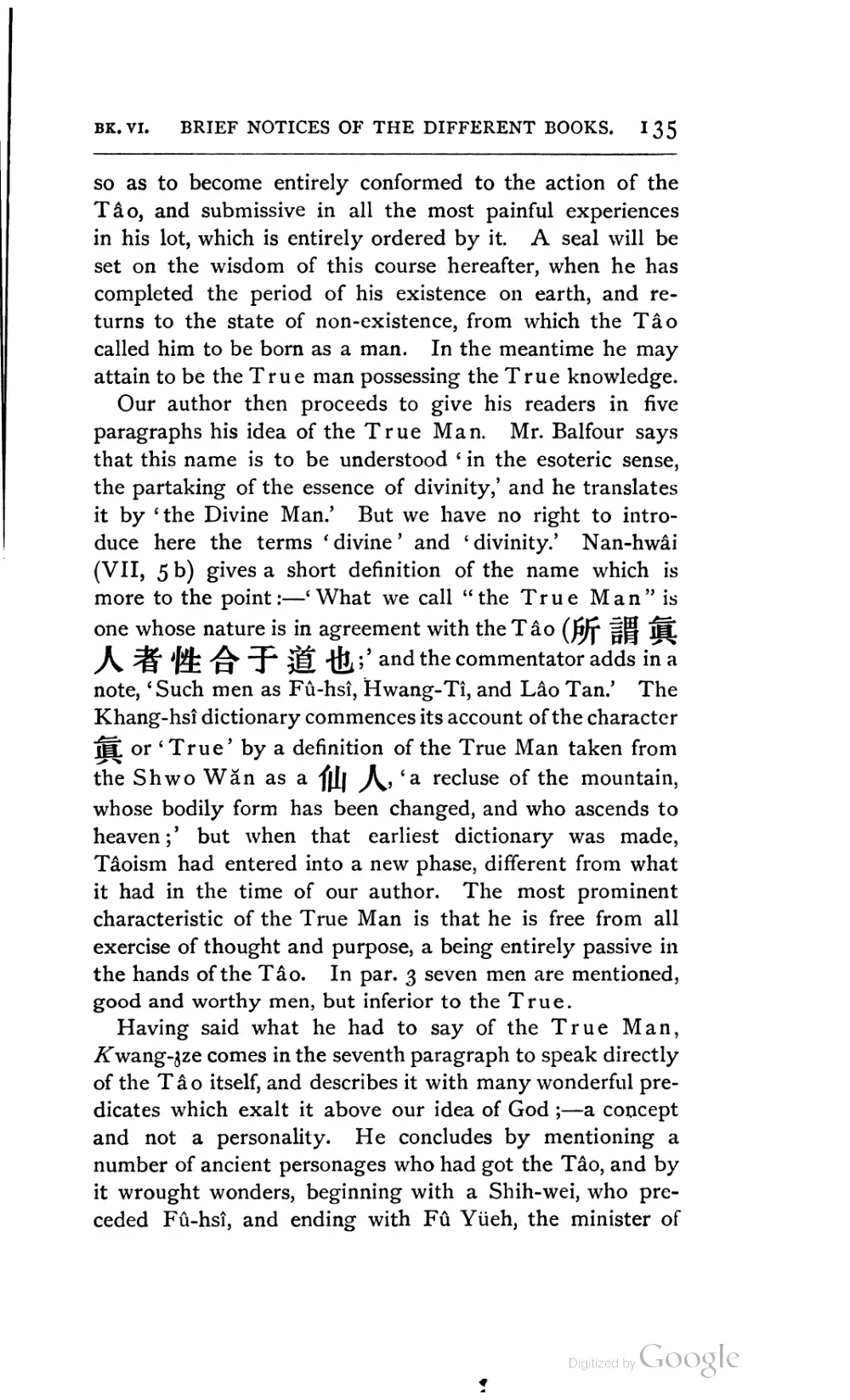
The key to it is found in the first of its fifteen paragraphs. There are two elements in man: the Heavenly, or Taoistic, and the human. The disciple of the Tao, recognising them both, cultivates what he knows as a man so as to become entirely conformed to the action of the Tao, and submissive in all the most painful experiences of his lot, which is entirely ordered by it. A seal will be set on the wisdom of this course hereafter, when he has completed the period of his existence on earth and returns to the state of non-existence from which the Tao called him to be born as a man. In the meantime he may come to be the True man, possessing the True knowledge.