Legge describes the fû as two slips made to fit each other exactly, by which each party proved his relation to the other, and then translates it “Seal”. A seal is single and stamped from above; the fû is a half that proves itself by meeting its other half. His own account of the Book, a man's virtue proved by the response it finds in others, fits the tally better than the seal, and it is the instrument he explained at Lâo-ȝze's chapter 79, the left-hand half of the bond.
The Tâo Teh King — Sacred Books of China Part I, SBE Vol. 39 (trans. James Legge, 1891)
Open to all
page 133
No image is selected for this page; its own page image is shown.
page 133
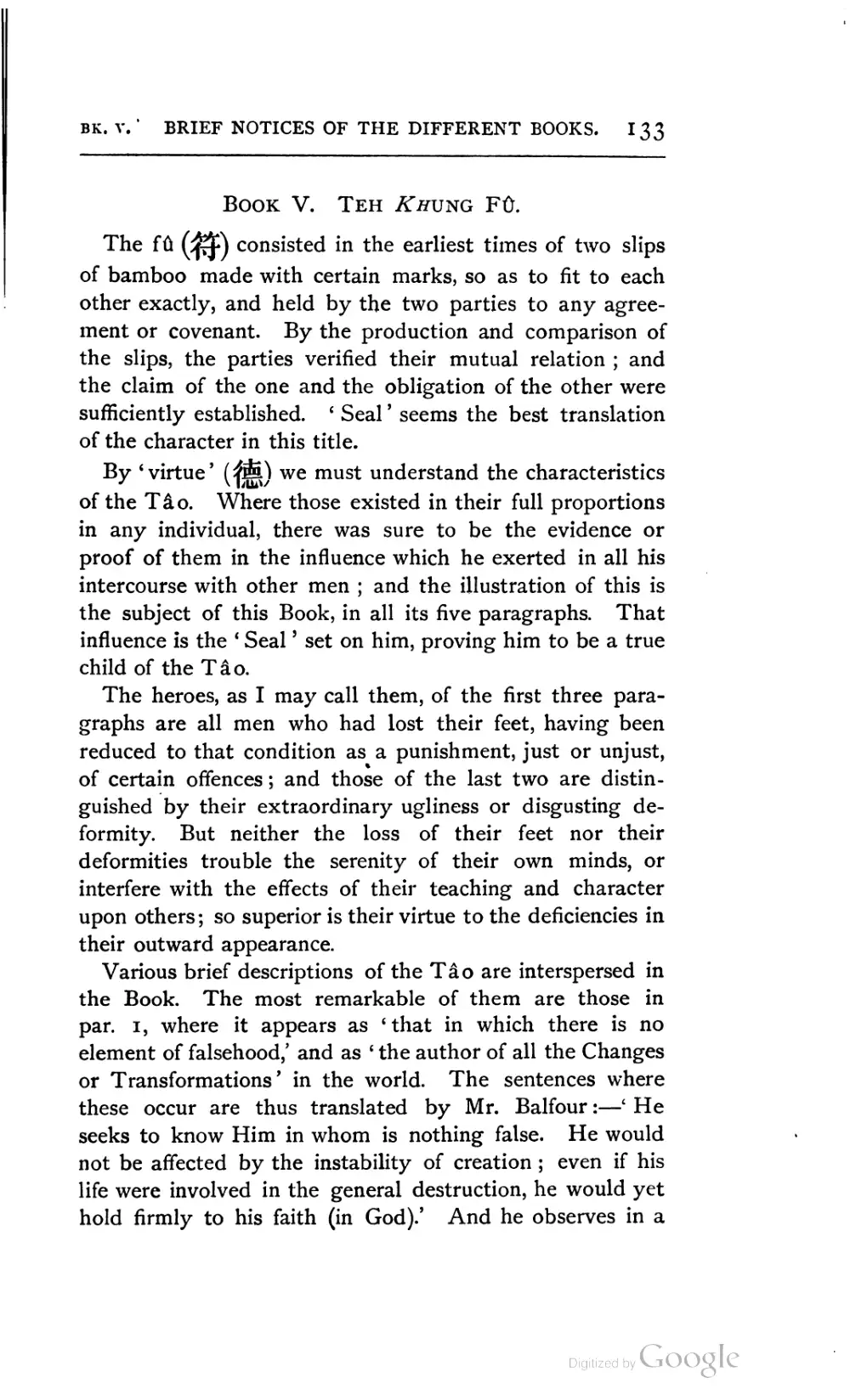
Book V. TEH KHUNG FÛ.
The fû (符 [Press: a tally]) consisted, in the earliest times, of two slips of bamboo cut with certain marks so as to fit each other exactly, and held by the two parties to any agreement or covenant. By producing and comparing the slips, the parties verified their mutual relation; and the claim of the one and the obligation of the other were sufficiently established. ‘Seal’ seems the best translation of the character in this title.
By ‘virtue’ (德) we must understand the characteristics of the Tao. Where these existed in their full proportions in any individual, there was sure to be evidence or proof of them in the influence he exerted in all his dealings with other men; and the illustration of this is the subject of this Book, in all its five paragraphs. That influence is the ‘Seal’ set on him, proving him to be a true child of the Tao.
The heroes, as I may call them, of the first three paragraphs are all men who had lost their feet, having been reduced to that condition as a punishment, just or unjust, for certain offences; and those of the last two are marked by their extraordinary ugliness or repellent deformity. But neither the loss of their feet nor their deformities trouble the serenity of their own minds, or interfere with the effects of their teaching and character on others; so superior is their virtue to the defects in their outward appearance.
Various brief descriptions of the Tâo are scattered through the Book. The most remarkable of them are those in par. 1, where it appears as ‘that in which there is no element of falsehood,’ and as ‘the author of all the Changes or Transformations’ in the world. The sentences where these occur are translated thus by Mr. Balfour:—‘He seeks to know Him in whom is nothing false. He would not be affected by the instability of creation; even if his life were involved in the general destruction, he would still hold firmly to his faith (in God).’
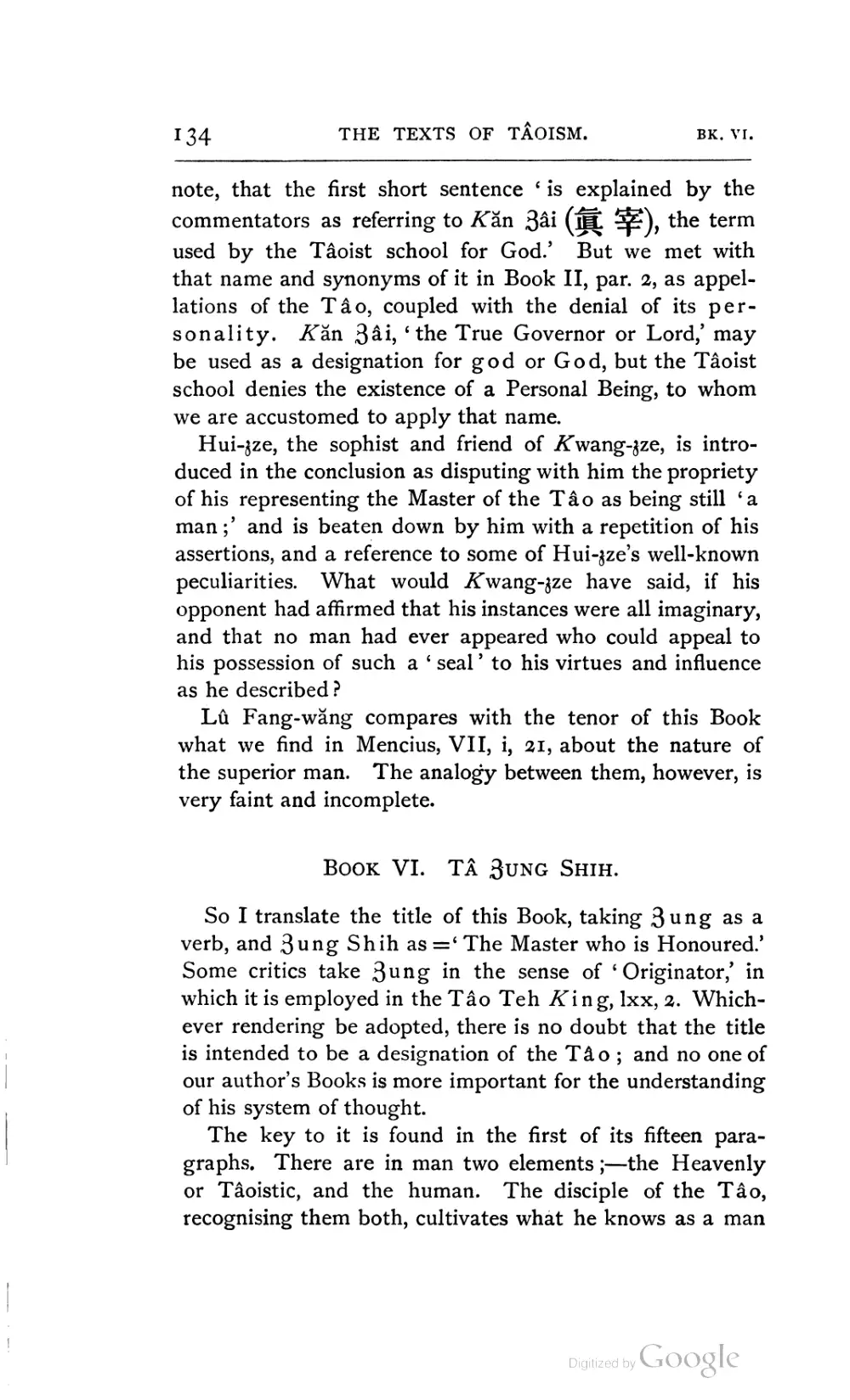
And he observes in a note that the first short sentence ‘is explained by the commentators as referring to Kăn ȝâi (眞宰), the term used by the Taoist school for God.’ But we met with that name, and synonyms of it, in Book II, par. 2, as names of the Tâo, coupled with the denial of its personality. Kăn Ȝâi, ‘the True Governor or Lord,’ may be used as a designation for god or God, but the Taoist school denies the existence of a Personal Being, to whom