Legge does not invent a source for “A master of the art of war has said”, suggesting the author “only adopted the style of quotation”. The book's habit supports the caution, since it cites unnamed authorities more than once: “a sage has said” stands at chapters 57 and 78 as well. Real sayings or a manner of speaking, they show the book presenting its teaching as gathered from older voices, and Legge is right to leave them nameless.
The Tâo Teh King — Sacred Books of China Part I, SBE Vol. 39 (trans. James Legge, 1891)
Open to all
page 112
No image is selected for this page; its own page image is shown.
page 112
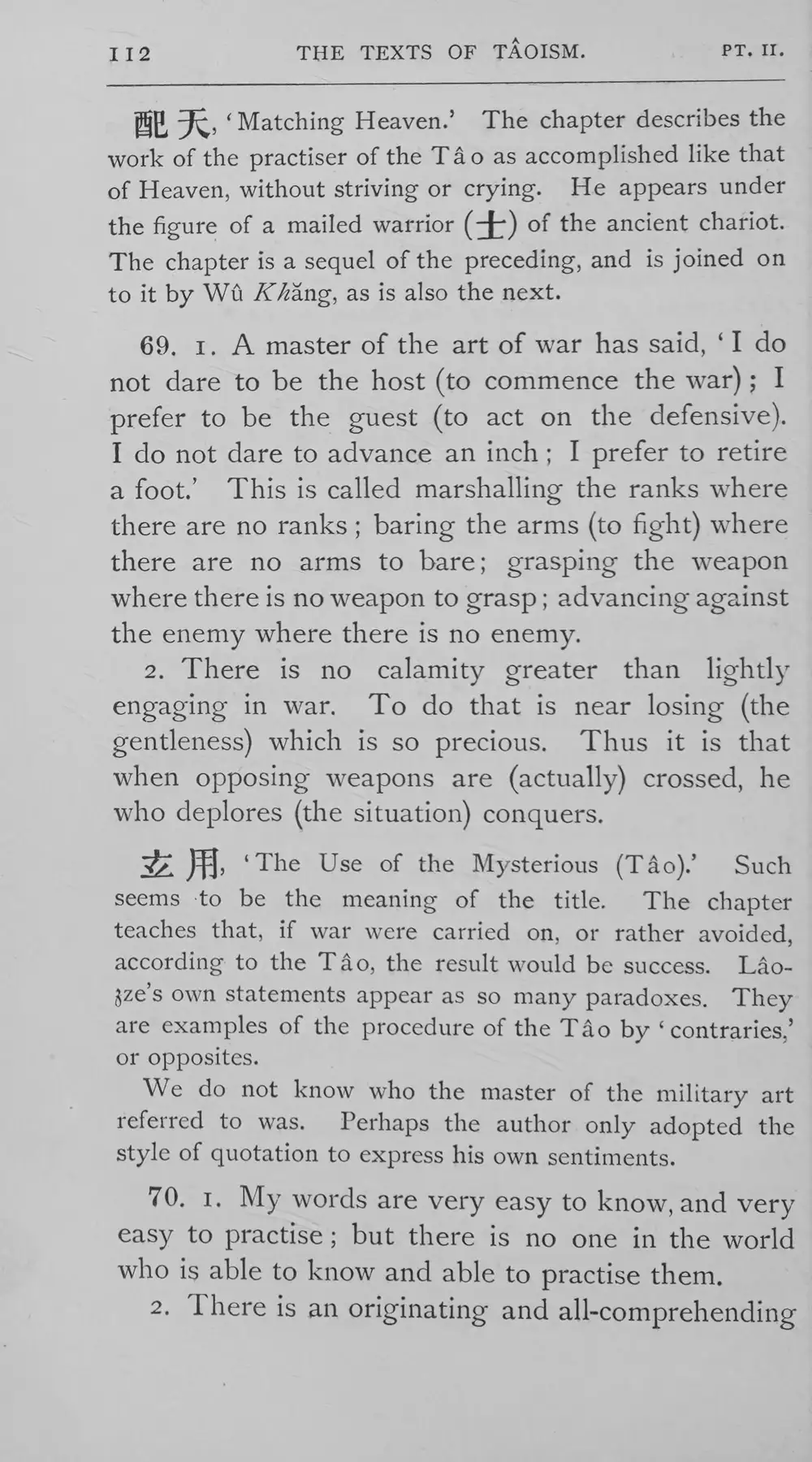
配天, ‘Matching Heaven.’ The chapter describes the work of the practiser of the Tao as accomplished like that of Heaven, without striving or crying out. He appears under the figure of a mailed warrior (士) of the ancient chariot. The chapter is a sequel to the preceding one, and is joined on to it by Wû Khăng, as is the next one also.
69. 1. A master of the art of war has said, ‘I do not dare to be the host (to begin the war); I prefer to be the guest (to act on the defensive). I do not dare to advance an inch; I prefer to retreat a foot. This is called marshalling the ranks where there are no ranks; baring the arms (to fight) where there are no arms to bare; grasping the weapon where there is no weapon to grasp; advancing against the enemy where there is no enemy.
2. There is no calamity greater than lightly engaging in war. To do that is close to losing (the gentleness) which is so precious. So it is that when opposing weapons are (actually) crossed, he who grieves (at the situation) conquers.
玄用, ‘The Use of the Mysterious (Tâo).’ That seems to be the meaning of the title. The chapter teaches that if war were carried on, or rather avoided, according to the Tao, the result would be success. Lâo-ȝze’s own statements appear as so many paradoxes. They are examples of the Tao’s way of proceeding by ‘contraries,’ or opposites.
We do not know who the master of the military art referred to was. Perhaps the author merely adopted the form of a quotation to express his own views.
70. 1. My words are very easy to know, and very easy to practise; but there is no one in the world who is able to know them and able to practise them.
2. There is an originating and all-comprehending (principle) in my words, and an authoritative law for the things (which I enforce). It is because they do not know these that men do not know me.