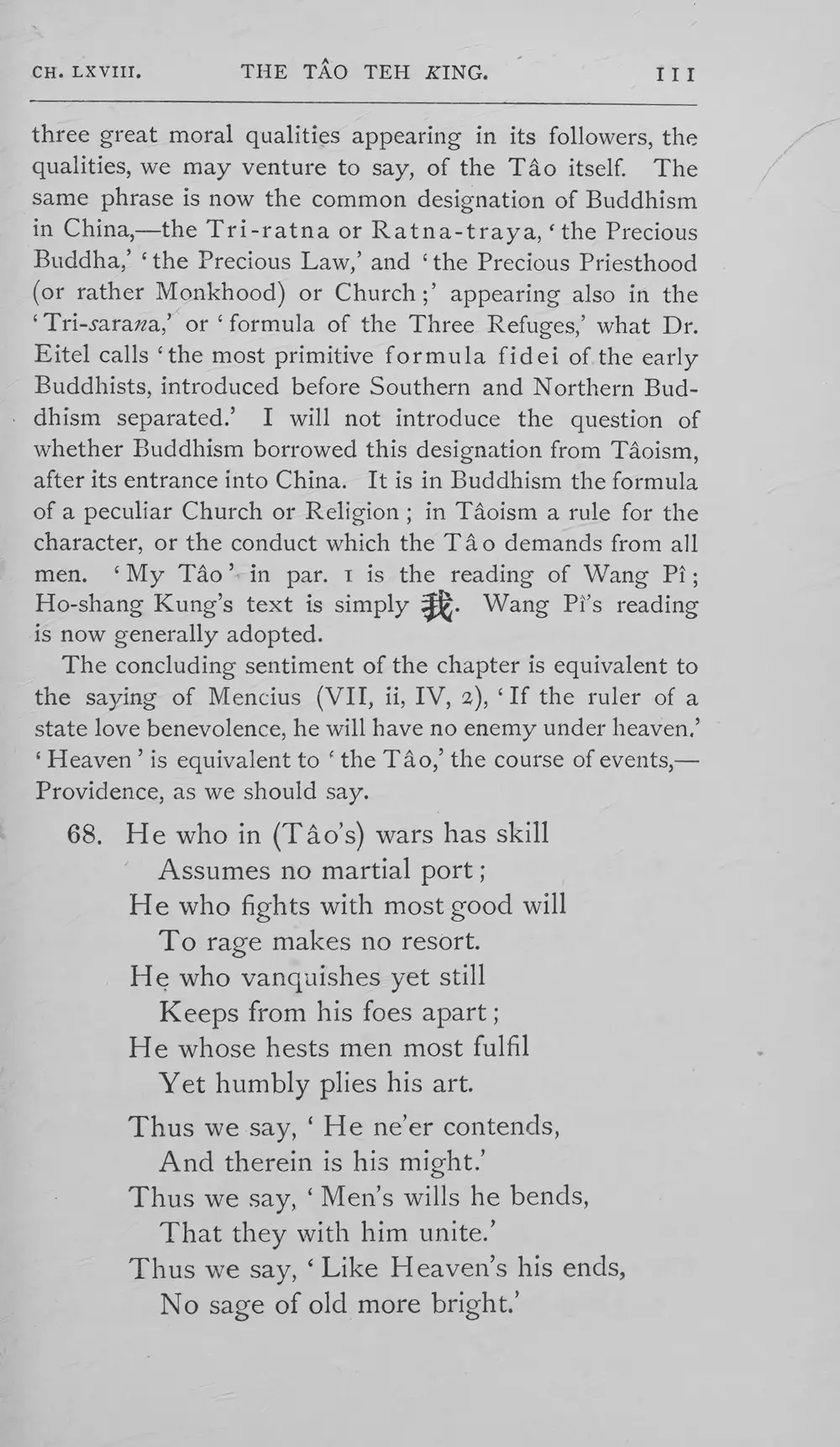
Legge's verse speaks of skill in “(Tao's) wars”, which turns the chapter into a figure for the inner life. His own note on the next page says its subject appears “under the figure of a mailed warrior” of the ancient chariot, and the chapter after it is about actual war. The parenthesis softens a text that, on Legge's own account, speaks of soldiers: the claim is that the best fighter does not rage, not that fighting is a metaphor.
The Tâo Teh King — Sacred Books of China Part I, SBE Vol. 39 (trans. James Legge, 1891)
Open to all
page 111
No image is selected for this page; its own page image is shown.
page 111
68. He who has skill in (the Tao’s) wars takes on no warlike air; he who fights with the best will makes no resort to rage. He who conquers, yet still keeps apart from his foes; he whose orders men most fulfil, yet humbly practises his art. So we say, ‘He never contends, and in that lies his might.’ So we say, ‘He bends men’s wills, so that they unite with him.’ So we say, ‘His ends are like Heaven’s; no sage of old was brighter.’