The Satapatha-Brâhmana, Part IV — SBE Vol. 43 — trans. Julius Eggeling (1897)
The translator’s English as printed (Julius Eggeling). The original-language text is not held; names are romanised as the translator printed them.
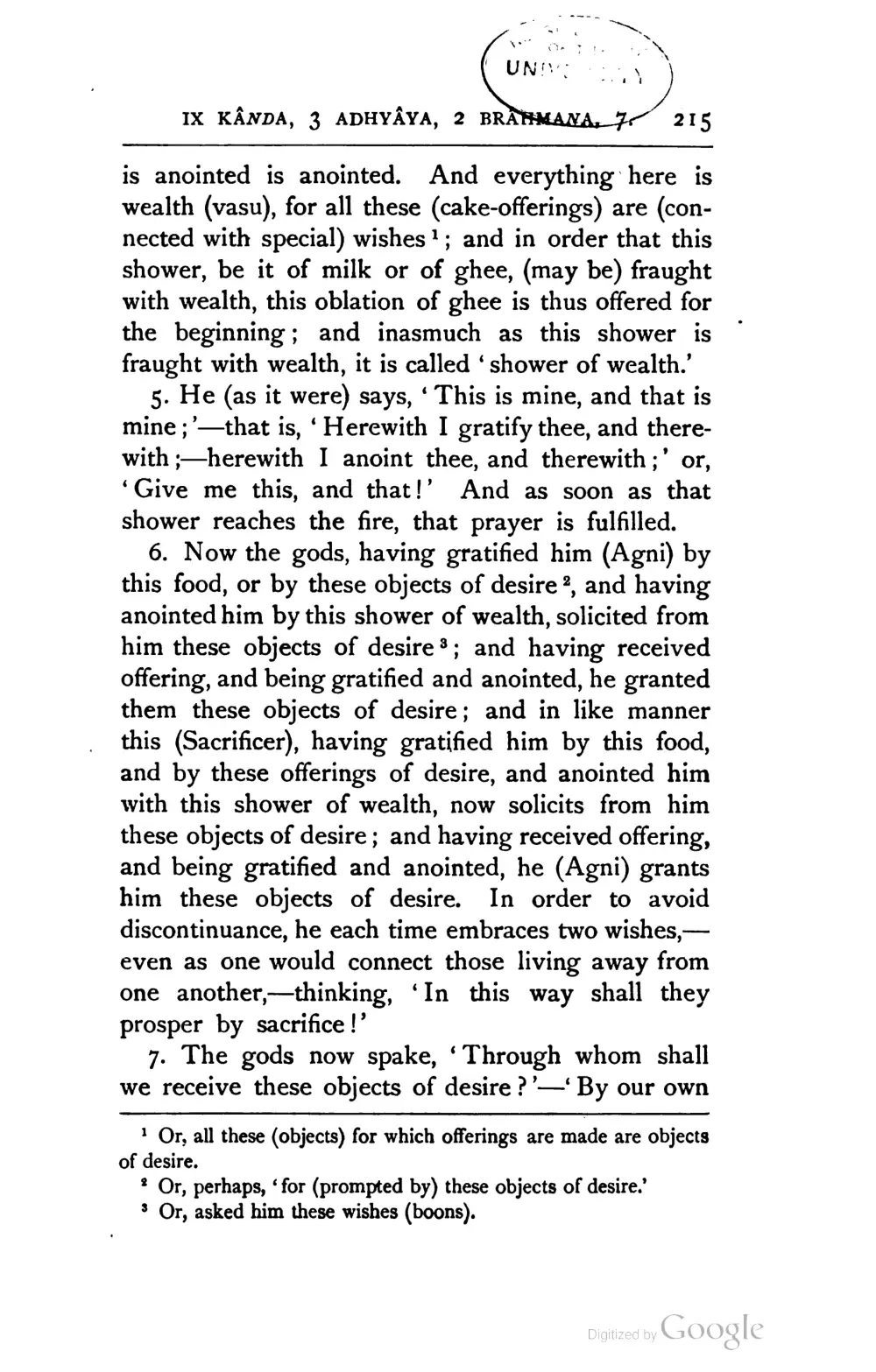
9:3:2:66. Now the gods, having gratified him (Agni) by this food, or by these objects of desire , and having anointed him by this shower of wealth, solicited from him these objects of desire ; and having received offering, and being gratified and anointed, he granted them these objects of desire; and in like manner this (Sacrificer), having gratified him by this food, and by these offerings of desire, and anointed him with this shower of wealth, now solicits from him these objects of desire; and having received offering, and being gratified and anointed, he (Agni) grants him these objects of desire. In order to avoid discontinuance, he each time embraces two wishes,--even as one would connect those living away from one another,--thinking, 'In this way shall they prosper by sacrifice!'
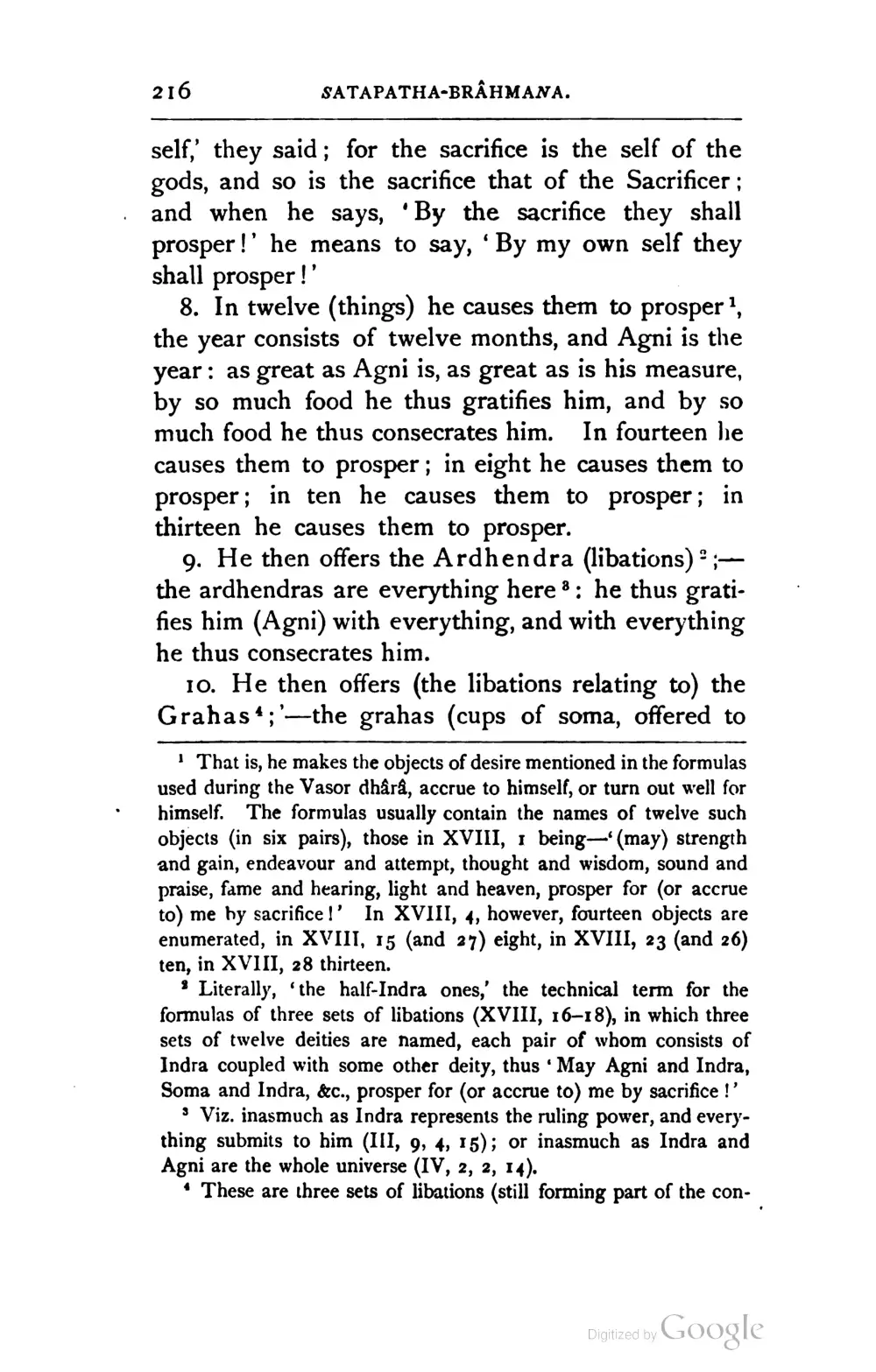
9:3:2:77. The gods now spake, 'Through whom shall we receive these objects of desire? By our own self,' they said; for the sacrifice is the self of the gods, and so is the sacrifice that of the Sacrificer; and when he says, 'By the sacrifice they shall prosper!' he means to say, 'By my own self they shall prosper!'
9:3:2:88. In twelve (things) he causes them to prosper , the year consists of twelve months, and Agni is the year: as great as Agni is, as great as is his measure, by so much food he thus gratifies him, and by so much food he thus consecrates him. In fourteen he causes them to prosper; in eight he causes them to prosper; in ten he causes them to prosper; in thirteen he causes them to prosper.
9:3:2:99. He then offers the Ardhendra (libations) ;the ardhendras are everything here : he thus gratifies him (Agni) with everything, and with everything he thus consecrates him.
9:3:2:1010. He then offers (the libations relating to) the Grahas ;--the grahas (cups of soma, offered to
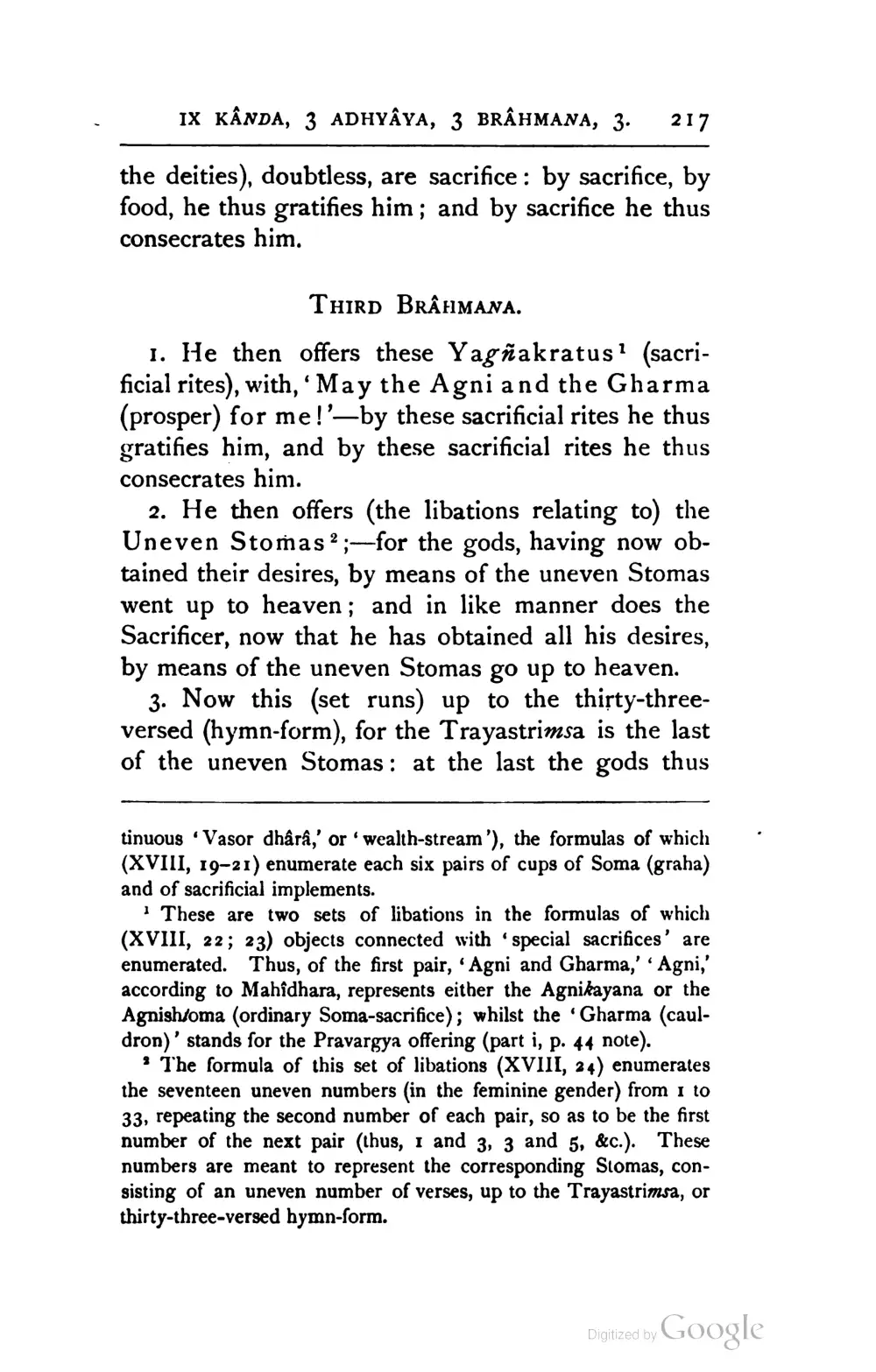
the deities), doubtless, are sacrifice: by sacrifice, by food, he thus gratifies him; and by sacrifice he thus consecrates him.
Footnotes
213:1 That is, after offering all the seven Mâruta cakes, the formulas of the last six of which (Vâg. S. XVII, 81-85; XXXIX, 7) are not given in the Brâhmana. At the end the Adhvaryu mutters the verse XVII, 86, and thereupon he either makes the Sacrificer mutter (or mutters himself) verses 87-99 in praise of Agni. Kâty. Sr. XVIII, 4, 25; 26.
213:2 Thus, according to Kâty. XVIII, 5, 1 (the Adhvaryu, according to Weber, Ind. Stud. XIII, p. 283).
213:3 It would rather seem to mean 'stream, or shower, of wealth;' cf. paragraph 4.
213:4 That is, the consecration ceremony, in which the king is sprinkled' with sacred water, or, so to speak, anointed. The 'Vasor dhârâ,' or 'shower of wealth,' consisting of an uninterrupted series of 401 libations to Agni (through which all the powers of the god are to be secured to the Sacrificer), is intended as the equivalent of that ceremony for the consecration of Agni as king; and, indeed, as a kind of superior consecration ceremony for the (royal) Sacrificer himself, more potent than the Râgasûya and Vâgapeya. There is thus to be noticed here the same tendency as elsewhere of exalting the efficacy of the Agnikayana, and of making it take the place of the whole of the ordinary sacrificial ceremonial.
214:1 When anointed, or consecrated, the king is first sprinkled from the front and then from behind, and finally rubbed all over, with the consecrated water; see V, 4, 2, 1 seq.
214:2 That is, as soon as the Adhvaryu has put the Aranyeऽnûkya cake in the fire the Sacrificer begins to pour the ghee on it with a large offering-ladle of udumbara wood, and the Adhvaryu begins to mutter the formulas.
215:1 Or, all these (objects) for which offerings are made are objects of desire.
215:2 Or, perhaps, 'for (prompted by) these objects of desire.'
215:3 Or, asked him these wishes (boons).
216:1 That is, he makes the objects of desire mentioned in the formulas used during the Vasor dhârâ, accrue to himself, or turn out well for himself. The formulas usually contain the names of twelve such objects (in six pairs), those in XVIII, 1 being--'(may) strength and gain, endeavour and attempt, thought and wisdom, sound and praise, fame and hearing, light and heaven, prosper for (or accrue to) me by sacrifice!' In XVIII, 4, however, fourteen objects are enumerated, in XVIII, 15 (and 27) eight, in XVIII, 23 (and 26). ten, in XVIII, 28 thirteen.
216:2 Literally, 'the half-Indra ones,' the technical term for the formulas of three sets of libations (XVIII, 16-18), in which three sets of twelve deities are named, each pair of whom consists of Indra coupled with some other deity, thus 'May Agni and Indra, Soma and Indra, &c., prosper for (or accrue to) me by sacrifice!'
216:3 Viz. inasmuch as Indra represents the ruling power, and everything submits to him (III, 9, 4, 15); or inasmuch as Indra and Agni are the whole universe (IV, 2, 2, 14).
216:4 These are three sets of libations (still forming part of the continuous 'Vasor dhârâ,' or 'wealth-stream'), the formulas of which (XVIII, 19-21) enumerate each six pairs of cups of Soma (graha) and of sacrificial implements.
9:3:3
THIRD BRÂHMANA.
9:3:3:11. He then offers these Yagñakratus (sacrificial rites), with,' May the Agni and the Gharma (prosper) for me!'--by these sacrificial rites he thus gratifies him, and by these sacrificial rites he thus consecrates him.
No commentary for this page.