The Satapatha-Brâhmana, Part IV — SBE Vol. 43 — trans. Julius Eggeling (1897)
The translator’s English as printed (Julius Eggeling). The original-language text is not held; names are romanised as the translator printed them.
176:2 The procedure in this case is an exact counterpart of the ploughing of the altar-site, for which see VII, 2, 2, 8-12, with notes. Hence also the verbs expressive of the two actions are closely analogous, viz. vikrishati and vikarshati.
178:1 The Gâyatra-sâman is the hymn-tune composed on the verse called 'the Gâyatrî,' par excellence, or 'Sâvitrî' (tat savitur varenyam, Rig-veda III, 62, 10), which plays an important part in the religious fife of the Hindu. The verse, as figured for chanting, is given, Sâma-v. Calc. ed. vol. v, p. 60 1. On the present occasion, according to Lâty. Sr. I, 5, 11, a different text, viz. Sâma-v. II, 8, 14 (Rig-veda IX, 66, 19, agna âyûmshi payase), is to be sung to this tune.
179:1 The Rathantara, Brihat, Vâmadevya, and Yagñâyagñiya tunes are apparently to be sung here on their original texts (Sâma-v. II, 30, 31, abhi tvâ sûra nonumah; II, 159, 160, tvâm id dhi havâmahe; II, 32, 33, kayâ nas kitra â bhuvat; and II, 53, 54, yagñâ-yagñâ vo agnaye), though hardly in their elaborate setting, as performed in chanting.
179:2 It should be remembered that the chanting of the Yagñâyagñiya (or Agnishtoma)-sâman marks the completion (samsthâ) of the ordinary (Agnishtoma) Soma-sacrifice.
180:1 The Pragâpati-hridaya, or Pragâpater hridayam, as figured for chanting, is given, Sâma-v. Calc. ed. vol. ii, p. 499. It consists of the words, imâh pragâh pragâpate(r) hridayam pragârûpam agîgane, with inserted stobhas and modulations. It is followed by a simpler form, which is perhaps the one used on the present occasion.
180:2 Viz. on the place where the right wing joins the body of the altar. According to other authorities, the Syaita hymn-tune is likewise to be sung near the left arm-pit (or, according to Sândilya, at the place where the Adhvaryu mounts the altar). For other variations, see Weber, Ind. Stud. XIII, p. 276. I do not think that the ritual of the White Yagus, in omitting the left arm-pit, shows any gap or inconsistency, since the right arm-pit is marked out, not for any bodily parallelism, but for the simple reason that it is supposed to indicate the position of the heart. Whilst all the other places on which hymns are sung are essential parts of the bird Agni, the arm-pit is not an essential part, but is merely indicative of the central organ of the body. Lâty. I, 5, 11 seqq. supplies the following directions, apparently implying a somewhat different order of procedure from that followed in our text: He passes along the south, and whilst standing (east of the altar) with his face towards the west, he sings the Gâyatra at the head. Returning, he sings the Rathantara at the right wing. Going round behind, he sings the Brihat at the left wing. Going back, and standing behind the tail, with his face towards the east, he sings the Yagñâyagñiya. The Vâmadevya he sings at the right, and the Pragâpati-hridaya at the left, arm-pit. Then follow different views held by different teachers.--With this ceremony, by which homage is paid to the different parts of Agni-Pragâpati's body, compare the similar, but more elaborate, ceremony of the Parimâdah at the Mahâvrata, X, 1, 2, 9 with note.
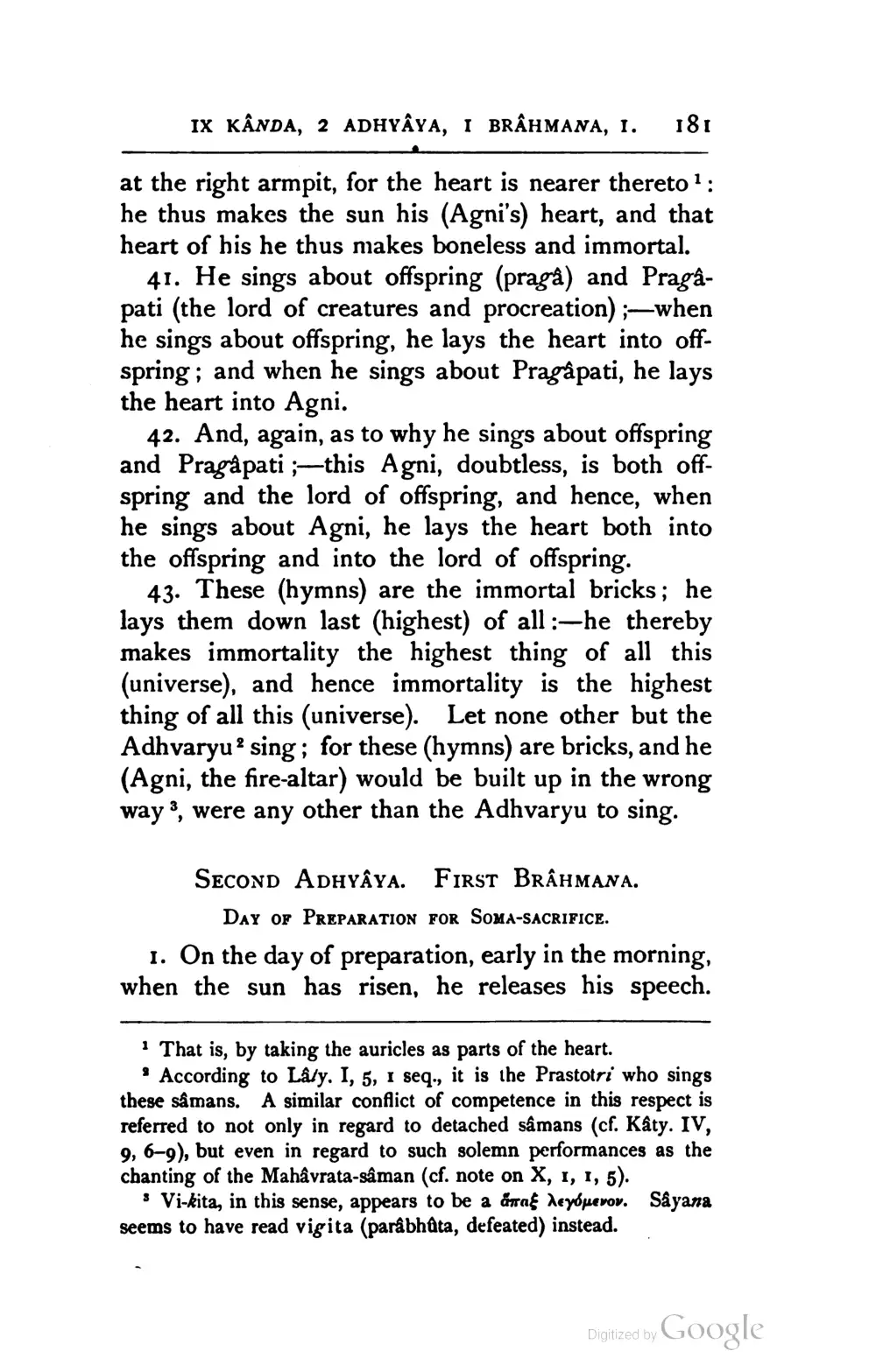
181:1 That is, by taking the auricles as parts of the heart.
181:2 According to Lâty. I, 5, 1 seq., it is the Prastotri who sings these sâmans. A similar conflict of competence in this respect is referred to not only in regard to detached sâmans (cf. Kâty. IV, 9, 6-9), but even in regard to such solemn performances as the chanting of the Mahâvrata-sâman (cf. note on X, 1, 1, 5).
181:3 Vi-kita, in this sense, appears to be a ἅπαξ λεγόμενον. Sâyana seems to have read vigita (parâbhûta, defeated) instead.
9:2:1
SECOND ADHYÂYA. FIRST BRÂHMANA.
DAY OF PREPARATION FOR SOMA-SACRIFICE.
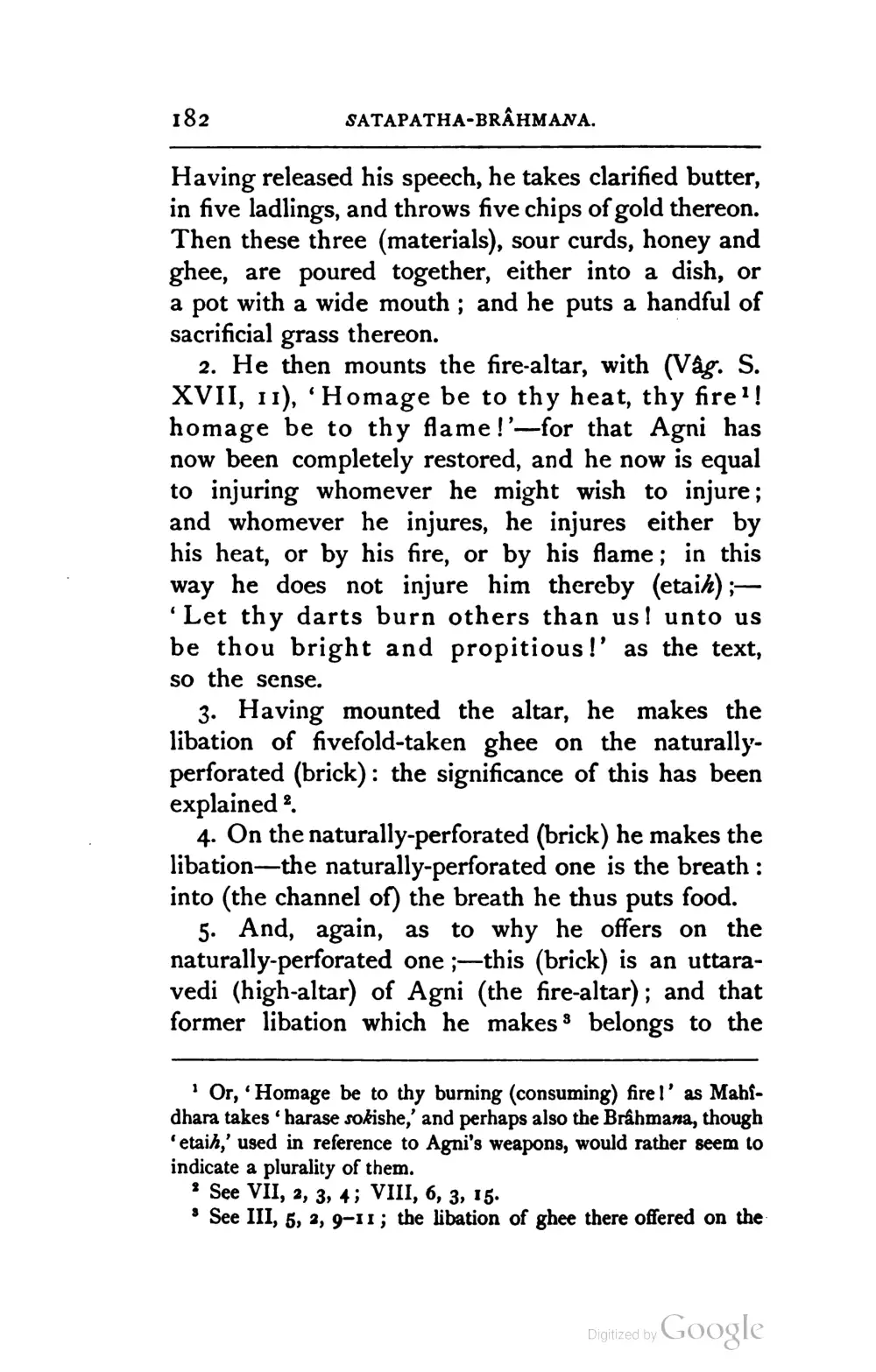
9:2:1:11. On the day of preparation, early in the morning, when the sun has risen, he releases his speech.
[paragraph continues] Having released his speech, he takes clarified butter, in five ladlings, and throws five chips of gold thereon. Then these three (materials), sour curds, honey and ghee, are poured together, either into a dish, or a pot with a wide mouth; and he puts a handful of sacrificial grass thereon.
9:2:1:22. He then mounts the fire-altar, with (Vâg. S. XVII, II), 'Homage be to thy heat, thy fire ! homage be to thy flame!'--for that Agni has now been completely restored, and he now is equal to injuring whomever he might wish to injure; and whomever he injures, he injures either by his heat, or by his fire, or by his flame; in this way he does not injure him thereby (etaih);--'Let thy darts burn others than us! unto us be thou bright and propitious!' as the text, so the sense.
9:2:1:33. Having mounted the altar, he makes the libation of fivefold-taken ghee on the naturally-perforated (brick): the significance of this has been explained .
9:2:1:44. On the naturally-perforated (brick) he makes the libation--the naturally-perforated one is the breath: into (the channel of) the breath he thus puts food.
No commentary for this page.