The Satapatha-Brâhmana, Part IV — SBE Vol. 43 — trans. Julius Eggeling (1897)
The translator’s English as printed (Julius Eggeling). The original-language text is not held; names are romanised as the translator printed them.
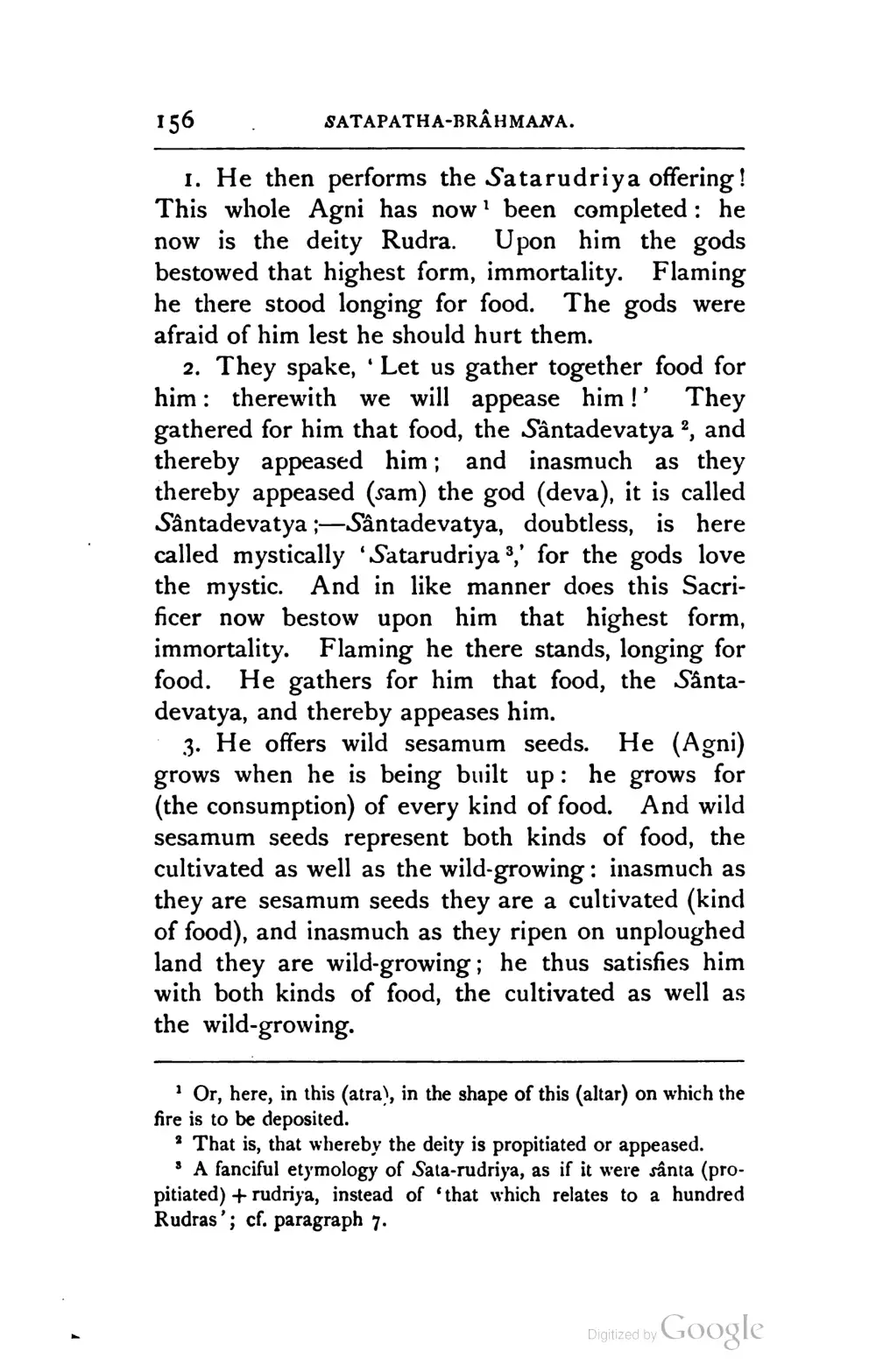
9:1:1:11. He then performs the Satarudriya offering! This whole Agni has now been completed: he now is the deity Rudra. Upon him the gods bestowed that highest form, immortality. Flaming he there stood longing for food. The gods were afraid of him lest he should hurt them.
9:1:1:22. They spake, 'Let us gather together food for him: therewith we will appease him!' They gathered for him that food, the Sântadevatya , and thereby appeased him; and inasmuch as they thereby appeased (sam) the god (deva), it is called Sântadevatya;--Sântadevatya, doubtless, is here called mystically 'Satarudriya ,' for the gods love the mystic. And in like manner does this Sacrificer now bestow upon him that highest form, immortality. Flaming he there stands, longing for food. He gathers for him that food, the Sântadevatya, and thereby appeases him.
9:1:1:33. He offers wild sesamum seeds. He (Agni) grows when he is being built up: he grows for (the consumption) of every kind of food. And wild sesamum seeds represent both kinds of food, the cultivated as well as the wild-growing: inasmuch as they are sesamum seeds they are a cultivated (kind of food), and inasmuch as they ripen on unploughed land they are wild-growing; he thus satisfies him with both kinds of food, the cultivated as well as the wild-growing.
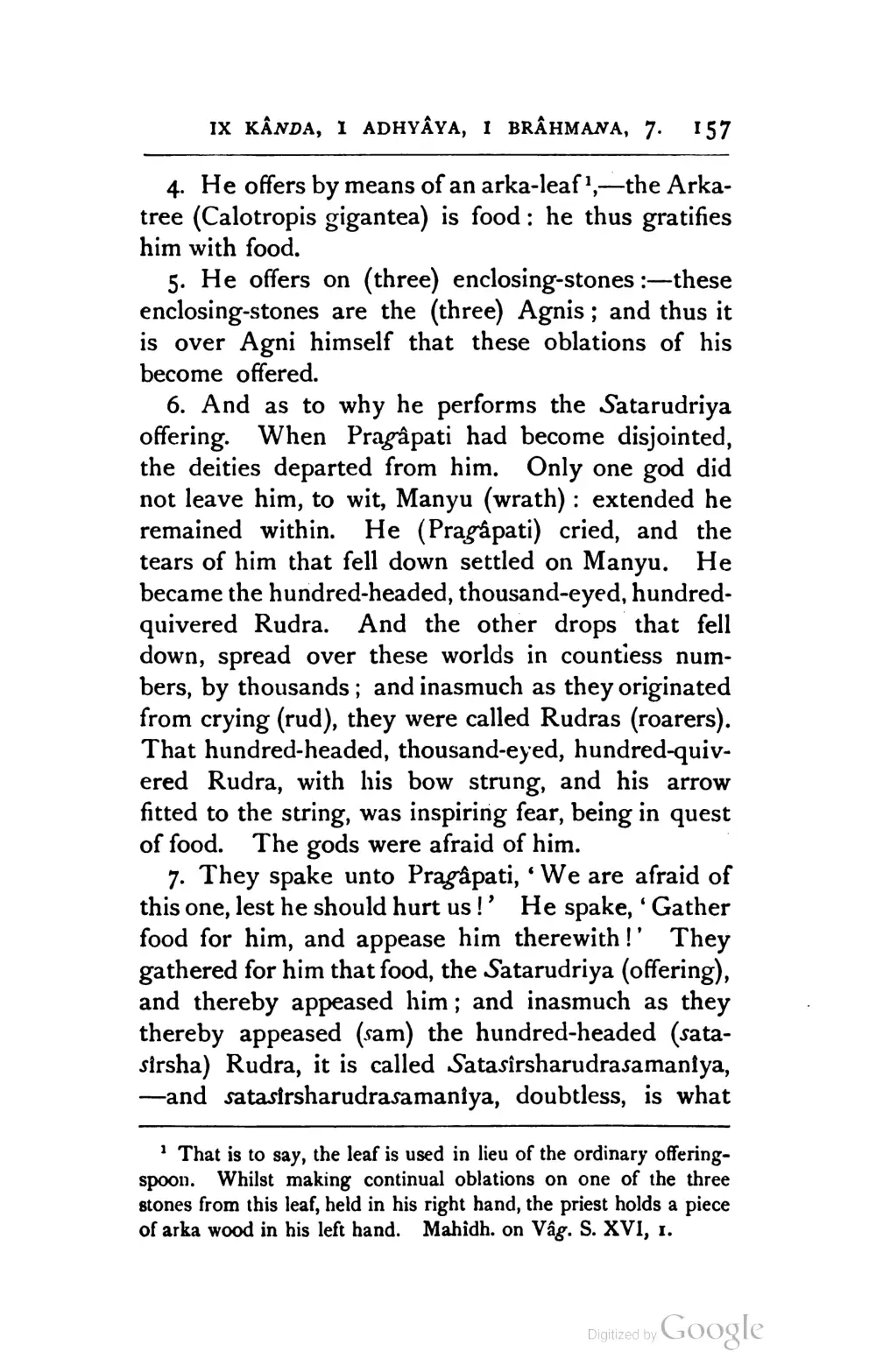
9:1:1:44. He offers by means of an arka-leaf ,--the Arka-tree (Calotropis gigantea) is food: he thus gratifies him with food.
9:1:1:55. He offers on (three) enclosing-stones:--these enclosing-stones are the (three) Agnis; and thus it is over Agni himself that these oblations of his become offered.
9:1:1:66. And as to why he performs the Satarudriya offering. When Pragâpati had become disjointed, the deities departed from him. Only one god did not leave him, to wit, Manyu (wrath): extended he remained within. He (Pragâpati) cried, and the tears of him that fell down settled on Manyu. He became the hundred-headed, thousand-eyed, hundred-quivered Rudra. And the other drops that fell down, spread over these worlds in countless numbers, by thousands; and inasmuch as they originated from crying (rud), they were called Rudras (roarers). That hundred-headed, thousand-eyed, hundred-quivered Rudra, with his bow strung, and his arrow fitted to the string, was inspiring fear, being in quest of food. The gods were afraid of him.
9:1:1:77. They spake unto Pragâpati 'We are afraid of this one, lest he should hurt us!' He spake, 'Gather food for him, and appease him therewith!' They gathered for him that food, the Satarudriya (offering), and thereby appeased him; and inasmuch as they thereby appeased (sam) the hundred-headed (satasîrsha) Rudra, it is called Satasîrsharudrasamanîya,--and satasîrsharudrasamanîya, doubtless, is what they mystically call Satarudriya, for the gods love the mystic. And in like manner does this (Sacrificer) now gather for him that food, the Satarudriya, and appease him thereby.
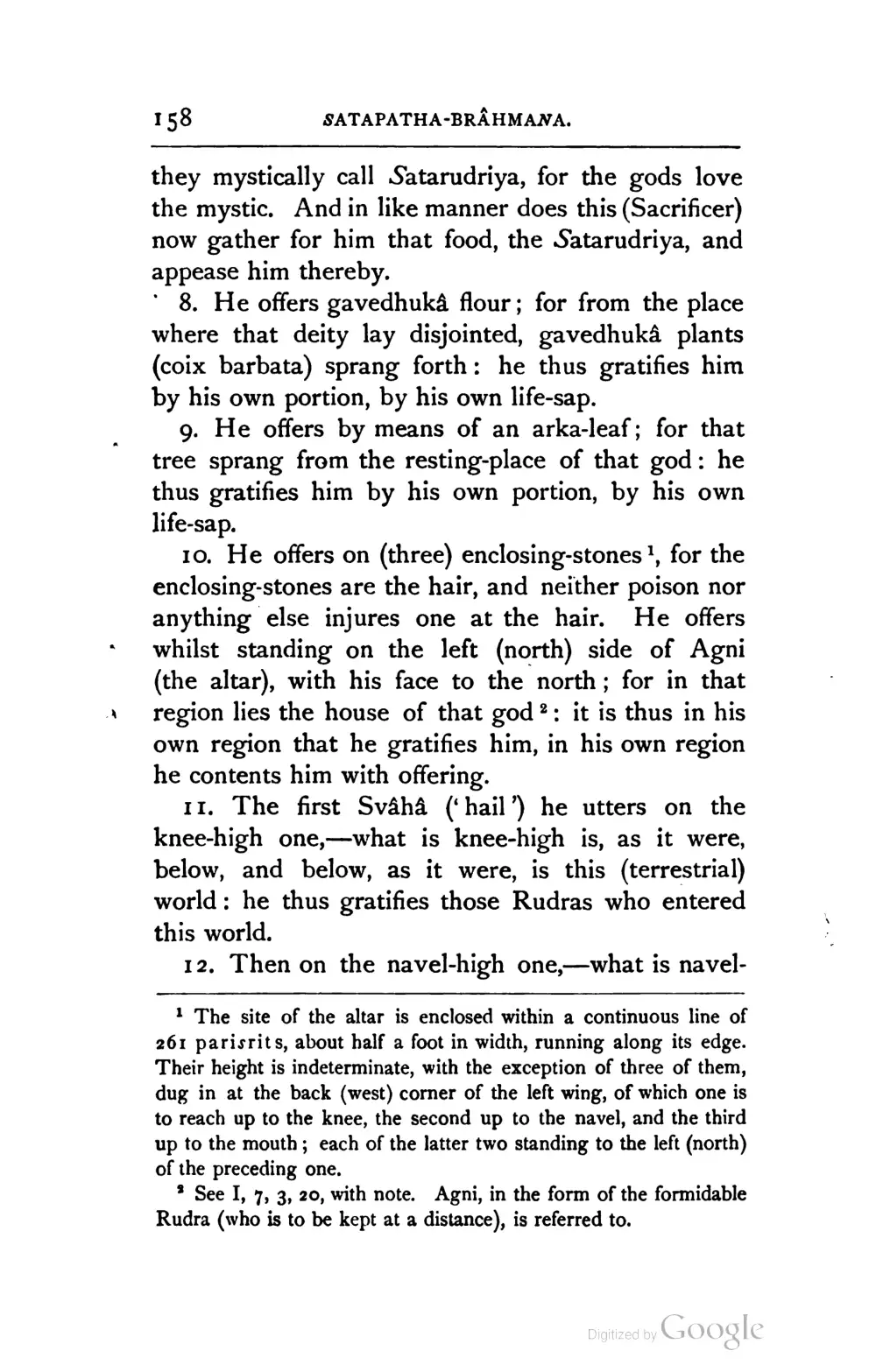
9:1:1:88. He offers gavedhukâ flour; for from the place where that deity lay disjointed, gavedhukâ plants (coix barbata) sprang forth: he thus gratifies him by his own portion, by his own life-sap.
9:1:1:99. He offers by means of an arka-leaf; for that tree sprang from the resting-place of that god: he thus gratifies him by his own portion, by his own life-sap.
9:1:1:1010. He offers on (three) enclosing-stones , for the enclosing-stones are the hair, and neither poison nor anything else injures one at the hair. He offers whilst standing on the left (north) side of Agni (the altar), with his face to the north; for in that region lies the house of that god : it is thus in his own region that he gratifies him, in his own region he contents him with offering.
9:1:1:1111. The first Svâhâ ('hail') he utters on the knee-high one,---what is knee-high is, as it were, below, and below, as it were, is this (terrestrial) world: he thus gratifies those Rudras who entered this world.
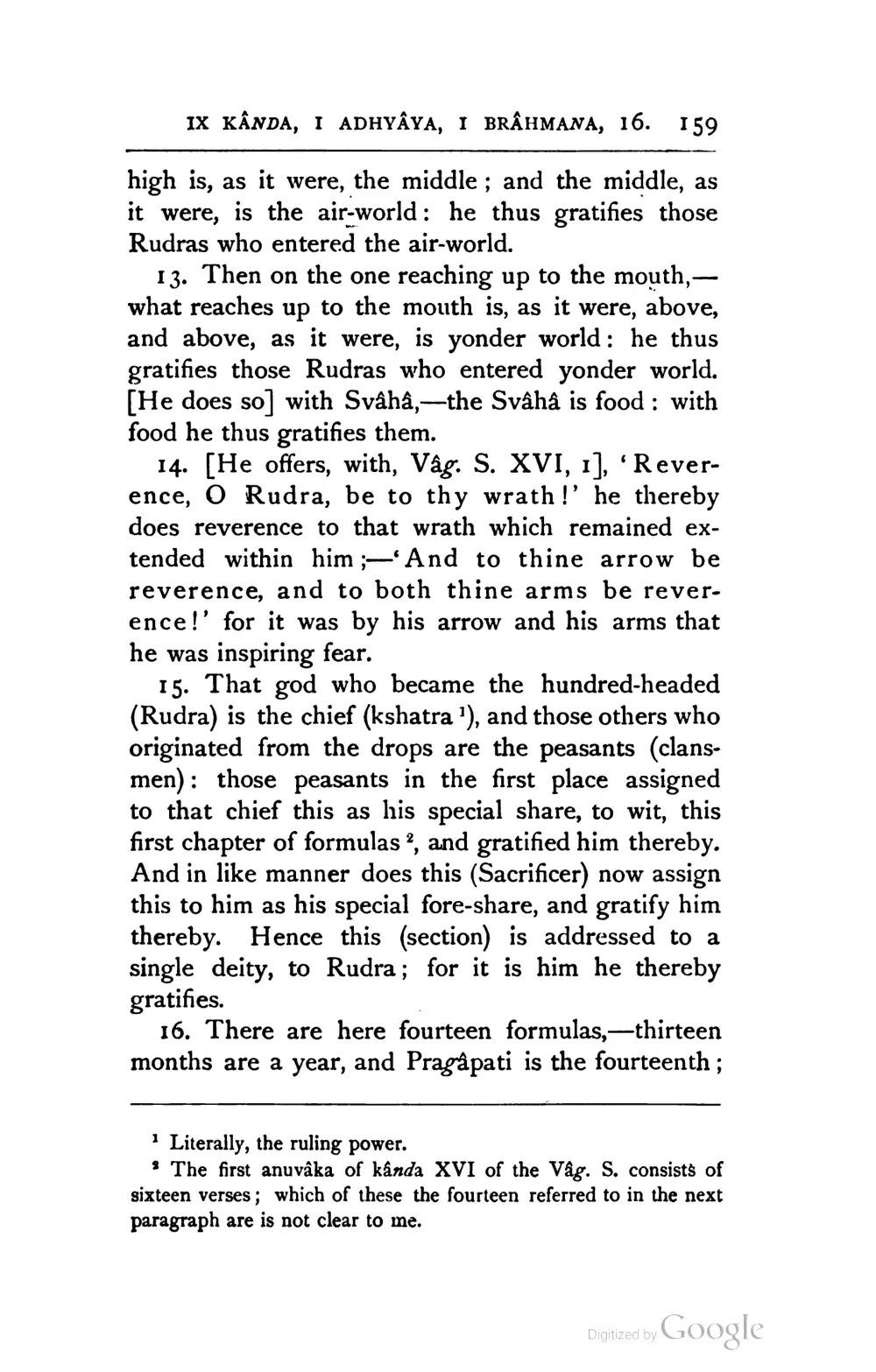
9:1:1:1212. Then on the navel-high one,--what is navel-high is, as it were, the middle; and the middle, as it were, is the air-world: he thus gratifies those Rudras who entered the air-world.
9:1:1:1313. Then on the one reaching up to the mouth,--what reaches up to the mouth is, as it were, above, and above, as it were, is yonder world: he thus gratifies those Rudras who entered yonder world. [He does so] with Svâhâ,--the Svâhâ is food: with food he thus gratifies them.
9:1:1:1414. [He offers, with, Vâg. S. XVI, 1], 'Reverence, O Rudra, be to thy wrath!' he thereby does reverence to that wrath which remained extended within him;--'And to thine arrow be reverence, and to both thine arms be reverence!' for it was by his arrow and his arms that he was inspiring fear.
No commentary for this page.