The Satapatha-Brâhmana, Part IV — SBE Vol. 43 — trans. Julius Eggeling (1897)
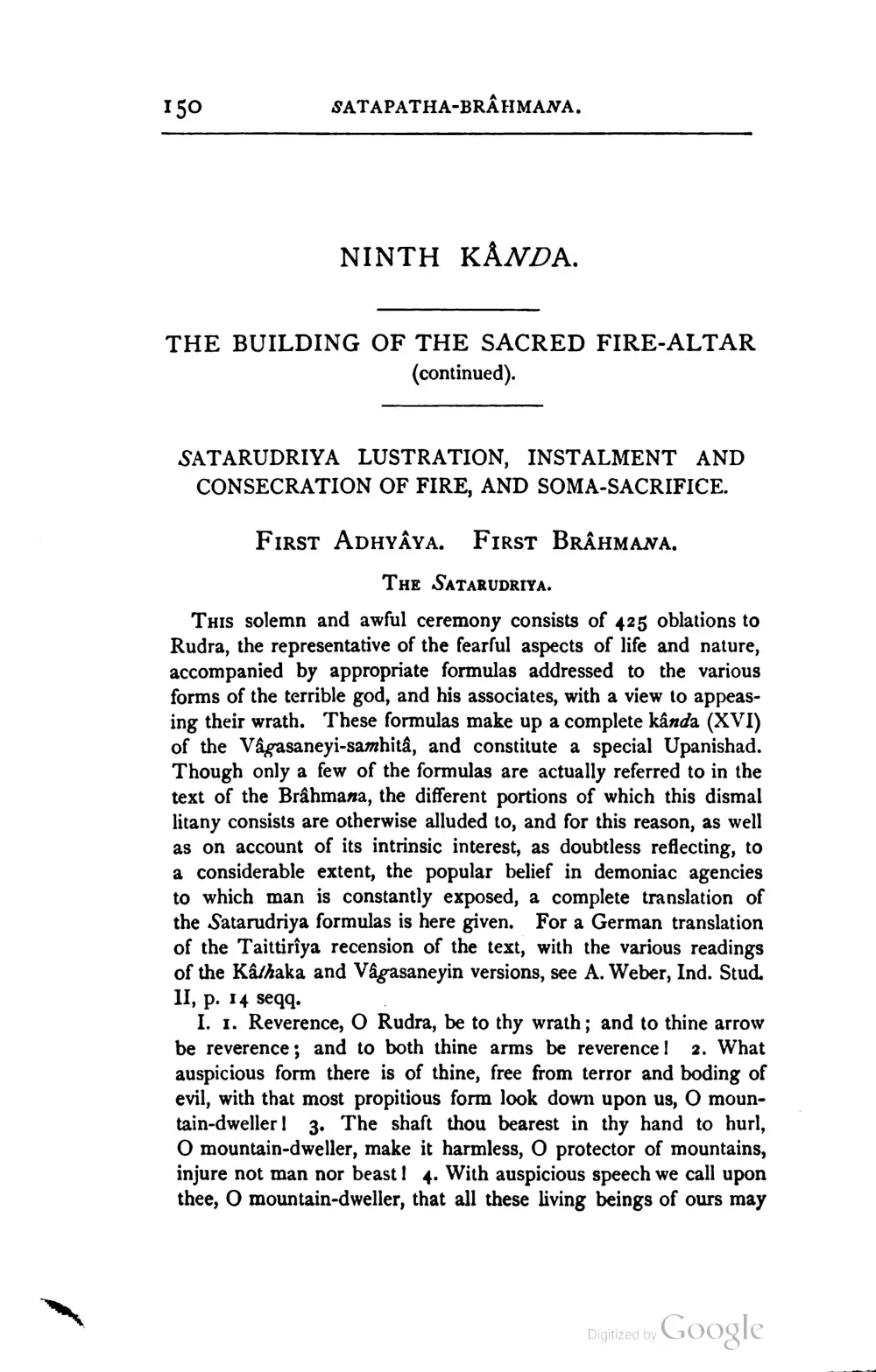
The translator’s English as printed (Julius Eggeling). The original-language text is not held; names are romanised as the translator printed them.
145:1 These hymn-tunes are given, Sam. Ved. V, p. 487, in the way in which they are here to be chanted. They consist entirely of the respective words, separated four times by musical interjections (stobhas) inserted between them, ending with the common finale: thus, (r) bhûh--bhûh--hoyi--bhûh--hoyi--bhûh--hâ~ûvâ~e--suvargyotî~h; (2) bhuvâh--bhuvah--hoyi--bhuvah--hâ~ûvâ~e--suvargyotî~h; (3) suvâh--suvah--hoyi--suvah--hoyi--suvah--hâ~ûvâ~e--suvargyotî~h. Along with these, as to be chanted on the same model, are given, (4) the 'satyam sâman,' beginning 'satyâm--satyam--hoyi' &c., and (5) the 'purusha-sâman,' beginning 'purushâh--purusha--hoyi' &c.; which are similarly chanted by the Sacrificer at the beginning of the first layer, when laying down the lotus leaf (part iii, p. 363, where note 1 should be corrected in accordance with the present note), and the gold man (ib. p. 369, where the note requires likewise to be corrected), as the 'kitre gâyati,' 'he sings on the bright one,' of the text cannot refer to the 'Kitra-sâman' there referred to. Cf. Lâty. S. I, 5, 8.--In regard to these sâmans (hymn-verses), the text might lead one to suppose that they only consist of two, instead of the usual four parts (omitting the intermediate Udgîtha and Pratihâra, cf. part ii, p. 310 note). The sâman being, however, sung by the Sacrificer himself, the usual distinction into parts to be performed by different chanters was probably dispensed with.
146:1 That is, the Sacrificer bestows it on Agni; with probably, however, the double entente, 'this Adhvaryu priest bestows it on the Sacrificer.'
146:2 See VII, 4, 1, 10 seq.; 15 seq.
147:1 Viz. of Agni (and the Sacrificer). The ceremony alluded to was the fivefold libation of ghee offered on the gold man (representing Agni and the Sacrificer), see VII, 4, 1, 34-35.
148:1 That is, so much as to the objects to which the different parts of the altar are sacred or dedicated.
9:1:1
NINTH KÂNDA.
THE BUILDING OF THE SACRED FIRE-ALTAR
(continued).
SATARUDRIYA LUSTRATION, INSTALMENT AND CONSECRATION OF FIRE, AND SOMA-SACRIFICE.
FIRST ADHYÂYA. FIRST BRÂHMANA.
THE SATARUDRIYA.
THIS solemn and awful ceremony consists of 425 oblations to Rudra, the representative of the fearful aspects of life and nature, accompanied by appropriate formulas addressed to the various forms of the terrible god, and his associates, with a view to appeasing their wrath. These formulas make up a complete kânda (XVI) of the Vâgasaneyi-samhitâ, and constitute a special Upanishad. Though only a few of the formulas are actually referred to in the text of the Brâhmana, the different portions of which this dismal litany consists are otherwise alluded to, and for this reason, as well as on account of its intrinsic interest, as doubtless reflecting, to a considerable extent, the popular belief in demoniac agencies to which man is constantly exposed, a complete translation of the Satarudriya formulas is here given. For a German translation of the Taittirîya recension of the text, with the various readings of the Kâthaka and Vâgasaneyin versions, see A. Weber, Ind. Stud. II, p. 14 seqq.
I. 1. Reverence, O Rudra, be to thy wrath; and to thine arrow be reverence; and to both thine arms be reverence! 2. What auspicious form there is of thine, free from terror and boding of evil, with that most propitious form look down upon us, O mountain-dweller! 3. The shaft thou bearest in thy hand to hurl, O mountain-dweller, make it harmless, O protector of mountains, injure not man nor beast! 4. With auspicious speech we call upon thee, O mountain-dweller, that all these living beings of ours may
No commentary for this page.