The Satapatha-Brâhmana, Part IV — SBE Vol. 43 — trans. Julius Eggeling (1897)
The translator’s English as printed (Julius Eggeling). The original-language text is not held; names are romanised as the translator printed them.
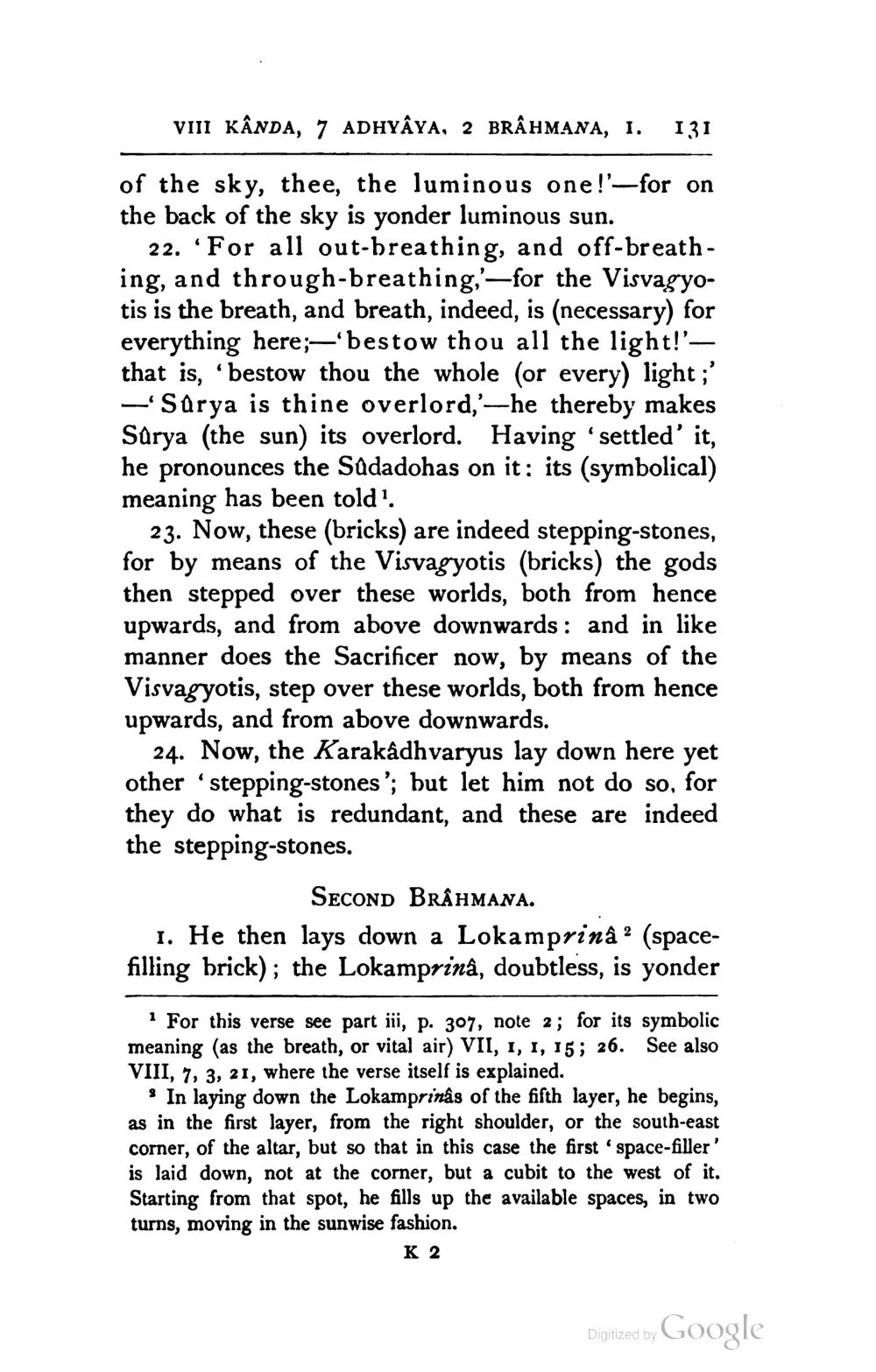
8:7:1:2222. 'For all out-breathing, and off-breathing, and through-breathing,'--for the Visvagyotis is the breath, and breath, indeed, is (necessary) for everything here;--'bestow thou all the light!'--that is, 'bestow thou the whole (or every) light;'--'Sûrya is thine overlord,'--he thereby makes Sûrya (the sun) its overlord. Having 'settled' it, he pronounces the Sûdadohas on it: its (symbolical) meaning has been told .
8:7:1:2323. Now, these (bricks) are indeed stepping-stones, for by means of the Visvagyotis (bricks) the gods then stepped over these worlds, both from hence upwards, and from above downwards: and in like manner does the Sacrificer now, by means of the Visvagyotis, step over these worlds, both from hence upwards, and from above downwards.
8:7:1:2424. Now, the Karakâdhvaryus lay down here yet other 'stepping-stones'; but let him not do so, for they do what is redundant, and these are indeed the stepping-stones.
Footnotes
125:3 Or, he places the chieftaincy in every clan.
126:1 Or, all this universe.
127:1 For the symbolic meaning of the three svayam-âtrinnâs, as the central bricks of the first and third layers, and the one lying on the centre of the fifth layer, see part iii, p. 155, note 8.
127:2 On the three Visvagyotis bricks, placed in the same layers, as representing the gods Agni, Vâyu and Âditya respectively, see VI, 3, 3, 16; 5, 3, 3.
128:1 Or, But these (bricks) also are (or mean) generative power, cf. paragraph 1.
128:2 That is, he is not to shift them from their proper place, but place each subsequent pair exactly on those laid down before. As a matter of fact, however, these two bricks (if we determine their site by mere calculation) would seem, in the fifth layer, to lie by half a foot further away from the central point, than the Ritavyâs of the other layers do. This is owing to the fact that whilst, in the layers in which a Svayamâtrinnâ lies in the middle, only one half of these central bricks lie on the east side of the central point, in the present layer the eastern -portion of the Gârhapatya (occupying the central part of the layer) consists of full-sized bricks. This discrepancy of half a foot was probably made good by some space being left, which was afterwards filled up with earth; unless, indeed, the Svayamâtrinnâs, as apparently natural stones, were allowed to somewhat exceed the ordinary size of bricks.
131:1 For this verse see part iii, p. 307, note 2; for its symbolic meaning (as the breath, or vital air) VII, 1, 1, 15; 26. See also VIII, 7, 3, 21, where the verse itself is explained.
8:7:2
SECOND BRÂHMANA.
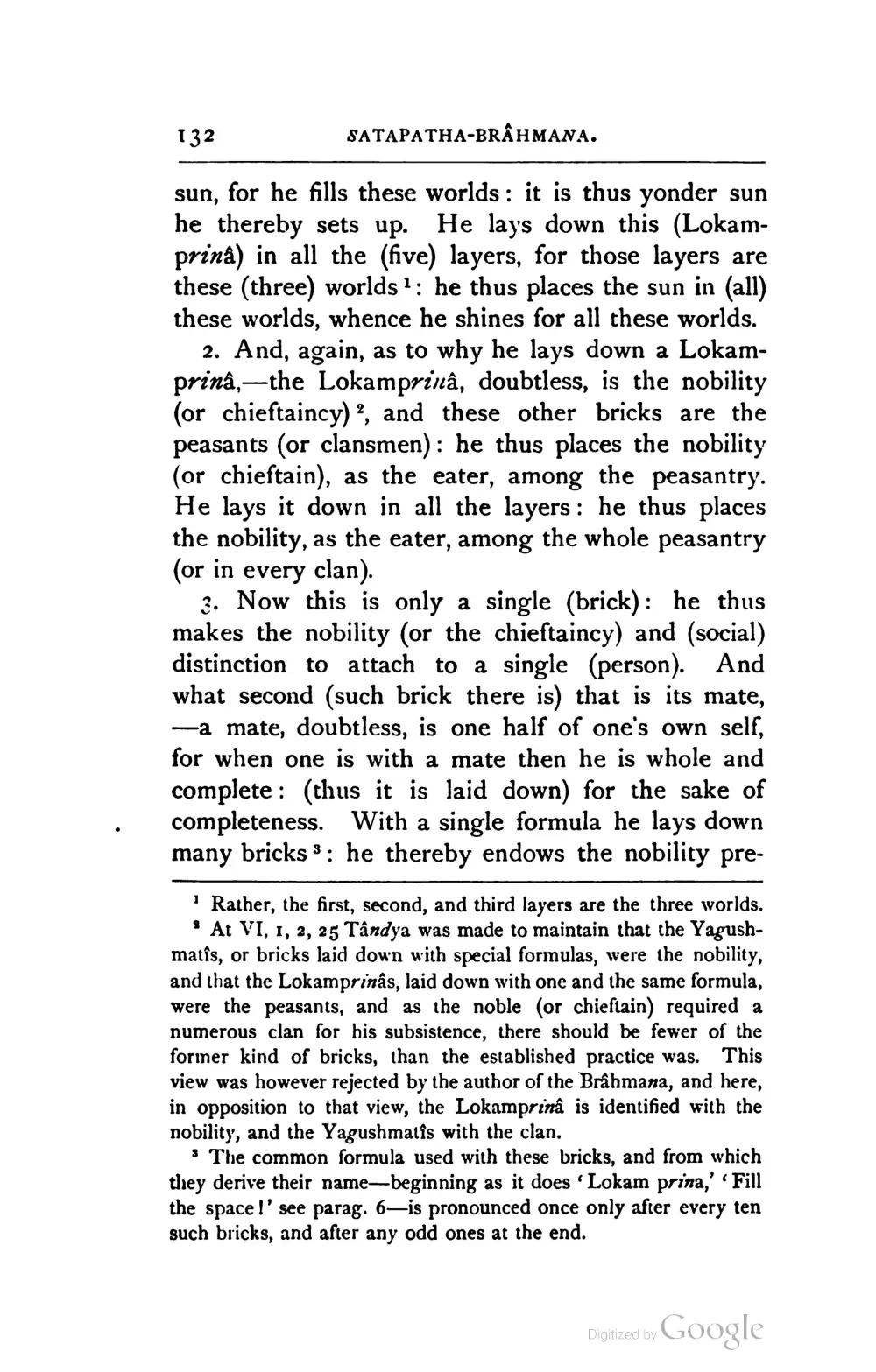
8:7:2:11. He then lays down a Lokamprinâ (space-filling brick); the Lokamprinâ, doubtless, is yonder sun, for he fills these worlds: it is thus yonder sun he thereby sets up. He lays down this (Lokamprinâ) in all the (five) layers, for those layers are these (three) worlds : he thus places the sun in (all) these worlds, whence he shines for all these worlds.
8:7:2:22. And, again, as to why he lays down a Lokamprinâ,--the Lokamprinâ, doubtless, is the nobility (or chieftaincy) , and these other bricks are the peasants (or clansmen): he thus places the nobility (or chieftain), as the eater, among the peasantry. He lays it down in all the layers: he thus places the nobility, as the eater, among the whole peasantry (or in every clan).
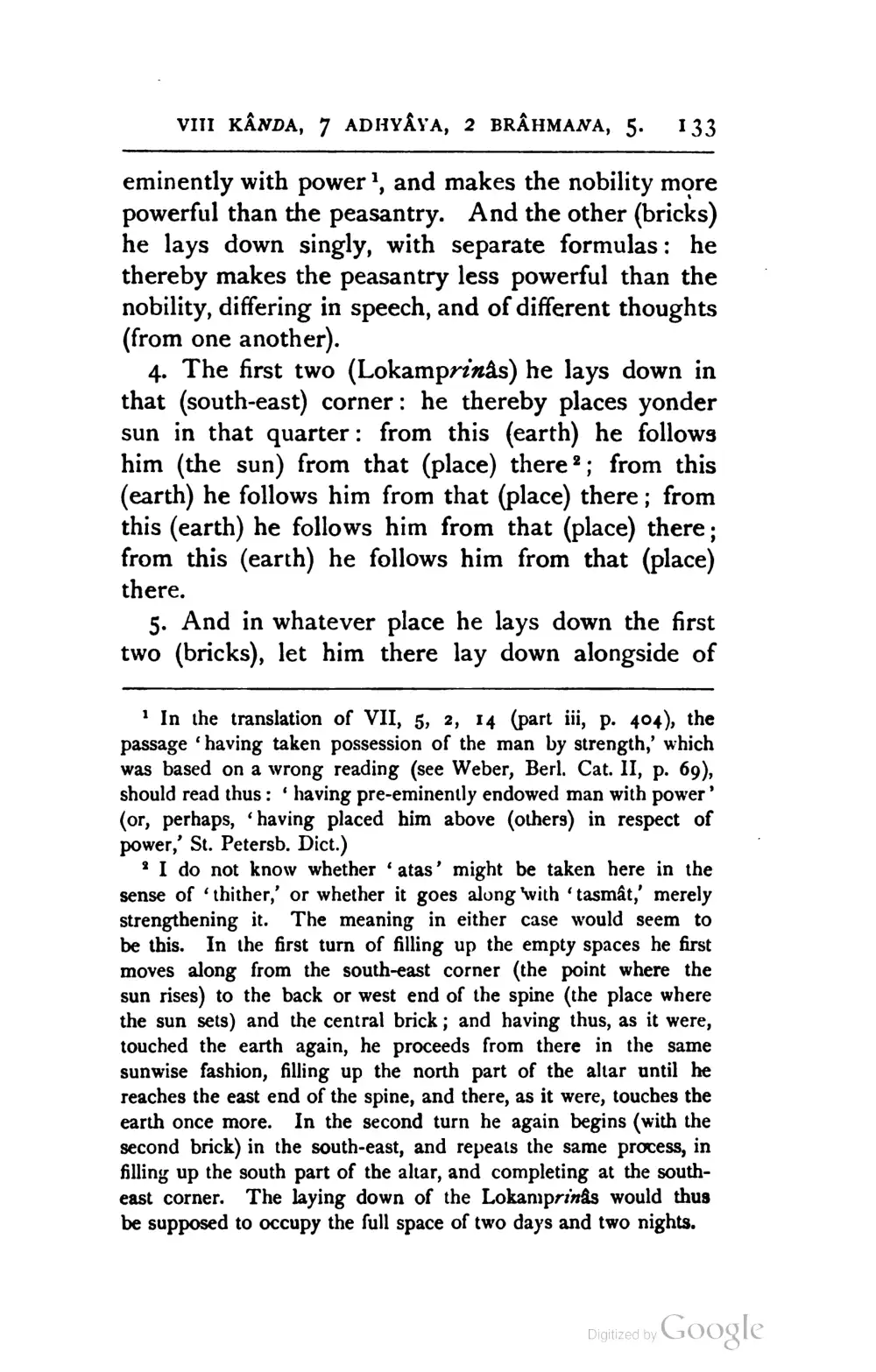
8:7:2:33. Now this is only a single (brick): he thus makes the nobility (or the chieftaincy) and (social) distinction to attach to a single (person). And what second (such brick there is) that is its mate,--a mate, doubtless, is one half of one's own self, for when one is with a mate then he is whole and complete: (thus it is laid down) for the sake of completeness. With a single formula he lays down many bricks : he thereby endows the nobility preeminently with power , and makes the nobility more powerful than the peasantry. And the other (bricks) he lays down singly, with separate formulas: he thereby makes the peasantry less powerful than the nobility, differing in speech, and of different thoughts (from one another).
8:7:2:44. The first two (Lokamprinâs) he lays down in that (south-east) corner: he thereby places yonder sun in that quarter: from this (earth) he follows him (the sun) from that (place) there ; from this (earth) he follows him from that (place) there; from this (earth) he follows hire from that (place) there; from this (earth) he follows him from that (place) there.
8:7:2:55. And in whatever place he lays down the first two (bricks), let him there lay down alongside of
No commentary for this page.