The Satapatha-Brâhmana, Part IV — SBE Vol. 43 — trans. Julius Eggeling (1897)
The translator’s English as printed (Julius Eggeling). The original-language text is not held; names are romanised as the translator printed them.
8:5:4:22. And, again, as to why (on the range) of the Ashâdhâ;--the Ashâdhâ, doubtless, is this (earth), and the Stomabhâgâs are yonder sun: he thus establishes yonder sun upon this earth as a firm foundation.
8:5:4:33. And, again, why (on that) of the Ashâdhâ;--the Ashâdhâ, doubtless, is this (earth), and the Stomabhâgâs are the heart: he thus lays into this (earth) the heart, the mind: whence on this (earth) one thinks with the heart, with the mind. He lays them down on every side: he thus places the heart, the mind everywhere; whence everywhere on this (earth) one thinks with the heart, with the mind. And, moreover, these (bricks) are lucky signs: he places them on all sides; whence they say of him who has a (lucky) sign (lakshman) on every (or any) side that he has good luck (punyalakshmîka).
8:5:4:44. He then covers them with loose soil; for loose soil (purîsha) means food, and this (set of bricks) is the essence (of food): he thus makes it invisible, for invisible, as it were, is the essence of food.
8:5:4:55. And, again, as to why (he covers it) with loose soil;--loose soil, doubtless, means food, and this (set of bricks) is the essence: he thus joins and unites the food and its essence.
8:5:4:66. And, again, as to why with loose soil;--the Stomabhâgâs are the heart, and the loose soil is the pericardium: he thus encloses the heart in the pericardium.
8:5:4:77. And, again, as to why with loose soil;--this fire-altar is the year, and by means of the soil-coverings of the layers he divides it: those first four layers are four seasons. And having laid down the Stomabhâgâs, he throws loose soil thereon: that is the fifth layer, that is the fifth season.
8:5:4:88. Here now they say, 'Since the other layers conclude with Lokamprinâs (space-filling bricks), and no space-filler is laid down in this (layer): what, then, is the space-filler therein?' The space-filler, surely, is yonder sun, and this layer is he; and this is of itself a space-filling layer. And what there is above this (layer) up to the covering of soil that is the sixth layer, that is the sixth season.
8:5:4:99. He then throws down the loose soil. Thereon he lays down the Vikarnî and the naturally-perforated (brick); he bestrews them with chips of gold, and places the fire thereon: that is the seventh layer, that is the seventh season.
8:5:4:1010. But, indeed, there are only six of them; for as to the Vikarnî and the Svayam-âtrinnâ, they belong to the sixth layer.
8:5:4:1111. And, indeed, there are only five of them,--on the other (layers) he throws down the loose soil with a prayer, and here (he does so) silently: in that respect this is not a layer. And the other layers end with space-fillers, but here he lays down no space-filler: in that respect also this is not a layer.
8:5:4:1212. And, indeed, there are only three of them,--the first layer is this very (terrestrial) world; and the uppermost (layer) is the sky; and those three (intermediate layers) are the air, for there is, as it were, only one air here: thus (there are) three, or five, or six, or seven of them.
Footnotes
95:1 Or, this fire-altar.
96:1 Or, and he (the sun) himself.
8:6:1
SIXTH ADHYÂYA. FIRST BRÂHMANA.
8:6:1:11. He lays down the Nâkasads (firmament-seated bricks): the firmament-seated ones, assuredly, are the gods. In this (layer) that whole fire-altar becomes completed, and therein these (bricks are) the firmament (nâka), the world of heaven: it is therein that the gods seated themselves; and inasmuch as the gods seated themselves on that firmament, in the world of heaven, the gods are the firmament-seated. And in like manner does the Sacrificer, when he lays down these (bricks), now seat himself on that firmament, in the world of heaven.
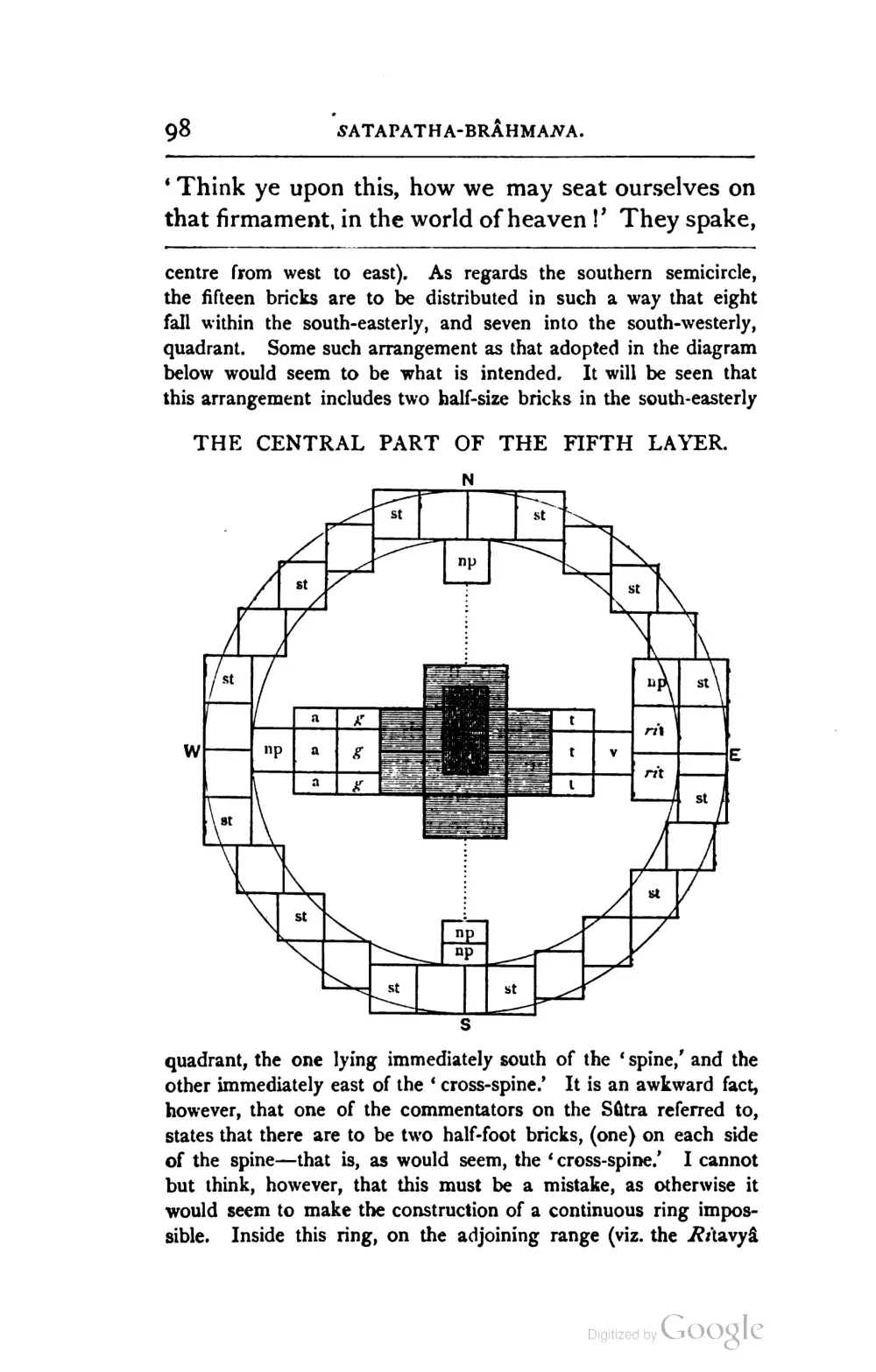
8:6:1:22. And, again, why he lays down the Nâkasads. Now at that time the gods saw that firmament, the world of heaven, these Stomabhâgâs . They spake,
[paragraph continues] 'Think ye upon this, how we may seat ourselves on that firmament, in the world of heaven!' They spake,
[paragraph continues] 'Meditate ye! seek ye a layer!' whereby, indeed, they said, 'Seek ye this, how we may seat ourselves on this firmament, in the world of heaven!'
8:6:1:33. Whilst meditating, they saw these bricks, the Nâkasads, and placed them on (the altar): by means of them they seated themselves on that firmament, in the world of heaven; and inasmuch as through them they seated themselves (sad) on that firmament (nâka), in the world of heaven, these are the Nâka-sad (bricks); and in like manner does the Sacrificer, when he lays down these (bricks), now seat himself on that firmament, in the world of heaven.
No commentary for this page.