The Satapatha-Brâhmana, Part IV — SBE Vol. 43 — trans. Julius Eggeling (1897)
The translator’s English as printed (Julius Eggeling). The original-language text is not held; names are romanised as the translator printed them.
8:4:2:66. 'Mitra's share thou art, Varuna s lordship!'--Mitra, doubtless, is the out-breathing, and Varuna the down-breathing: having bestowed a share on the out-breathing, he bestowed lordship on the down-breathing;--'heaven's rain, the wind is freed; the Ekavimsa-stoma!'--by means of the twenty-one-fold hymn-form he frees both rain and wind for living beings from evil, from death.
8:4:2:77. 'The Vasus’ share thou art, the Rudras' lordship!'--having bestowed a share on the Vasus, he bestowed lordship on the Rudras;--'the four-footed is freed, the Katurvimsa-stoma!'--by means of the twenty-five-fold hymn-form he freed the four-footed for living beings from evil, from death.
8:4:2:88. 'The Âdityas’ share thou art, the Maruts’ lordship!'--having bestowed a share on the Âdityas, he bestowed lordship on the Maruts;--'the embryos are freed, the Pañkavimsa-stoma!'--by means of the twenty-five-fold hymn-form he freed the embryos for living beings from evil, from death.
8:4:2:99. 'Aditi's share thou art, Pûshan's lordship!'--Aditi, doubtless, is this (earth): having bestowed a share on her, he bestowed lordship on Pûshan,--'vigour is freed; the Trinava-stoma!' by means of the thrice-ninefold hymn-form he freed vigour for living beings from evil, from death.
8:4:2:1010. 'God Savitri's share thou art, Brihaspati's lordship!'--having bestowed a share on the god Savitri, he bestows lordship on Brihaspati;--'the facing quarters are freed, the Katushtoma!'--by means of the chant of praise consisting of four stomas he freed all the (four) quarters for living beings from evil, from death.
8:4:2:1111. 'The Yavas’ share thou art, the Ayavas’ lordship!'--the Yavas, doubtless, are the first (light) fortnights, and the Ayavas the latter (dark) fortnights, for these gain (yu) and obtain (â-yu) everything here : having bestowed a share on the first fortnights, he bestowed lordship on the latter fortnights;--'the creatures are freed, the Katuskatvârimsa-stoma!'--by means of the forty-four-fold hymn-form he freed all creatures from evil, from death.
8:4:2:1212. 'The Ribhus’ share thou art, the All-gods’ lordship!'--having bestowed a share on the Ribhus, he bestowed lordship on the Visve-Devâh;--
[paragraph continues] 'the living being is freed, the Trayastrimsa-stoma!'--by means of the thirty-three-fold hymn-form he freed all living beings from evil, from death; and in like manner does the Sacrificer, by means of the thirty-three-fold hymn-form, now free all living beings from evil, from death.
8:4:2:1313. These, then, are ten bricks he lays down,--the Virâg consists of ten syllables, and Agni is Virâg (wide-shining); there are ten regions, and Agni is the regions; there are ten vital airs, and Agni is the vital airs: as great as Agni is, as great as is his measure, by so much he thus frees all these creatures from evil, from death.
8:4:2:1414. He then lays down two Ritavyâs (seasonal bricks);--the seasonal ones being the same as the seasons, it is the seasons he thus lays down;--with (Vâg. S. XIV, 27), 'Saha and Sahasya, the two winter-seasons!' These are the names of those two, it is with their names he thus lays them down. There are two such bricks, for a season consists of two months. Only once he settles them: he thus makes (the two months) one season.
8:4:2:1515. And as to why he places these two (bricks) in this (layer),--this Agni (fire-altar) is the year, and the year is these worlds: what part thereof is above the air, and below the sky, that is this fourth layer, and that is the winter-season thereof; and when he places these two in this (layer), he thereby restores to him (Pragâpati-Agni, the year and fire-altar) what part of his body these two (constitute). This is why he places these two in this (layer).
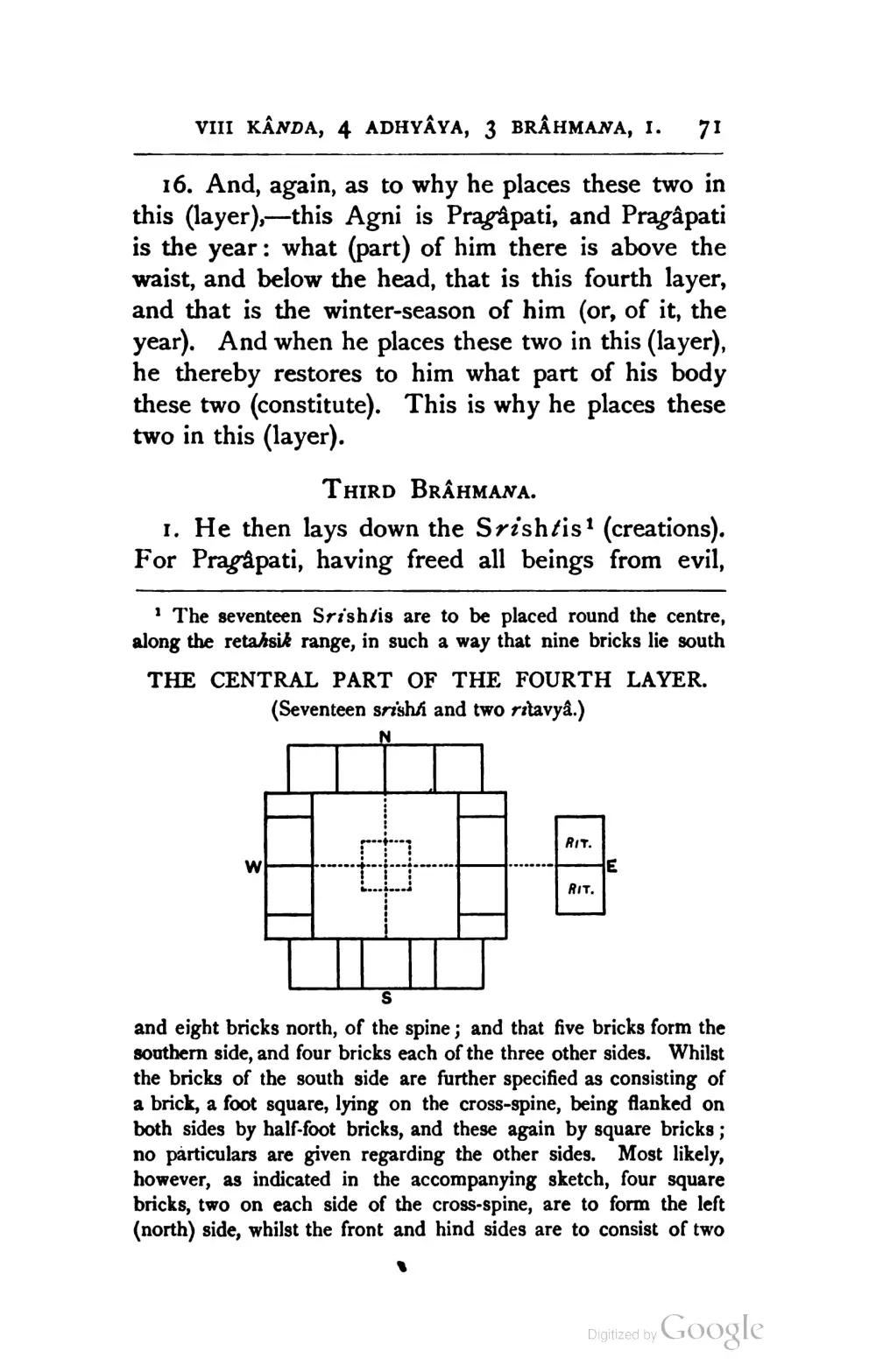
8:4:2:1616. And, again, as to why he places these two in this (layer),--this Agni is Pragâpati, and Pragâpati is the year: what (part) of him there is above the waist, and below the head, that is this fourth layer, and that is the winter-season of him (or, of it, the year). And when he places these two in this (layer), he thereby restores to him what part of his body these two (constitute). This is why he places these two in this (layer).
Footnotes
66:2 The ten Spritah are placed in close connection with the preceding set;--viz. at the front and back ends of the spine, two bricks, exactly corresponding in size to those already lying there, are placed south and north of these respectively. Similarly two bricks, a foot square, are placed on the 'cross-spine' immediately north of the two stoma-bricks lying there. The remaining six bricks are then placed behind the row of fourteen 'stomas' in the front part of the altar, three on each side of the spine.
67:1 Or, from that evil, death.
No commentary for this page.