The Satapatha-Brâhmana, Part IV — SBE Vol. 43 — trans. Julius Eggeling (1897)
The translator’s English as printed (Julius Eggeling). The original-language text is not held; names are romanised as the translator printed them.
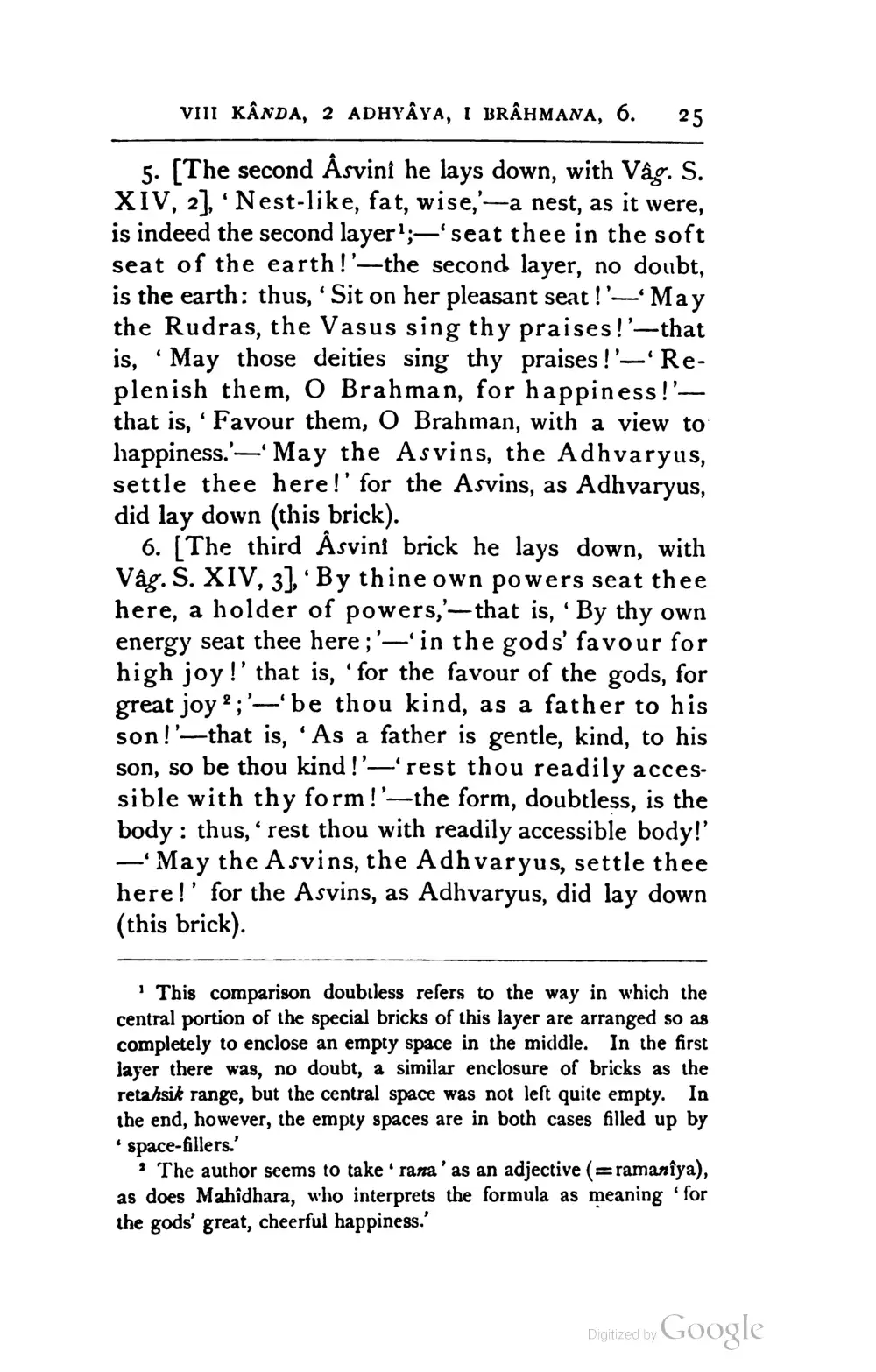
8:2:1:66. [The third Âsvinî brick he lays down, with Vâg. S. XIV, 3], 'By thine own powers seat thee here, a holder of powers,'--that is, 'By thy own energy seat thee here;'--'in the gods’ favour for high joy!' that is, 'for the favour of the gods, for great joy ;"--'be thou kind, as a father to his son!'--that is, 'As a father is gentle, kind, to his son, so be thou kind!'--'rest thou readily accessible with thy form!'--the form, doubtless, is the body: thus, 'rest thou with readily accessible body!'--'May the Asvins, the Adhvaryus, settle thee here!' for the Asvins, as Adhvaryus, did lay down (this brick).
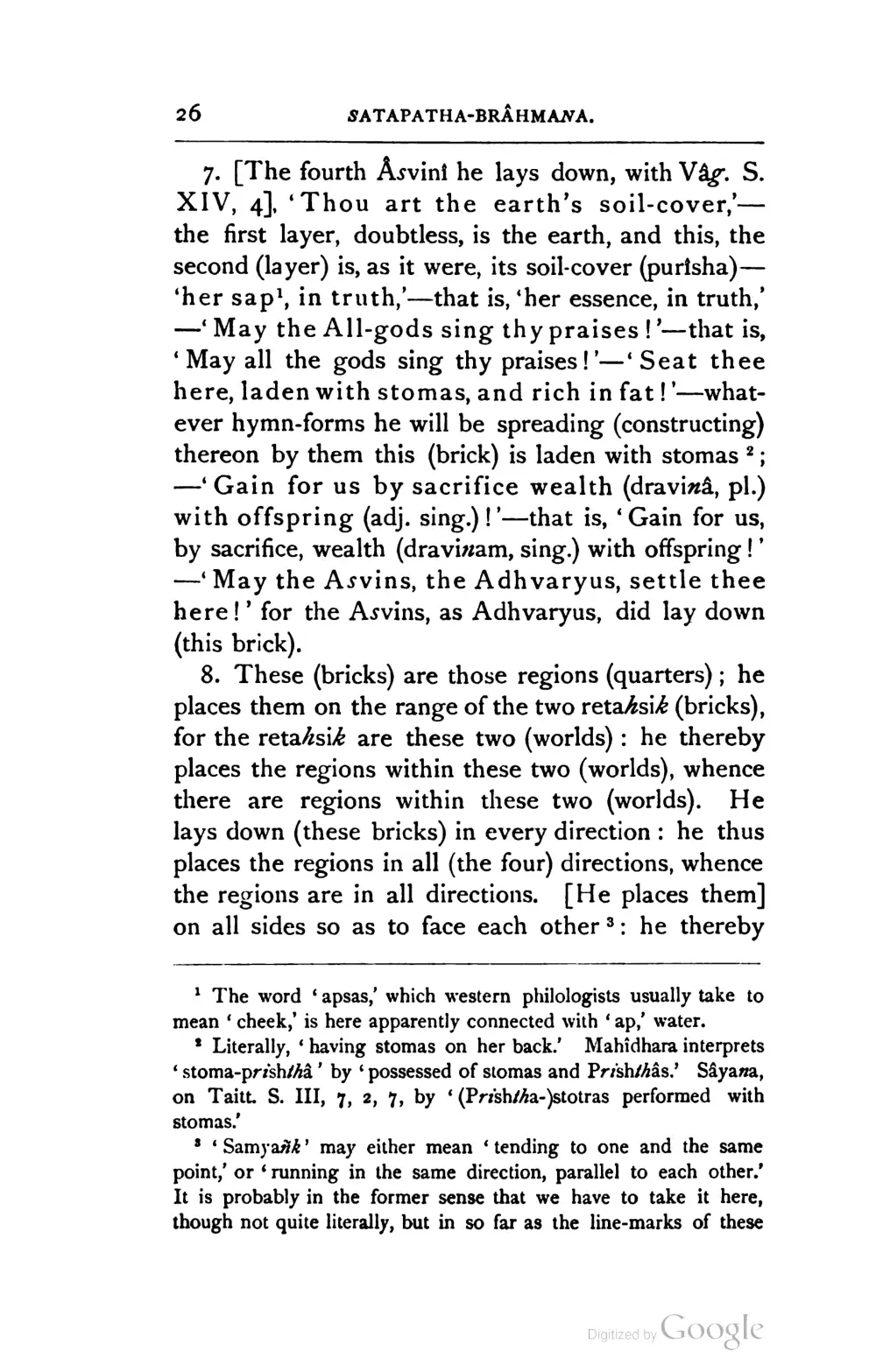
8:2:1:77. [The fourth Âsvinî he lays down, with Vâg. S. XIV, 4], 'Thou art the earth's soil-cover,'--the first layer, doubtless, is the earth, and this, the second (layer) is, as it were, its soil-cover (purîsha)--'her sap , in truth,'--that is, 'her essence, in truth,'--'May the All-gods sing thy praises!'--that is, 'May all the gods sing thy praises!'--'Seat thee here, laden with stomas, and rich in fat!'--whatever hymn-forms he will be spreading (constructing) thereon by them this (brick) is laden with stomas ;--'Gain for us by sacrifice wealth (dravinâ, pl.) with offspring (adj. sing.)!'--that is, 'Gain for us, by sacrifice, wealth (dravinam, sing.) with offspring!'--'May the Asvins, the Adhvaryus, settle thee here!' for the Asvins, as Adhvaryus, did lay down (this brick).
8:2:1:88. These (bricks) are those regions (quarters); he places them on the range of the two retahsik (bricks), for the retahsik are these two (worlds): he thereby places the regions within these two (worlds), whence there are regions within these two (worlds). He lays down (these bricks) in every direction: he thus places the regions in all (the four) directions, whence the regions are in all directions. [He places them] on all sides so as to face each other : he thereby makes the regions on all sides face each other, and hence the regions on all sides face each other. He lays (the bricks) down separately, settles them separately, and pronounces the sûdadohas over them separately, for separate are the regions.
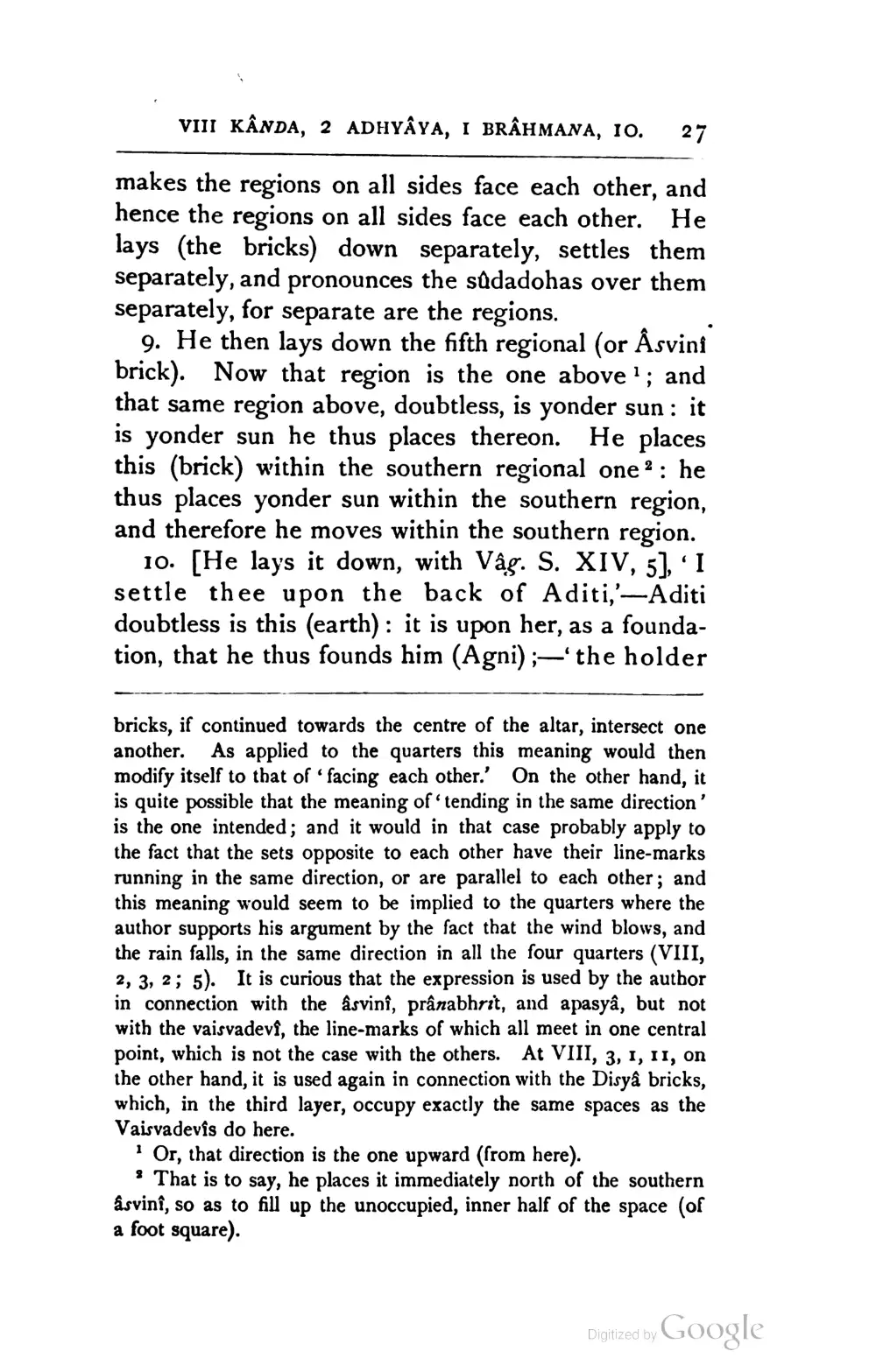
8:2:1:99. He then lays down the fifth regional (or Âsvinî brick). Now that region is the one above ; and that same region above, doubtless, is yonder sun: it is yonder sun he thus places thereon. He places this (brick) within the southern regional one : he thus places yonder sun within the southern region, and therefore he moves within the southern region.
8:2:1:1010. [He lays it down, with Vâg. S. XIV, 5], 'I settle thee upon the back of Aditi,'--Aditi doubtless is this (earth): it is upon her, as a foundation, that he thus founds him (Agni);--'the holder of the air, the supporter of the regions, the ruler of beings,'--for he (the sun) is indeed the holder of the air, the supporter of the regions, and the ruler of beings;--'thou art the wave, the drop, of water,'--the wave, doubtless, means the essence;--'Visvakarman is thy Rishi!'--Visvakarman (the all-shaper), doubtless, is Pragâpati: thus, 'Thou art fashioned by Pragâpati.'--'May the Asvins, the Adhvaryus, settle thee here!' for the Asvins, as Adhvaryus, did lay down (this brick).
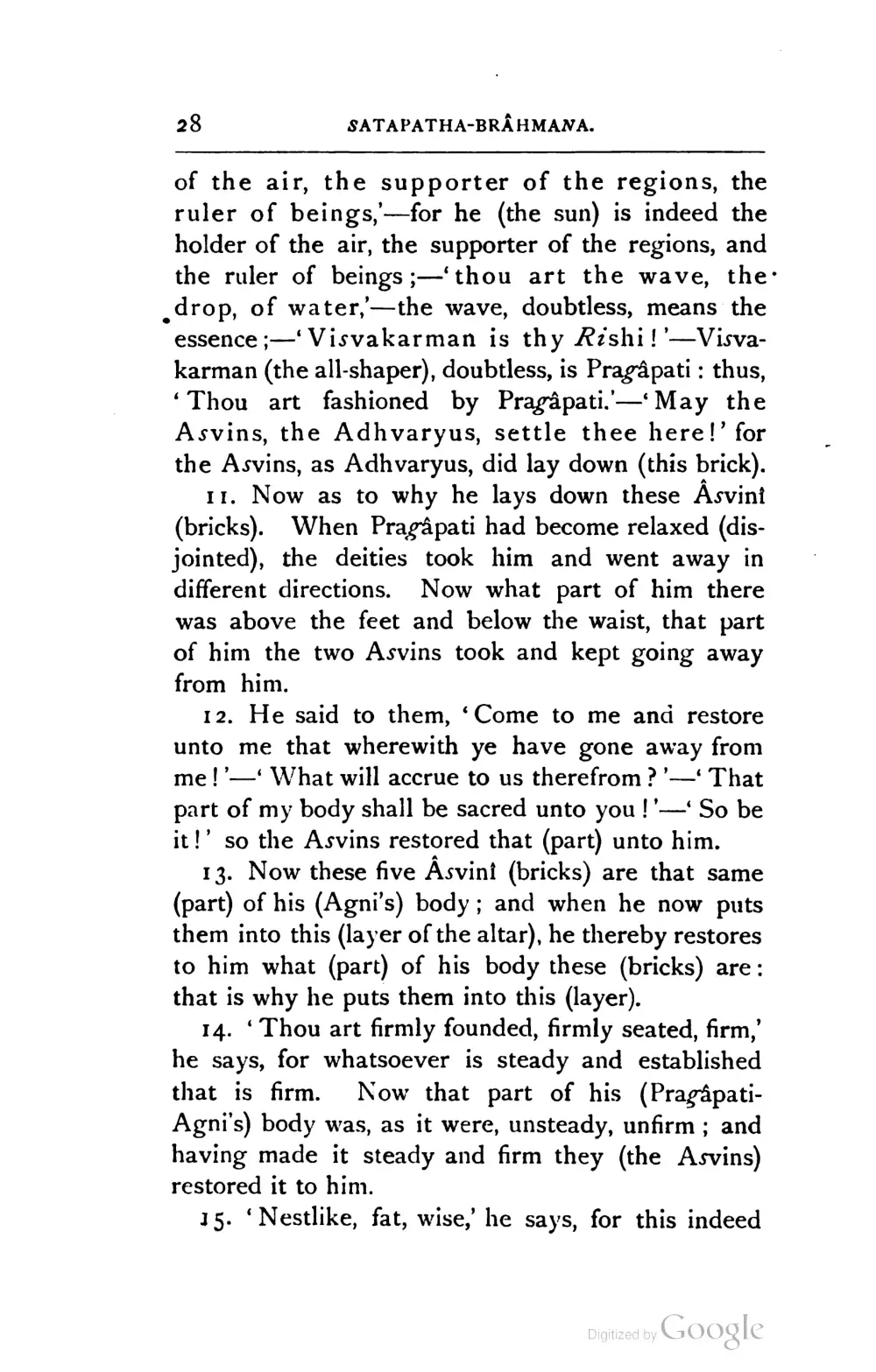
8:2:1:1111. Now as to why he lays down these Âsvinî (bricks). When Pragâpati had become relaxed (disjointed), the deities took him and went away in different directions. Now what part of him there was above the feet and below the waist, that part of him the two Asvins took and kept going away from him.
8:2:1:1212. He said to them, 'Come to me and restore unto me that wherewith ye have gone away from me!'--'What will accrue to us therefrom?'--'That part of my body shall be sacred unto you!'--'So be it!' so the Asvins restored that (part) unto him.
8:2:1:1313. Now these five Âsvinî (bricks) are that same (part) of his (Agni's) body; and when he now puts them into this (layer of the altar), he thereby restores to him what (part) of his body these (bricks) are: that is why he puts them into this (layer).
8:2:1:1414. 'Thou art firmly founded, firmly seated, firm,' he says, for whatsoever is steady and established that is firm. Now that part of his (Pragâpati-Agni's) body was, as it were, unsteady, unfirm; and having made it steady and firm they (the Asvins) restored it to him.
8:2:1:1515. 'Nestlike, fat, wise,' he says, for this indeed is as a nest for his body.--'By thine own powers seat thee here, a holder of powers,' he says, for they did make that (part) of him powerful.--'Thou art the Earth's soil-cover,' he says, for that (lower part) of his body is, as it were, in connection with the soil-cover. At the range of the Retahsik (he places the bricks),--the Retahsik are the ribs, for level with the ribs, as it were, is that (part) of his body. He places them on every side, for on every side the Asvins restored that (part) of his (Pragâpati's) body.
No commentary for this page.