The Satapatha-Brâhmana, Part IV — SBE Vol. 43 — trans. Julius Eggeling (1897)
The translator’s English as printed (Julius Eggeling). The original-language text is not held; names are romanised as the translator printed them.
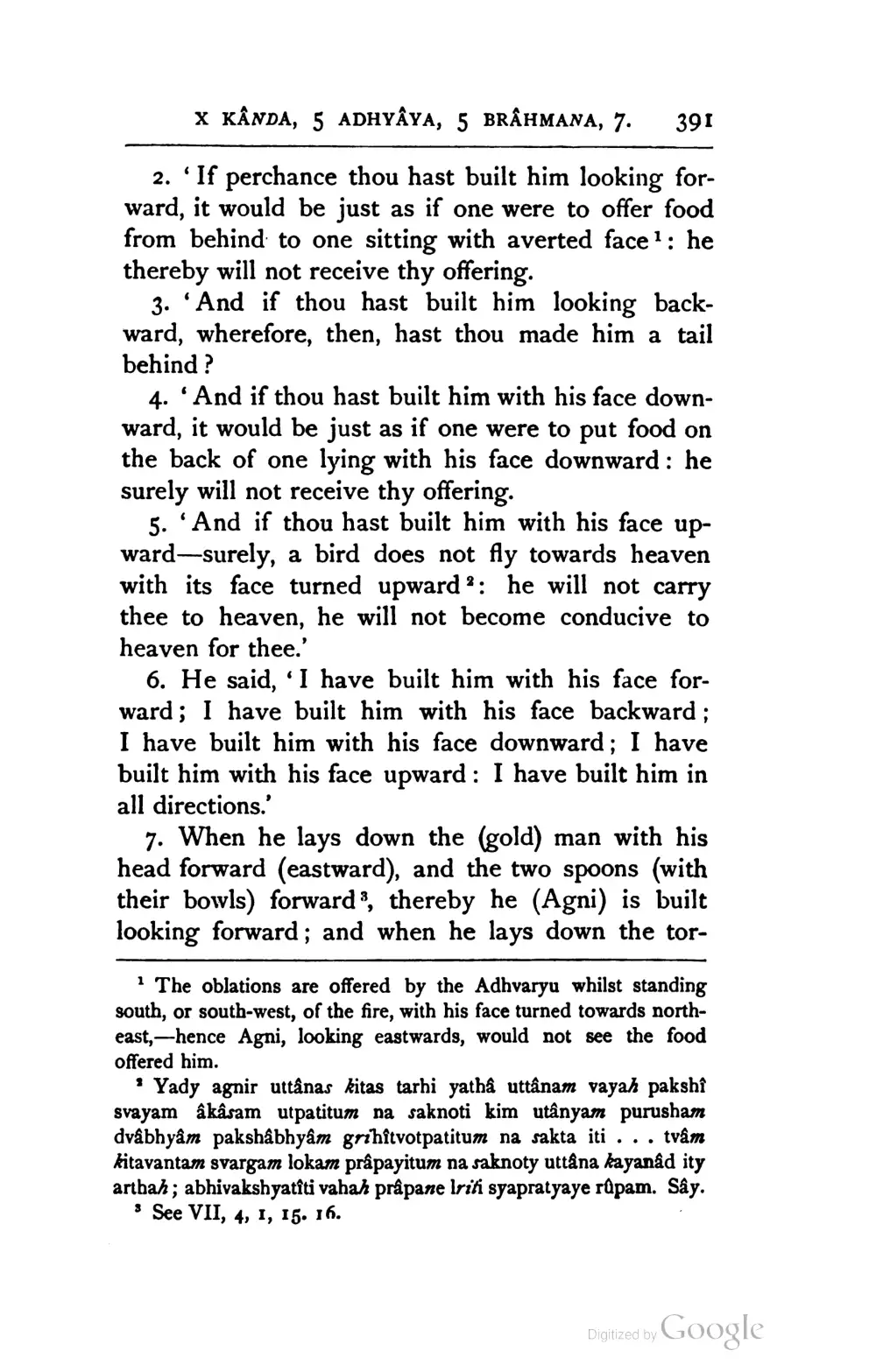
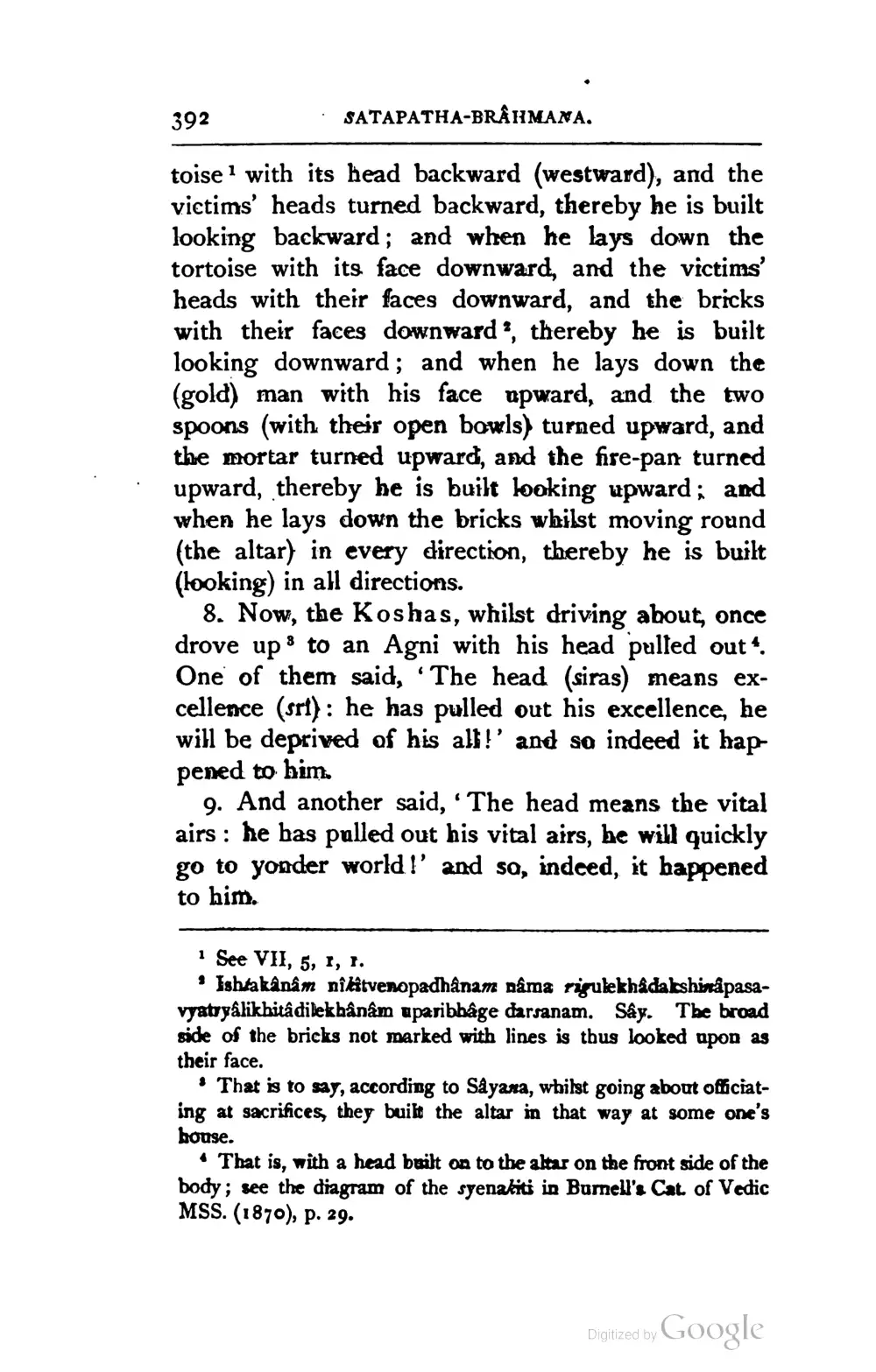
10:5:5:77. When he lays down the (gold) man with his head forward (eastward), and the two spoons (with their bowls) forward , thereby he (Agni) is built looking forward; and when he lays down the tortoise with its head backward (westward), and the victims’ heads turned backward, thereby he is built looking backward; and when he, lays down the tortoise with its face downward, and the victims’ heads with their faces downward, and the bricks with their faces downward , thereby he is built looking downward; and when he lays down the (gold) man with his face upward, and the two spoons (with their open bowls) turned upward, and the mortar turned upward, and the fire-pan turned upward, thereby he is built looking upward; and when he lays down the bricks whilst moving round (the altar) in every direction, thereby he is built (looking) in all directions.
10:5:5:88. Now, the Koshas, whilst driving about, once drove up to an Agni with his head pulled out . One of them said, 'The head (siras) means excellence (srî): he has pulled out his excellence, he will be deprived of his all!' and so indeed it happened to him.
10:5:5:99. And another said, 'The head means the vital airs: he has pulled out his vital airs, he will quickly go to yonder world!' and so, indeed, it happened to him.
10:5:5:1010. Upwards, indeed, he (Agni) is built up, to wit, (in the shape of) the grass-bunch, the clod-bricks, the lotus-leaf, the gold plate and man, the two spoons, the naturally-perforated one, the grass-brick, the Dviyagus, the two Retahsik, the Visvagyotis, the two seasonal bricks, the Ashâdhâ, and the tortoise; and that fire which is placed on the altar-pile, assuredly, is then most manifestly his (Agni's) head: let him therefore not pull out (the head).
Footnotes
390:2 That is, Kusri Gautama, (son and) disciple of Vâgasravas.
391:1 The oblations are offered by the Adhvaryu whilst standing south, or south-west, of the fire, with his face turned towards northeast,--hence Agni, looking eastwards, would not see the food offered him.
391:2 Yady agnir uttânas kitas tarhi yathâ uttânam vayah pakshî svayam âkâsam utpatitum na saknoti kim utânyam purusham dvâbhyâm pakshâbhyâm grihîtvotpatitum na sakta iti . . . tvâm kitavantam svargam lokam prâpayitum na saknoty uttâna kayanâd ity arthah; abhivakshyatîti vahah prâpane lriti syapratyaye rûpam. Sây.
391:3 See VII, 4, I, 15. 16.
392:1 See VII, 5, 1, 1.
392:2 Ishtakânâm nîkîtvenopadhânam nâma rigulekhâdakshinâpasavyatryâlikhitâdilekhânâm uparibhâge darsanam. Sây. The broad side of the bricks not marked with lines is thus looked upon as their face.
392:3 That is to say, according to Sâyana, whilst going about officiating at sacrifices, they built the altar in that way at some one's house.
392:4 That is, with a head built on to the altar on the front side of the body; see the diagram of the syenakiti in Burnell's Cat. of Vedic MSS. (1870), p. 29.
10:6:1
SIXTH ADHYÂYA. FIRST BRÂHMANA.
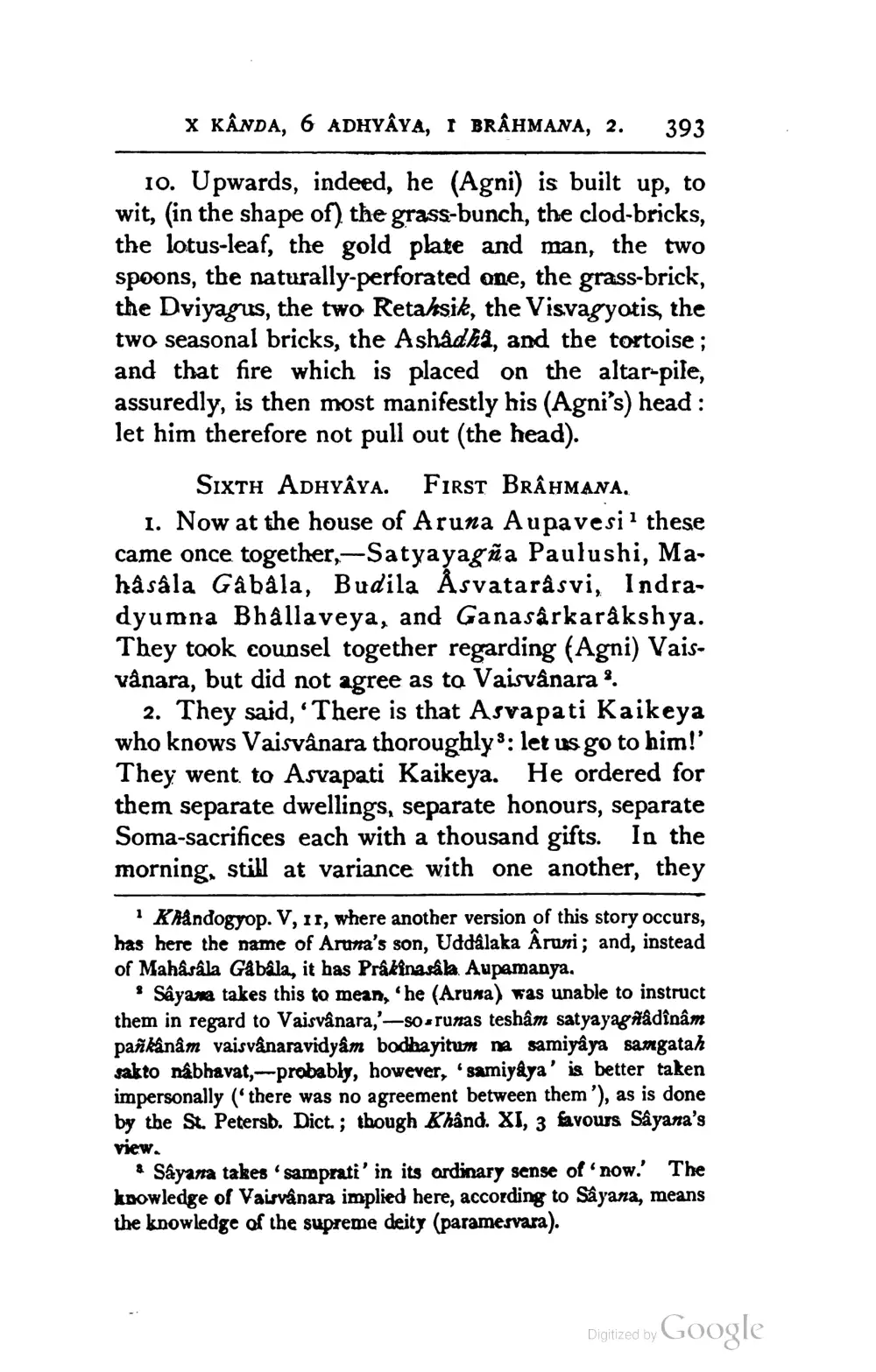
10:6:1:11. Now at the house of Aruna Aupavesi these came once together,--Satyayagña Paulushi, Mahâsâla Gâbâla, Budila Âsvatarâsvi, Indradyumna Bhâllaveya, and Ganasârkarâkshya. They took counsel together regarding (Agni) Vaisvânara, but did not agree as to Vaisvânara .
10:6:1:22. They said, 'There is that Asvapati Kaikeya who knows Vaisvânara thoroughly : let us go to him!' They went to Asvapati Kaikeya. He ordered for them separate dwellings, separate honours, separate Soma-sacrifices each with a thousand gifts. In the morning, still at variance with one another, they
came again to him, with fuel in their hands , saying, 'We want to become thy pupils.'
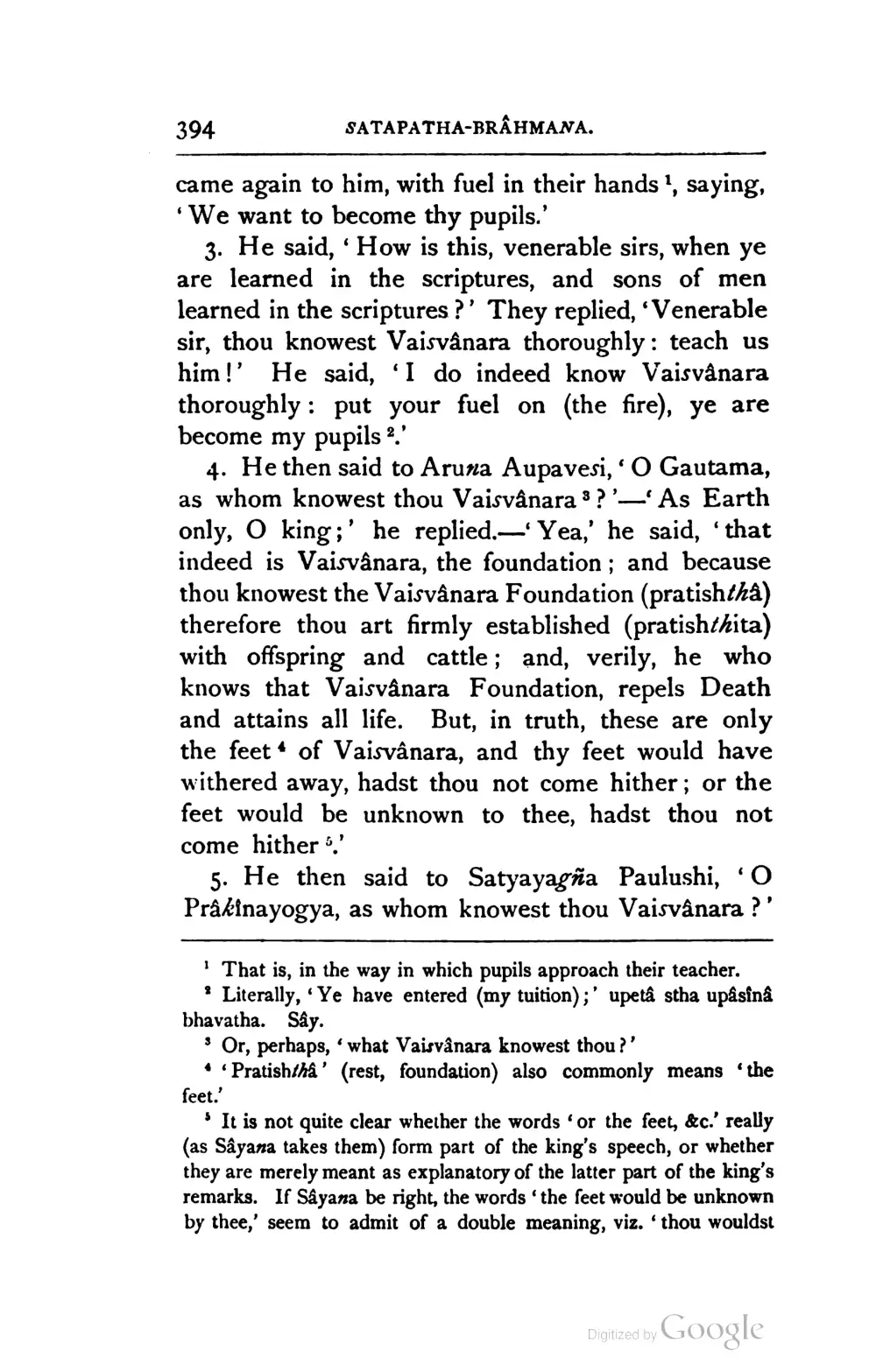
10:6:1:33. He said, 'How is this, venerable sirs, when ye are learned in the scriptures, and sons of men learned in the scriptures?' They replied, 'Venerable sir, thou knowest Vaisvânara thoroughly: teach us him!' He said, 'I do indeed know Vaisvânara thoroughly: put your fuel on (the fire), ye are become my pupils .'
10:6:1:44. He then said to Aruna Aupavesi, 'O Gautama, as whom knowest thou Vaisvânara ?'--'As Earth only, O king;' he replied.--'Yea,' he said, 'that indeed is Vaisvânara, the foundation; and because thou knowest the Vaisvânara Foundation (pratishthâ) therefore thou art firmly established (pratishthita) with offspring and cattle; and, verily, he who knows that Vaisvânara Foundation, repels Death and attains all life. But, in truth, these are only the feet of Vaisvânara, and thy feet would have withered away, hadst thou not come hither; or the feet would be unknown to thee, hadst thou not come hither .'
10:6:1:55. He then said to Satyayagña Paulushi, 'O Prâkînayogya, as whom knowest thou Vaisvânara?'
[paragraph continues] --'As Water only, O king;' he replied.--'Yea,' he said, 'that indeed is the Vaisvânara Wealth; and because thou knowest that Vaisvânara Wealth, therefore thou art wealthy and prosperous; and, verily, he who knows that Vaisvânara Wealth, repels death and attains all life. But, in truth, this is only the bladder of Vaisvânara, and thy bladder would have failed thee, hadst thou not come hither; or the bladder would be unknown to thee, hadst thou not come hither.'
No commentary for this page.