The Satapatha-Brâhmana, Part IV — SBE Vol. 43 — trans. Julius Eggeling (1897)
The translator’s English as printed (Julius Eggeling). The original-language text is not held; names are romanised as the translator printed them.
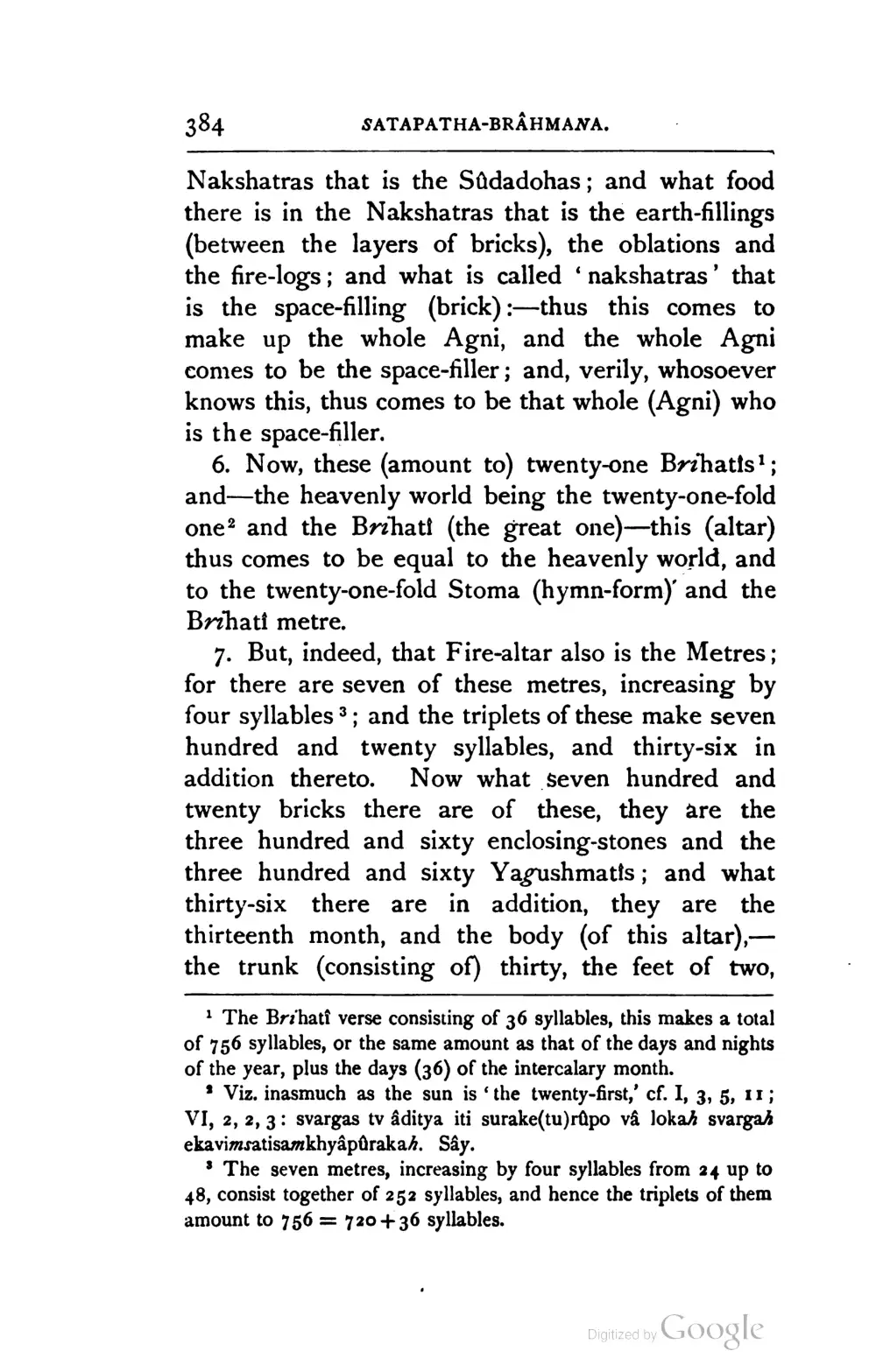
10:5:4:77. But, indeed, that Fire-altar also is the Metres; for there are seven of these metres, increasing by four syllables ; and the triplets of these make seven hundred and twenty syllables, and thirty-six in addition thereto. Now what seven hundred and twenty bricks there are of these, they are the three hundred and sixty enclosing-stones and the three hundred and sixty Yagushmatîs; and what thirty-six there are in addition, they are the thirteenth month, and the body (of this altar),--the trunk (consisting of) thirty, the feet of two, the vital airs of two, and the head itself being the (thirty-fifth and) thirty-sixth; and as to there being two of these, it is because 'siras' consists of two syllables.
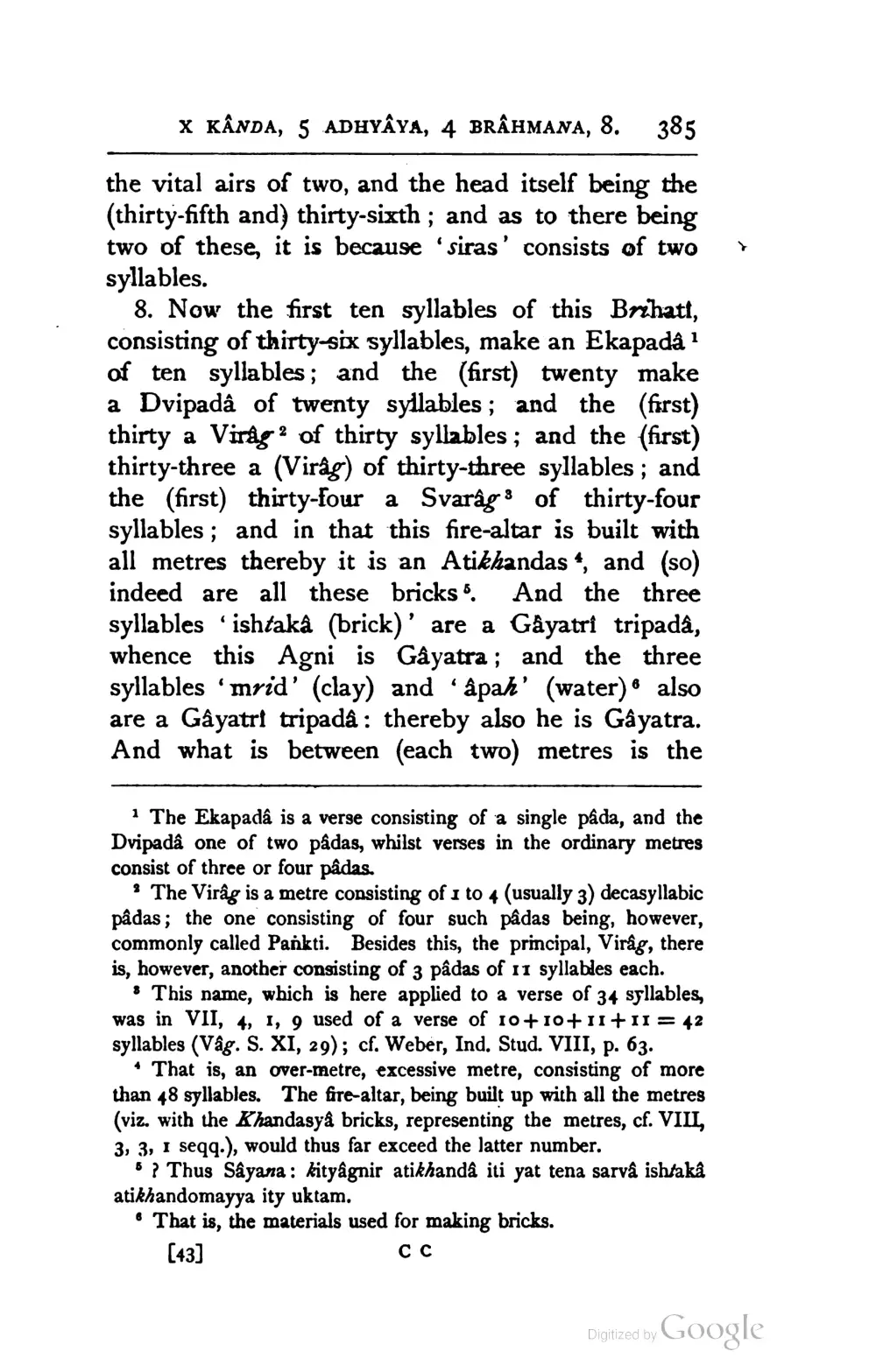
10:5:4:88. Now the first ten syllables of this Brihatî, consisting of thirty-six syllables, make an Ekapadâ of ten syllables; and the (first) twenty make a Dvipadâ of twenty syllables; and the (first) thirty a Virâg of thirty syllables; and the (first) thirty-three a (Virâg) of thirty-three syllables; and the (first) thirty-four a Svarâg of thirty-four syllables; and in that this fire-altar is built with all metres thereby it is an Atikhandas , and (so) indeed are all these bricks . And the three syllables 'ishtakâ (brick)' are a Gâyatrî tripadâ, whence this Agni is Gâyatra; and the three syllables 'mrid' (clay) and 'âpah' (water) also are a Gâyatrî tripadâ: thereby also he is Gâyatra. And what is between (each two) metres is the
[paragraph continues] Sûdadohas; and the food which is in the metres is the earth-fillings, the oblations, and the fire-logs; and what is called 'metres,' that is the space-filling (brick):--thus this comes to make up the whole Agni; and the whole Agni comes to be the space-filler; and, verily, whosoever knows this, comes to be that whole (Agni) who is the space-filler.
10:5:4:99. Now, these (amount to) twenty-one Brihatîs; and--the heavenly world being the twenty-one-fold and the Brihatî--this (altar) thus comes to be equal to the heavenly world, and to the twenty-one-fold Stoma and the Brihatî metre.
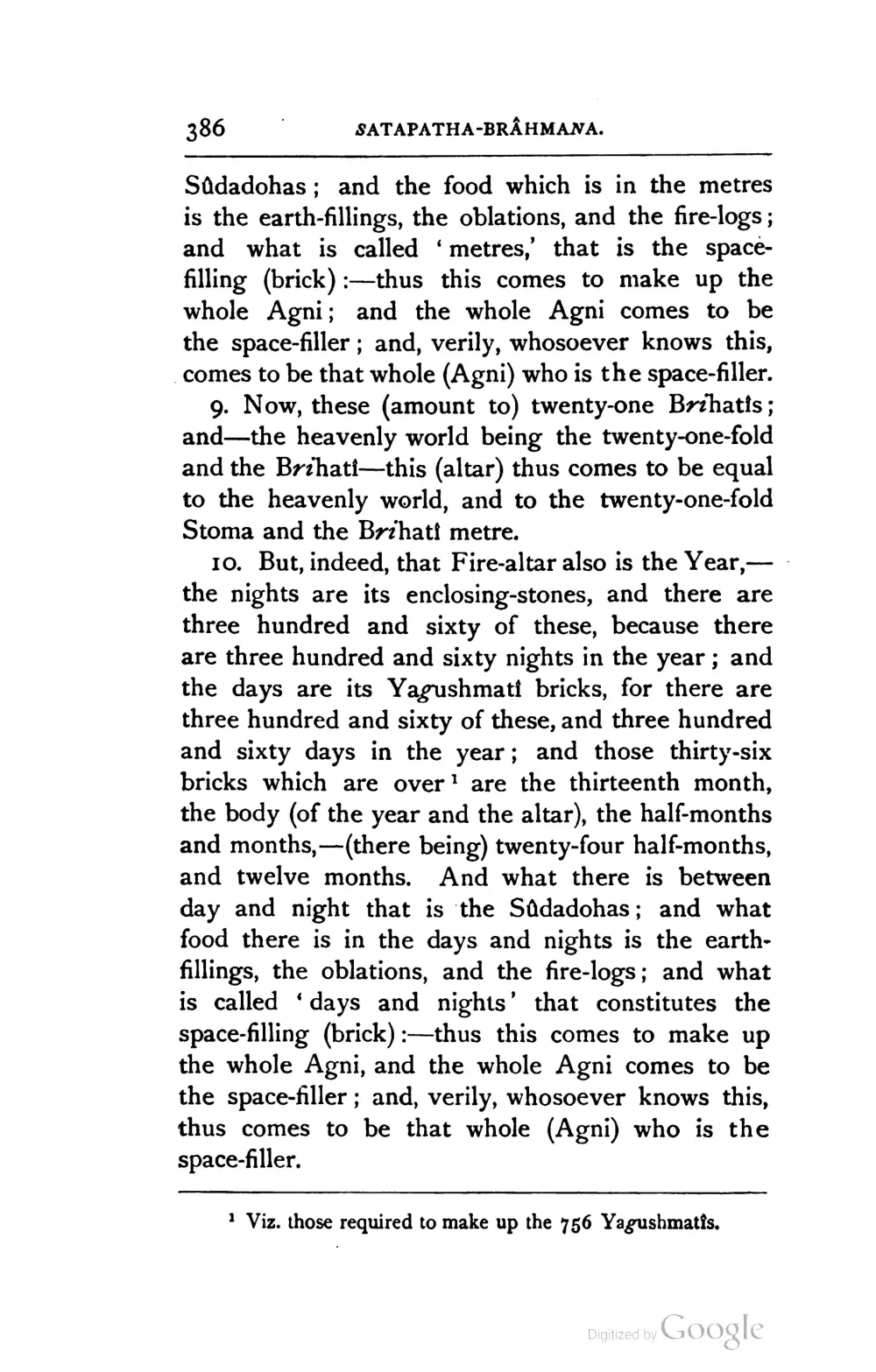
10:5:4:1010. But, indeed, that Fire-altar also is the Year,--the nights are its enclosing-stones, and there are three hundred and sixty of these, because there are three hundred and sixty nights in the year; and the days are its Yagushmatî bricks, for there are three hundred and sixty of these, and three hundred and sixty days in the year; and those thirty-six bricks which are over are the thirteenth month, the body (of the year and the altar), the half-months and months,--(there being) twenty-four half-months, and twelve months. And what there is between day and night that is the Sûdadohas; and what food there is in the days and nights is the earth-fillings, the oblations, and the fire-logs; and what is called 'days and nights' that constitutes the space-filling (brick):--thus this comes to make up the whole Agni, and the whole Agni comes to be the space-filler; and, verily, whosoever knows this, thus comes to be that whole (Agni) who is the space-filler.
10:5:4:1111. Now, these (amount to) twenty-one Brihatîs; and--the heavenly world being the twenty-one-fold and the Brihatî--this (altar) thus comes to be equal to the heavenly world, and to the twenty-one-fold Stoma and the Brihatî metre.
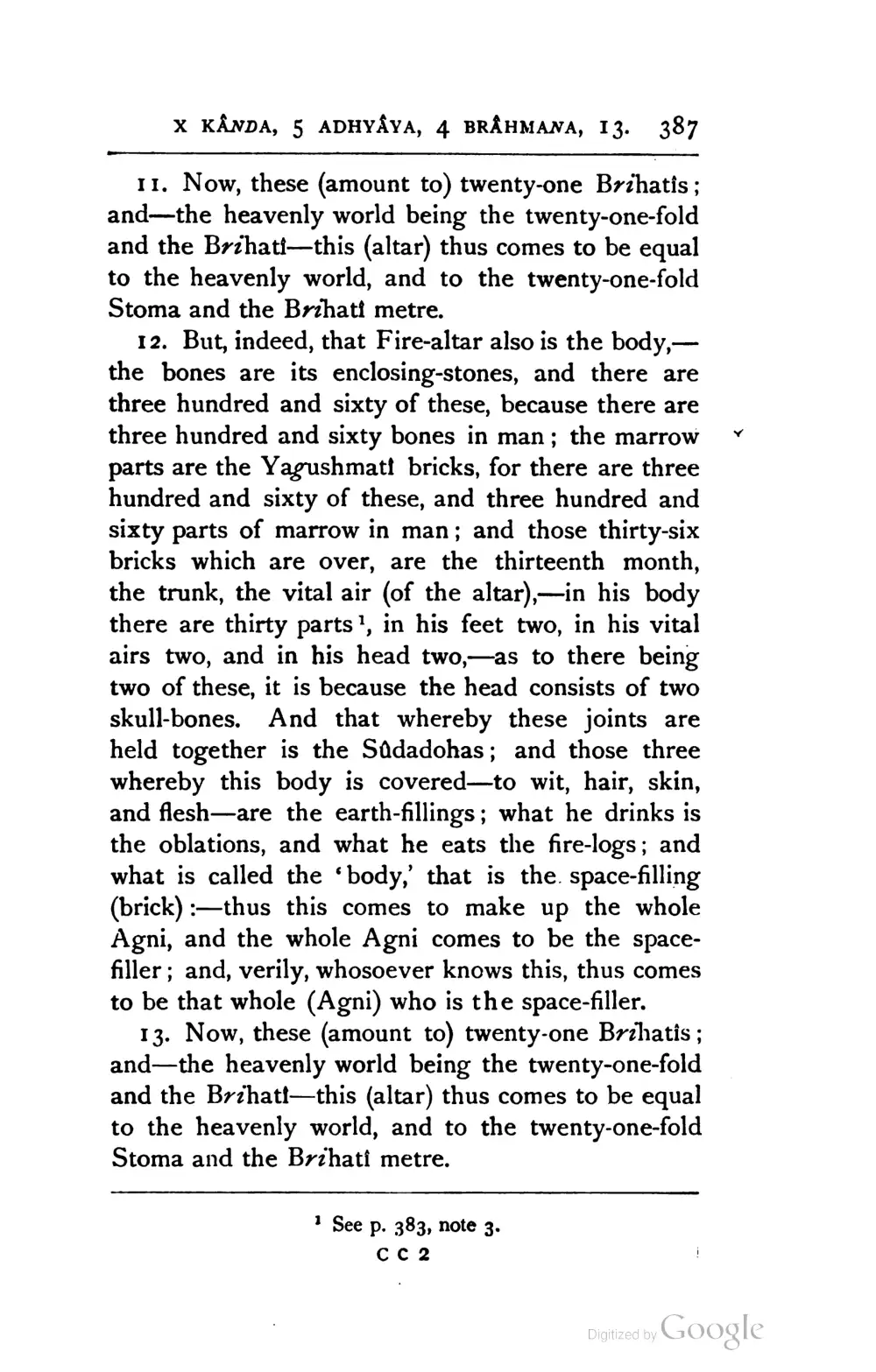
10:5:4:1212. But, indeed, that Fire-altar also-is the body,--the bones are its enclosing-stones, and there are three hundred and sixty of these, because there are three hundred and sixty bones in man; the marrow parts are the Yagushmatî bricks, for there are three hundred and sixty of these, and three hundred and sixty parts of marrow in man; and those thirty-six bricks which are over, are the thirteenth month, the trunk, the vital air (of the altar),--in his body there are thirty parts , in his feet two, in his vital airs two, and in his head two,--as to there being two of these, it is because the head consists of two skull-bones. And that whereby these joints are held together is the Sûdadohas; and those three whereby this body is covered--to wit, hair, skin, and flesh--are the earth-fillings; what he drinks is the oblations, and what he eats the fire-logs; and what is called the 'body,' that is the space-filling (brick):--thus this comes to make up the whole Agni, and the whole Agni comes to be the space-filler; and, verily, whosoever knows this, thus comes to be that whole (Agni) who is the space-filler.
10:5:4:1313. Now, these (amount to) twenty-one Brihatîs; and--the heavenly world being the twenty-one-fold and the Brihatî--this (altar) thus comes to be equal to the heavenly world, and to the twenty-one-fold Stoma and the Brihatî metre.
No commentary for this page.