The Satapatha-Brâhmana, Part IV — SBE Vol. 43 — trans. Julius Eggeling (1897)
The translator’s English as printed (Julius Eggeling). The original-language text is not held; names are romanised as the translator printed them.
5:1 For this and the other Prishtha-sâmans see part iii, introd. pp. xvi, xx seqq.
5:2 In Taitt. S. IV, 3, 2, 1, this formula is connected with the preceding one,--'from the Rathantara (was produced) the Rishi Vasishtha.' Similarly in the corresponding passages of the subsequent sets of bricks.
5:3 The sâdana, or settling, consists in the formula, 'By that deity, Aṅgiras-like, lie thou steady!' being pronounced over the bricks. See VI, 1, 2, 28.
5:4 For the sûdadohas verse, the pronunciation of which, together with the 'settling,' constitutes the two necessary (nitya) ceremonies, see part iii, p. 307.
6:1 Whilst standing on the right (south) side of the altar he lays down the third set of ten Prânabhritah, viz. those on the diagonal from the south-west corner (or right thigh) towards the centre. Whilst, in the actual performance, these bricks are only laid down after those referred to in paragraphs 1-3 of the next Brâhmana, the author, in his explanation of the formulas, follows the course of the sun from left to right.
6:2 For a similar combination of the south with the Trishtubh metre, the Brihat-sâman, the Pañkadasa-stoma, the summer season, and the Kshatra, see V, 4, 1, 4 (part iii, p. 91).
6:3 Svâra-sâman is called a chanted verse which has no special concluding nidhana, or finale, but in which the svarita (circumflex), or first rising then falling pitch (eg., f-g-f) of the final vowel, takes the place of the finale; whence 'svâra' is often explained by 'svaranidhana,' i.e. having the svara (svarita) for its nidhana. See Pañk. Br. IX, 3, 11, where a svâra-sâman is prescribed in case the Udgâtris have previously committed an excess in their chanting. The last tristich of the Mâdhyandina-pavamânastotra of the Agnishtoma, the Ausana-sâman (to Sâma-v., vol. ii, pp. 27-29), is chanted in this way, probably in order to make good the excess committed in the preceding triplet, the Yaudhâgaya (ii, pp. 25, 26), in which each verse is chanted with three nidhanas, one at the end, and two inserted inside the sâman. Lâty. Srautas. VI, 9, 6, the svâra-sâmans thus treated are called 'padânusvârâni;' whilst those with which the musical syllables 'hâ-i' are used with a similar effect, are called 'hâikârasvârâni.' As an instance of the former, the Ausana (Sâma-v., vol. iii, p. 8r) is adduced, and of the latter the Vâmadevya (iii, p. 89). It is not only the final syllable of a sâman, however, that may be modulated in this way, but also that of a musical section of the sâman; cf. Pañk. Br. X, 12, 2, where the Udgîtha is to be so treated to make up for the preceding Prastâva, chanted without a Stobha. Sacrificial calls such as the 'Svâhâ' and 'Vashat' are also modulated in this way,' ib. VII, 3, 26; XI, 5, 26.
8:1:2
SECOND BRÂHMANA.
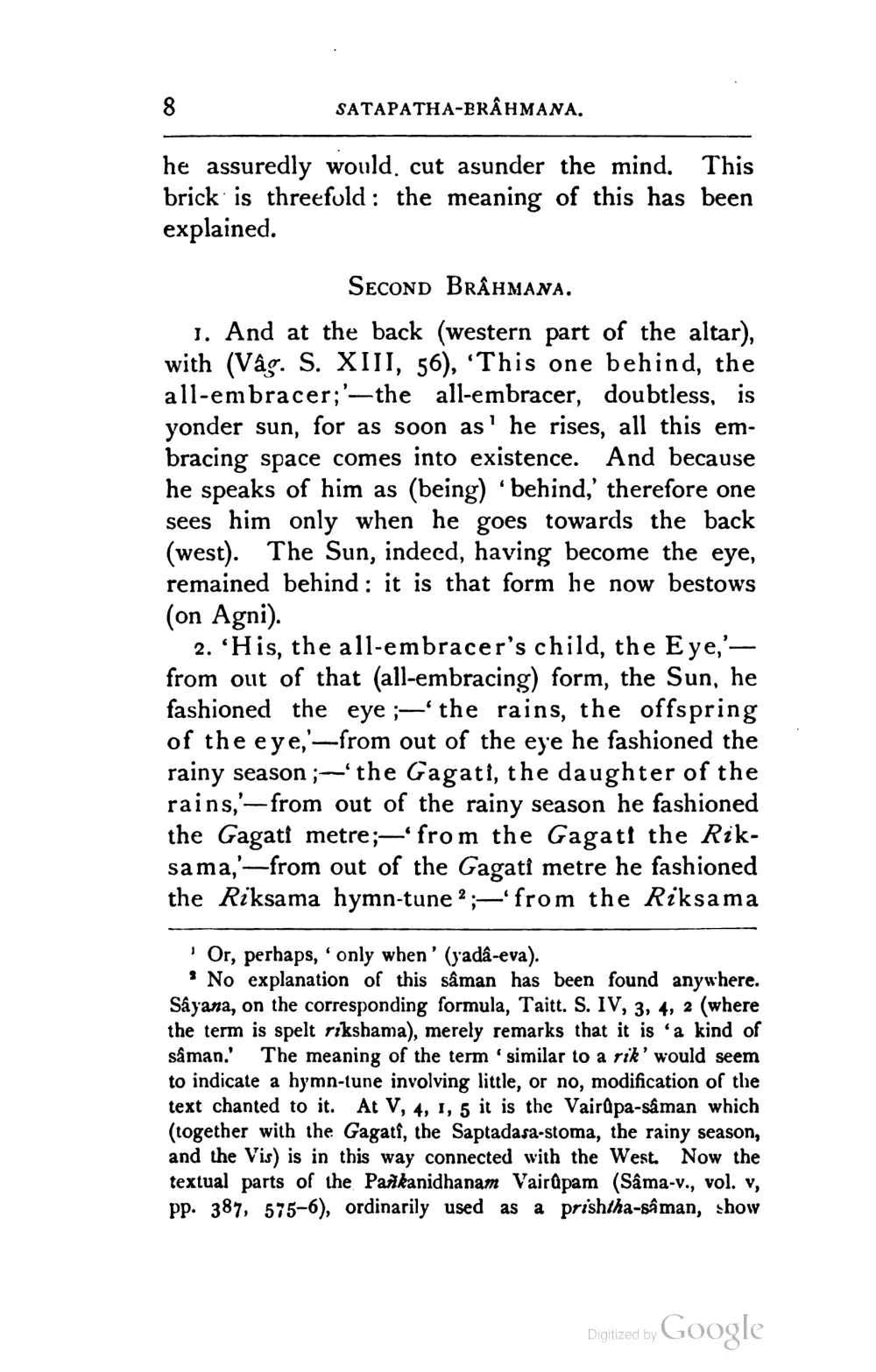
8:1:2:11. And at the back (western part of the altar), with (Vâg. S. XIII, 56), 'This one behind, the all-embracer;'--the all-embracer, doubtless, is yonder sun, for as soon as he rises, all this embracing space comes into existence. And because he speaks of him as (being) 'behind,' therefore one sees him only when he goes towards the back (west). The Sun, indeed, having become the eye, remained behind: it is that form he now bestows (on Agni).
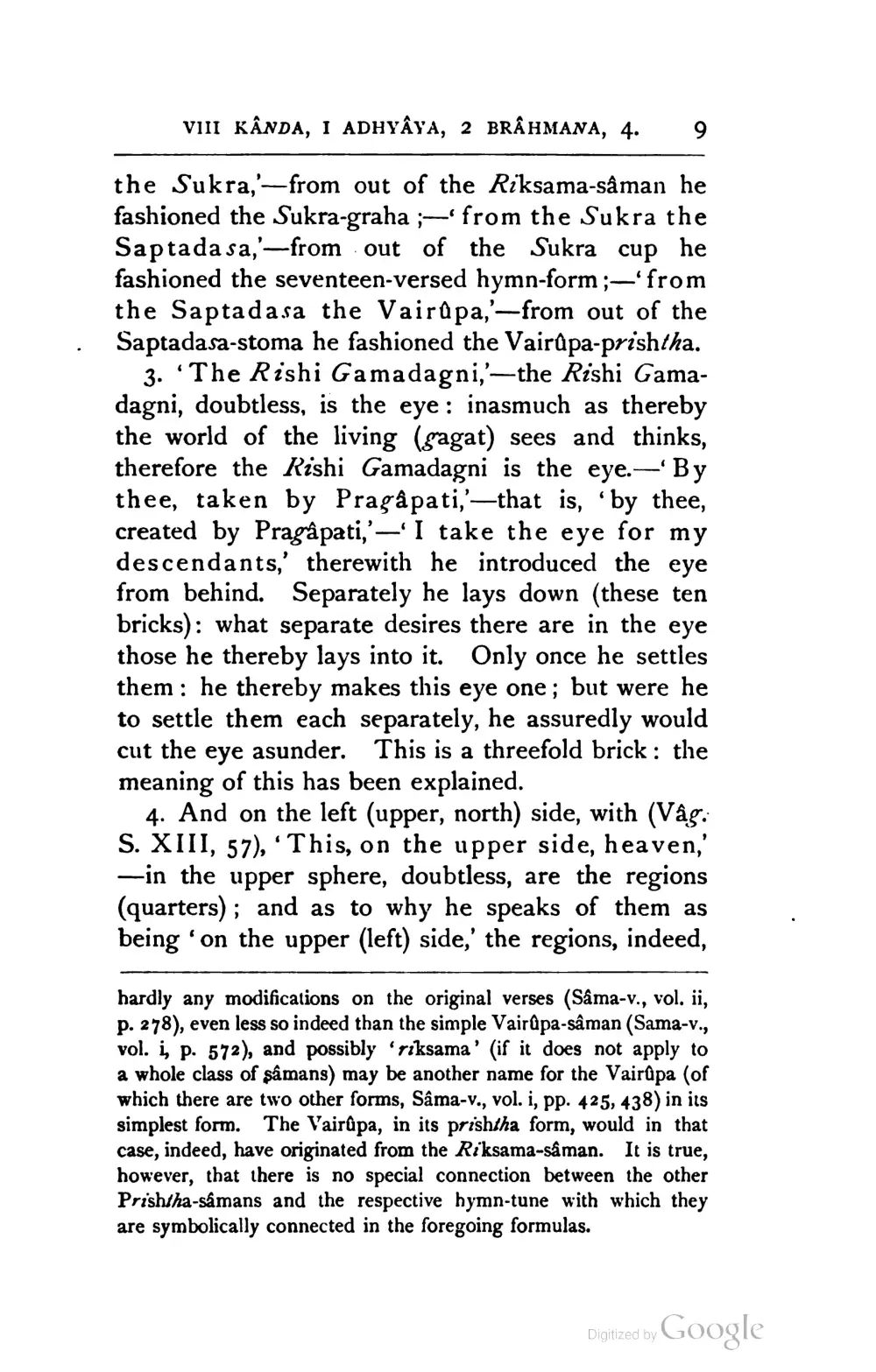
8:1:2:22. 'His, the all-embracer's child, the Eye,'--from out of that (all-embracing) form, the Sun, he fashioned the eye;--'the rains, the offspring of the eye,'--from out of the eye he fashioned the rainy season;--'the Gagatî, the daughter of the rains,'--from out of the rainy season he fashioned the Gagatî metre;--'from the Gagatî the Riksama,'--from out of the Gagatî metre he fashioned the Riksama hymn-tune ;--'from the Riksama the Sukra,'--from out of the Riksama-sâman he fashioned the Sukra-graha;--'from the Sukra the Saptadasa,'--from out of the Sukra cup he fashioned the seventeen-versed hymn-form;--'from the Saptadasa the Vairûpa,'--from out of the Saptadasa-stoma he fashioned the Vairûpa-prishtha.
No commentary for this page.