Legge defends “evil” for 祥 against those who gave “felicity”, appealing to the Khang-hsî dictionary. The chapter bears him out: the next line calls false the strength made when the mind drives the vital breath, and paragraph 4 says that things grown strong “they (then) become old”, which is “contrary to the Tao”. A version that called life-increasing arts a felicity would make the stanza contradict the paragraph that follows it.
The Tâo Teh King — Sacred Books of China Part I, SBE Vol. 39 (trans. James Legge, 1891)
Open to all
page 99
No image is selected for this page; its own page image is shown.
page 99
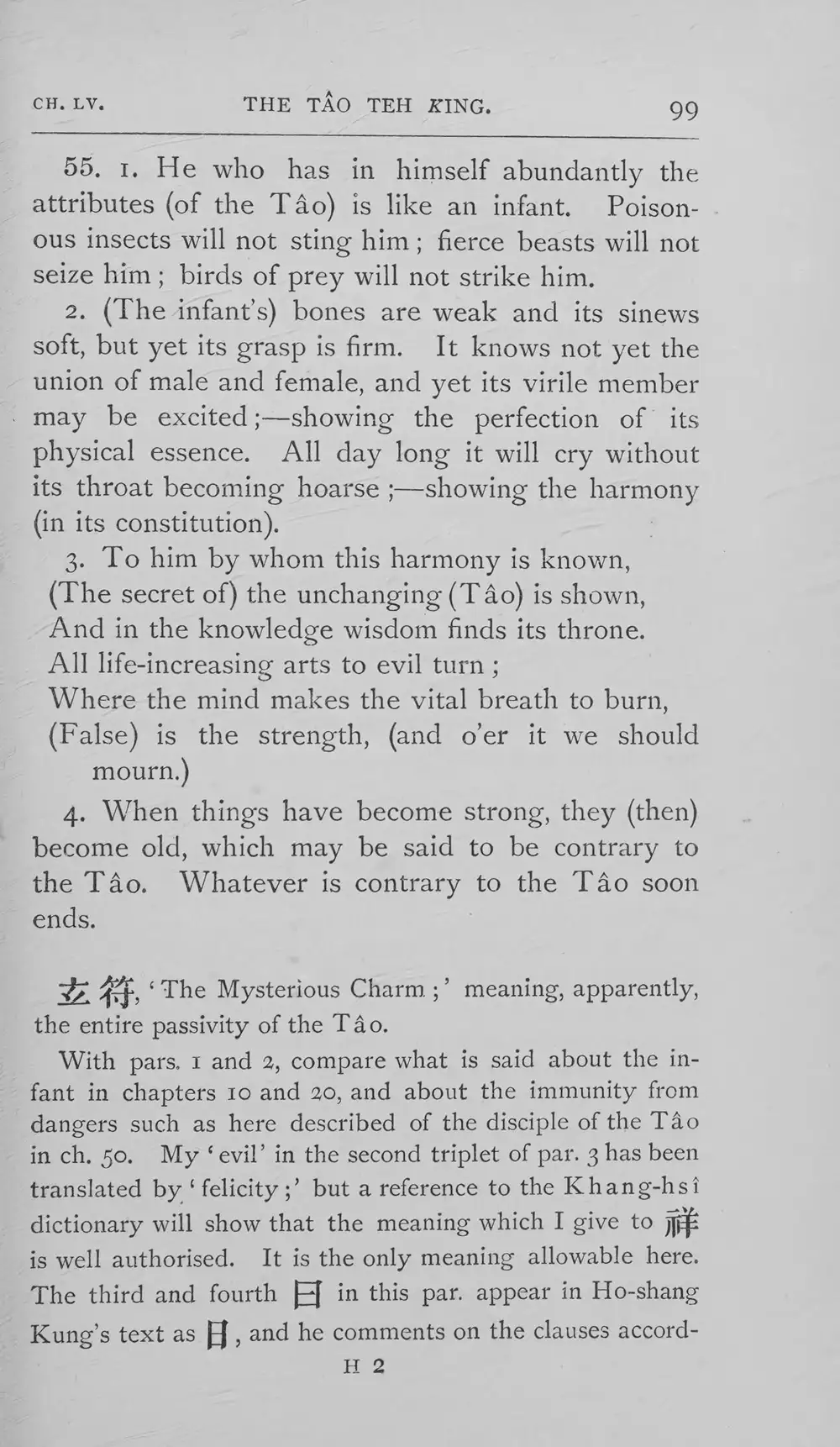
55. 1. He who has the attributes (of the Tâo) in abundance is like an infant. Poisonous insects will not sting him; fierce beasts will not seize him; birds of prey will not strike him.
2. (The infant’s) bones are weak and its sinews soft, yet its grasp is firm. It does not yet know the union of male and female, and yet its virile member may be excited;—showing the perfection of its physical essence. All day long it will cry without its throat becoming hoarse;—showing the harmony (in its constitution).
3. To him by whom this harmony is known, (The secret of) the unchanging (Tâo) is shown, And in the knowledge wisdom finds its throne. All life-increasing arts turn to evil; Where the mind makes the vital breath burn, (False) is the strength, (and over it we should mourn.)
4. When things have become strong, they (then) become old, which may be said to be contrary to the Tâo. Whatever is contrary to the Tâo soon ends.
玄符, ‘The Mysterious Charm;’ meaning, apparently, the entire passivity of the Tâo.
With pars. 1 and 2, compare what is said about the infant in chapters 10 and 20, and, in ch. 50, about the immunity of the disciple of the Tâo from dangers such as those described here. My ‘evil’ in the second triplet of par. 3 has been translated by ‘felicity;’ but a reference to the Khang-hsî dictionary will show that the meaning I give to 祥 [Press: an omen (lucky or unlucky); felicity] is well authorised. It is the only meaning allowable here.
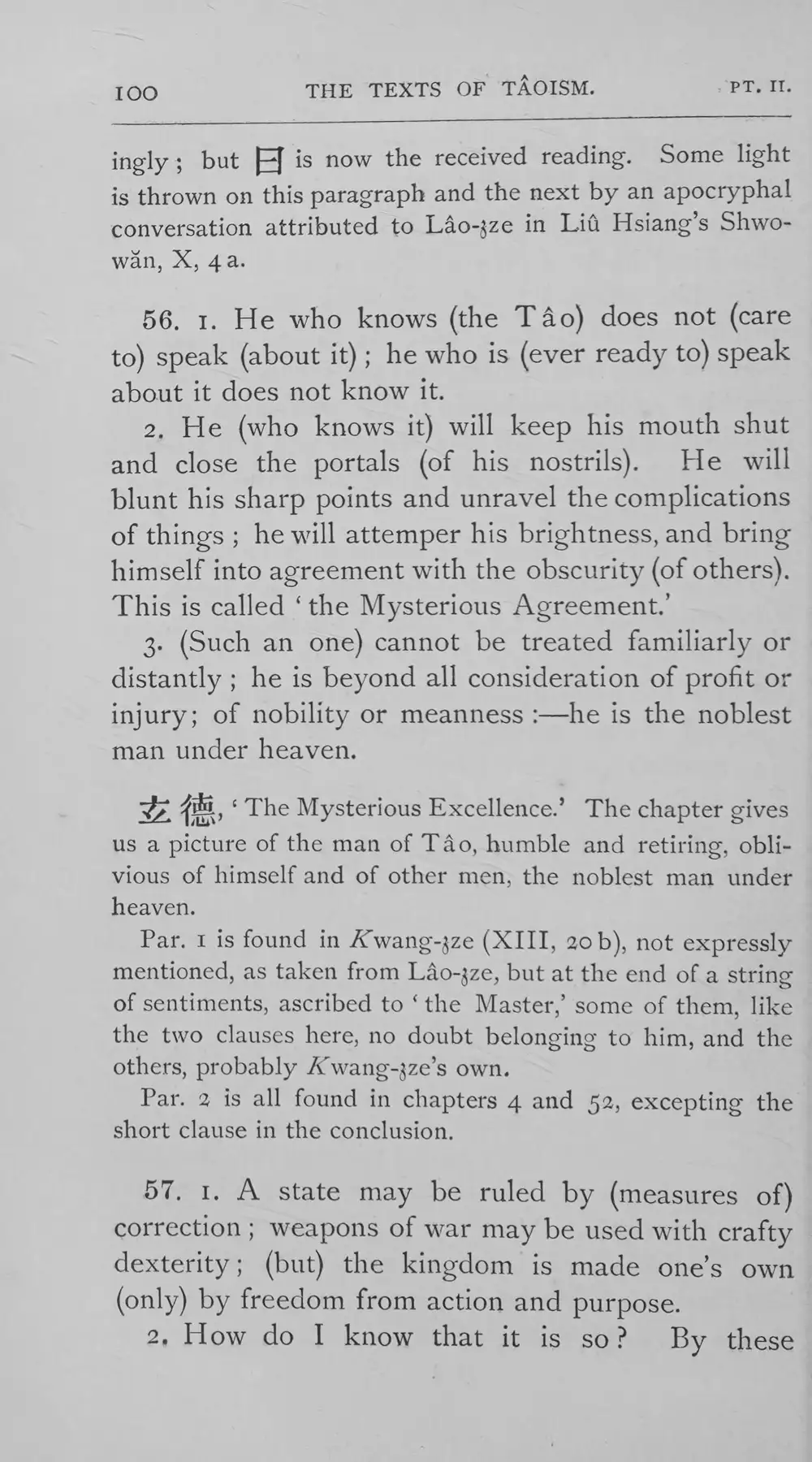
The third and fourth 曰 [Press: to say; is called] in this paragraph appear in Ho-shang Kung’s text as 日 [Press: the sun; day], and he comments on the clauses accordingly; but 曰 [Press: is called; to say] is now the received reading. Some light is thrown on this paragraph and the next by an apocryphal conversation attributed to Lâo-ȝze in Liû Hsiang’s Shwo-wan, X, 4a.