Legge takes “the sharp implements” of paragraph 2 not as weapons but as things “to add to their profit”, the secondary sense of 利. At chapter 81 he takes the same character in its primary sense, “sharpness”, against every translator before him. Both choices are argued from context, but one character has been turned two ways, and the “weapons of war” in the first paragraph here make the primary sense at least as natural.
The Tâo Teh King — Sacred Books of China Part I, SBE Vol. 39 (trans. James Legge, 1891)
Open to all
page 101
No image is selected for this page; its own page image is shown.
page 101
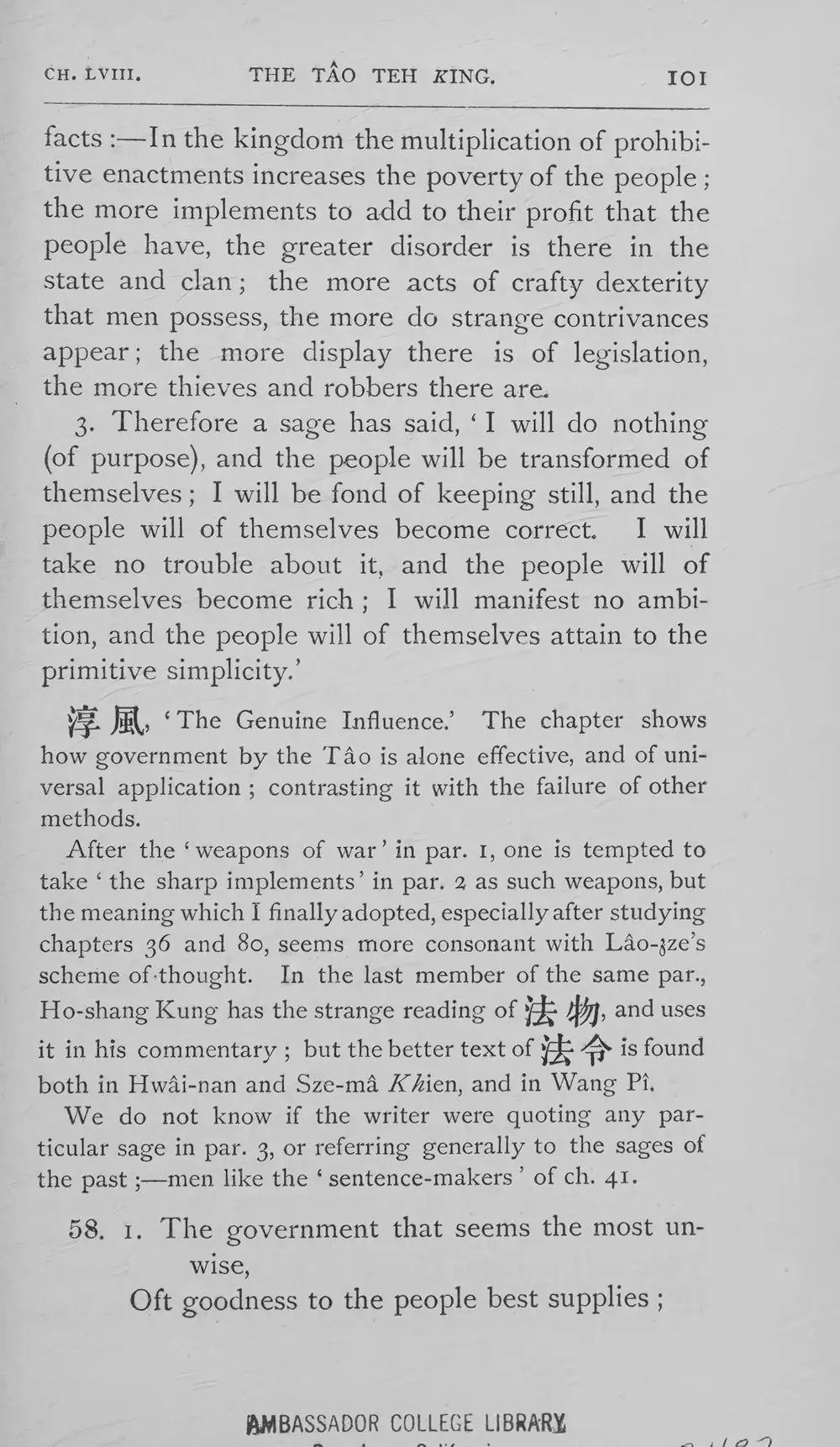
3. Therefore a sage has said, ‘I will do nothing (of purpose), and the people will be transformed of themselves; I will be fond of keeping still, and the people will of themselves become correct. I will take no trouble about it, and the people will of themselves become rich; I will show no ambition, and the people will of themselves attain to primitive simplicity.’
淳風, ‘The Genuine Influence.’ The chapter shows how government by the Tâo alone is effective and of universal application, contrasting it with the failure of other methods.
After the ‘weapons of war’ in par. 1, one is tempted to take ‘the sharp implements’ in par. 2 as such weapons, but the meaning I finally adopted, especially after studying chapters 36 and 80, seems more consonant with Lâo-ȝze’s scheme of thought. In the last member of the same paragraph, Ho-shang Kung has the strange reading 法物 [Press: fine, prized things], and uses it in his commentary; but the better text, 法令 [Press: laws and ordinances], is found both in Hwâi-nan and Sze-ma Kien, and in Wang Pî.
We do not know whether the writer was quoting any particular sage in par. 3, or referring generally to the sages of the past;—men like the ‘sentence-makers’ of ch. 41.
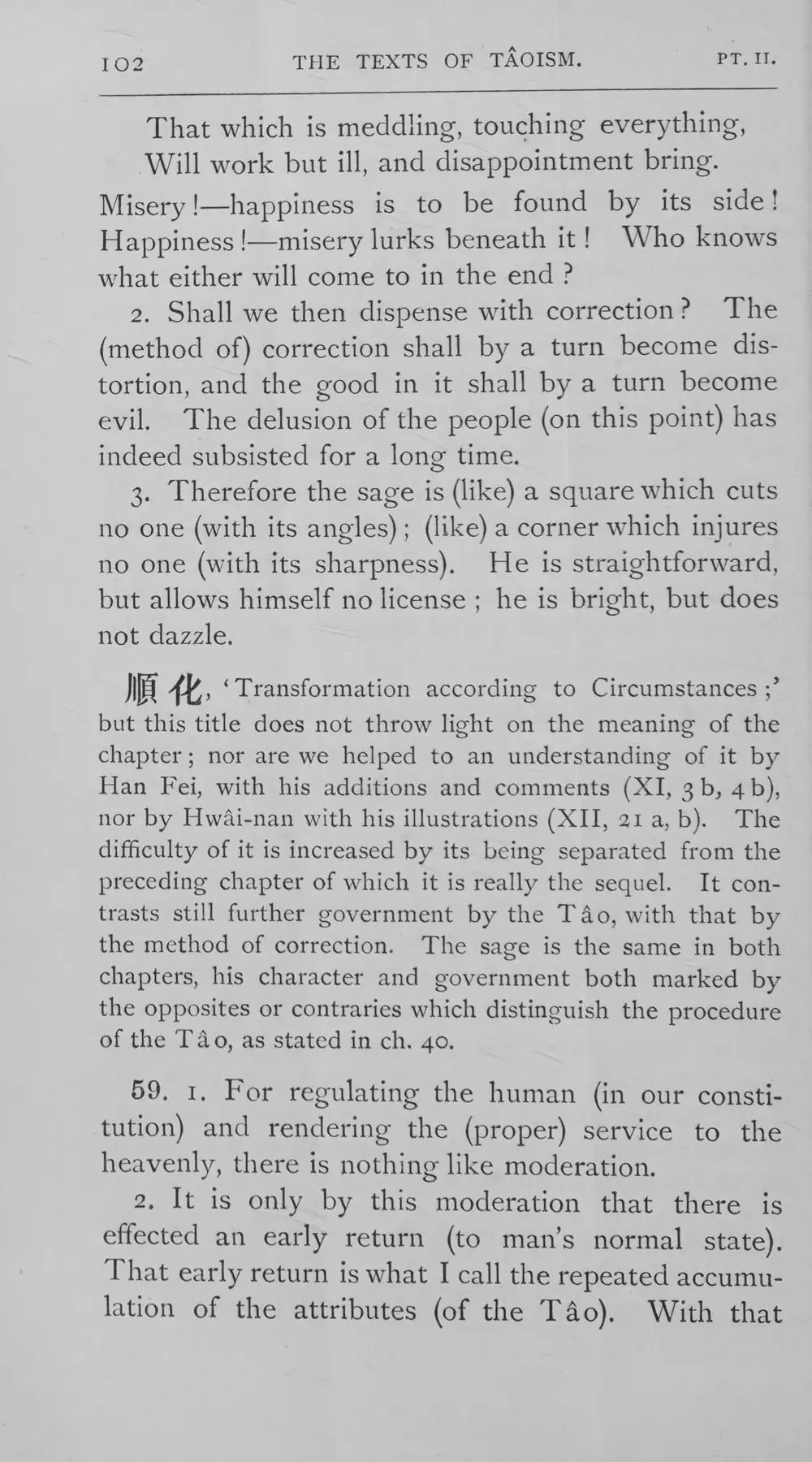
58. 1. The government that seems the most unwise Often best supplies goodness to the people; That which is meddling, touching everything, Will work but ill, and bring disappointment. Misery!—happiness is to be found by its side! Happiness!—misery lurks beneath it! Who knows what either will come to in the end?