Legge sends the reader to the Shû King for Hwan Tau, the Three Miâo and the Minister of Works, and settles a discrepancy on the way: the Shû gives the banishments to Shun, Kwang-ȝze to Yâo. His answer, that Shun acted as viceroy while Yâo still lived, makes both true. It is a harmonising reading, and it suits the argument here, which needs the punishments laid at the door of the sage-ruler whose benevolence provoked them.
The Tâo Teh King — Sacred Books of China Part I, SBE Vol. 39 (trans. James Legge, 1891)
Open to all
page 295
No image is selected for this page; its own page image is shown.
page 295
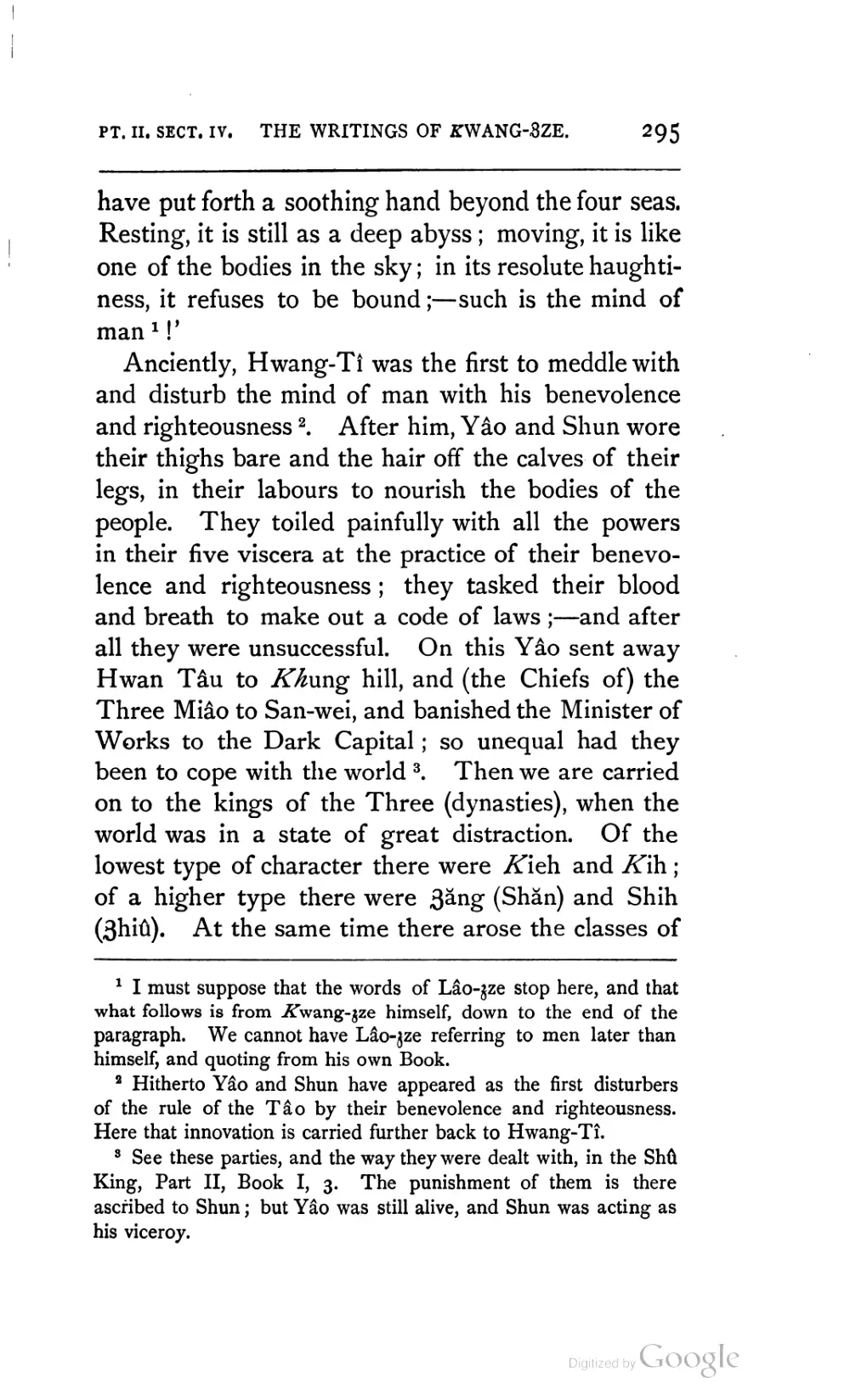
In ancient times Hwang-Ti was the first to meddle with and disturb the minds of men with his benevolence and righteousness2. After him, Yao and Shun wore their thighs bare and the hair off the calves of their legs in their labours to nourish the bodies of the people. They toiled painfully, with all the powers of their five viscera, at the practice of their benevolence and righteousness; they taxed their blood and breath to frame a code of laws;—and after all they did not succeed. Then Yao sent Hwan Tau away to Khung hill, and (the Chiefs of) the Three Miâo to San-wei, and banished the Minister of Works to the Dark Capital; so unequal had they been to coping with the world3. Then we come down to the kings of the Three (dynasties), when the world was in a state of great distraction. Of the lowest type of character there were Kieh and Kih; of a higher type there were Ȝăng (Shăn) and Shih (Ȝhiû). At the same time there arose the classes of the Literati and the Mohists.
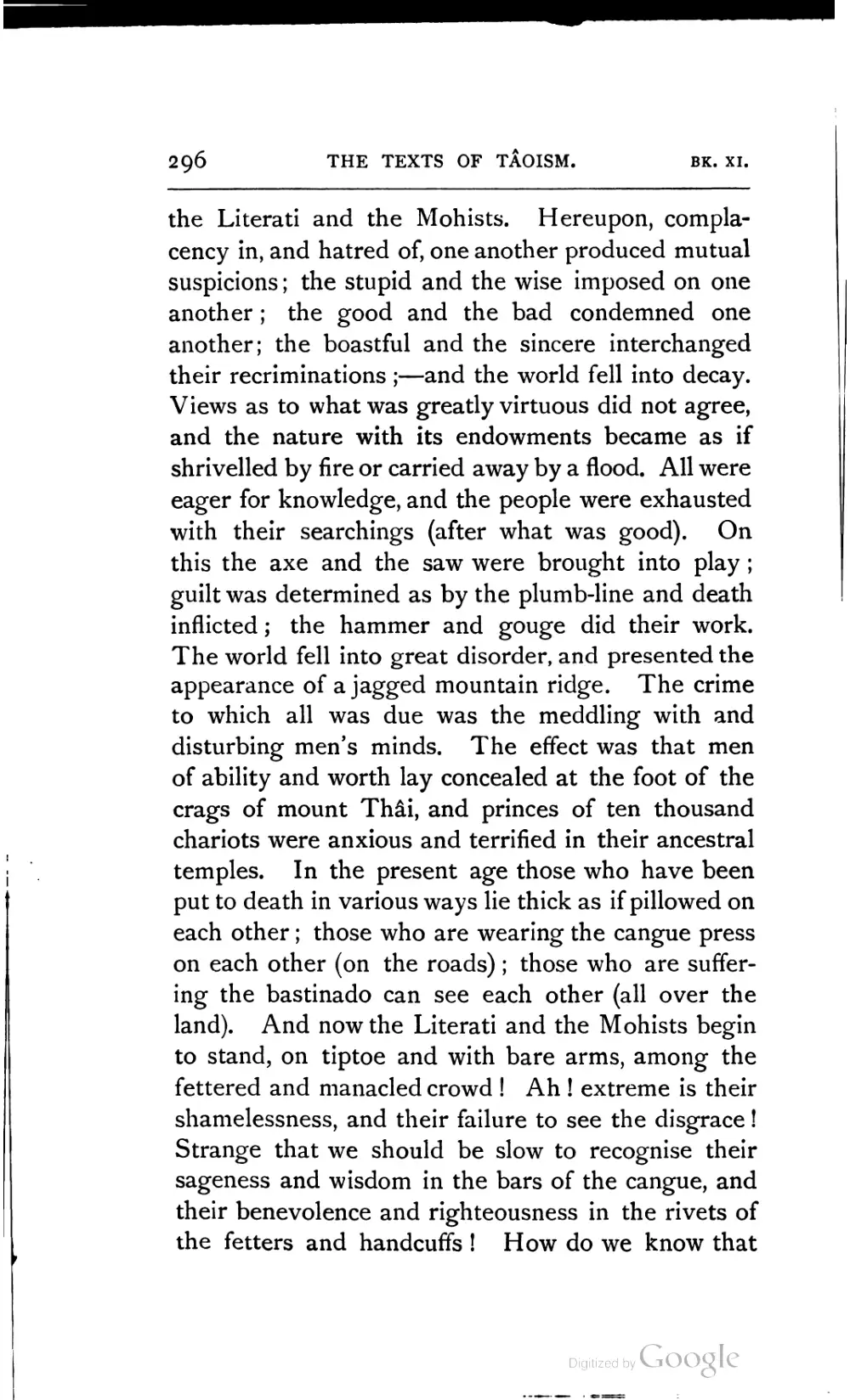
Thereupon self-satisfaction and hatred of one another produced mutual suspicion; the stupid and the wise imposed on each other; the good and the bad condemned each other; the boastful and the sincere traded recriminations;—and the world fell into decay. There was no agreement about what was greatly virtuous, and human nature with its endowments became as if scorched by fire or swept away by a flood. All were eager for knowledge, and the people were worn out with their searchings (after what was good). Then the axe and the saw were brought into play; guilt was settled as if by the plumb-line, and death was inflicted; the hammer and the gouge did their work. The world fell into great disorder, and looked like a jagged mountain ridge. The crime behind it all was the meddling with and disturbing of men’s minds. The result was that men of ability and worth lay hidden at the foot of the crags of mount Thai, and princes of ten thousand chariots were anxious and afraid in their ancestral temples.
In the present age those who have been put to death in various ways lie so thick that they seem pillowed on each other; those wearing the cangue press on each other (on the roads); those suffering the bastinado are in sight of each other (all over the land). And now the Literati and the Mohists begin to stand on tiptoe, with bare arms, among the fettered and manacled crowd! Ah! extreme is their shamelessness, and their failure to see the disgrace! Strange that we should be slow to recognise their sageness and wisdom in the bars of the cangue, and their benevolence and righteousness in the rivets of the fetters and handcuffs! How do we know that
1 I must suppose that the words of Lâo-ȝze stop here, and that what follows, down to the end of the paragraph, is from Kwang-ȝze himself. We cannot have Lâo-ȝze referring to men later than himself, and quoting from his own Book.
2 Until now Yao and Shun have appeared as the first disturbers of the rule of the Tâo by their benevolence and righteousness. Here that innovation is carried further back, to Hwang-Tî.
8 See these parties, and the way they were dealt with, in the Shû King, Part II, Book I, 3. The punishment of them is there ascribed to Shun; but Yao was still alive, and Shun was acting as his viceroy.
Legge ends Lâo-ȝze's speech before this passage because what follows names the Literati and the Mohists and closes with a quotation from the Tâo Teh King, and ‘We cannot have Lâo-ȝze referring to men later than himself’. The cut is consistent, but the criterion is chronology, not the text: nothing on the page marks a change of speaker. If, as the commentator Legge quotes on p. 302 says, the author frames his speakers to suit his purpose, the anachronism is part of the method rather than a seam to repair.