The Book opens by calling the webbed toe and the extra finger ‘more than is good for use,’ and this paragraph ends by forbidding their removal: what is long should not be cut, what is short not lengthened. The two positions are consistent once the target is seen. The excess condemned is the cultivated one, the added faculty of sight, hearing or debate; the remedy refused is amputation, which would be one more act of correction.
The Tâo Teh King — Sacred Books of China Part I, SBE Vol. 39 (trans. James Legge, 1891)
Open to all
page 270
No image is selected for this page; its own page image is shown.
page 270
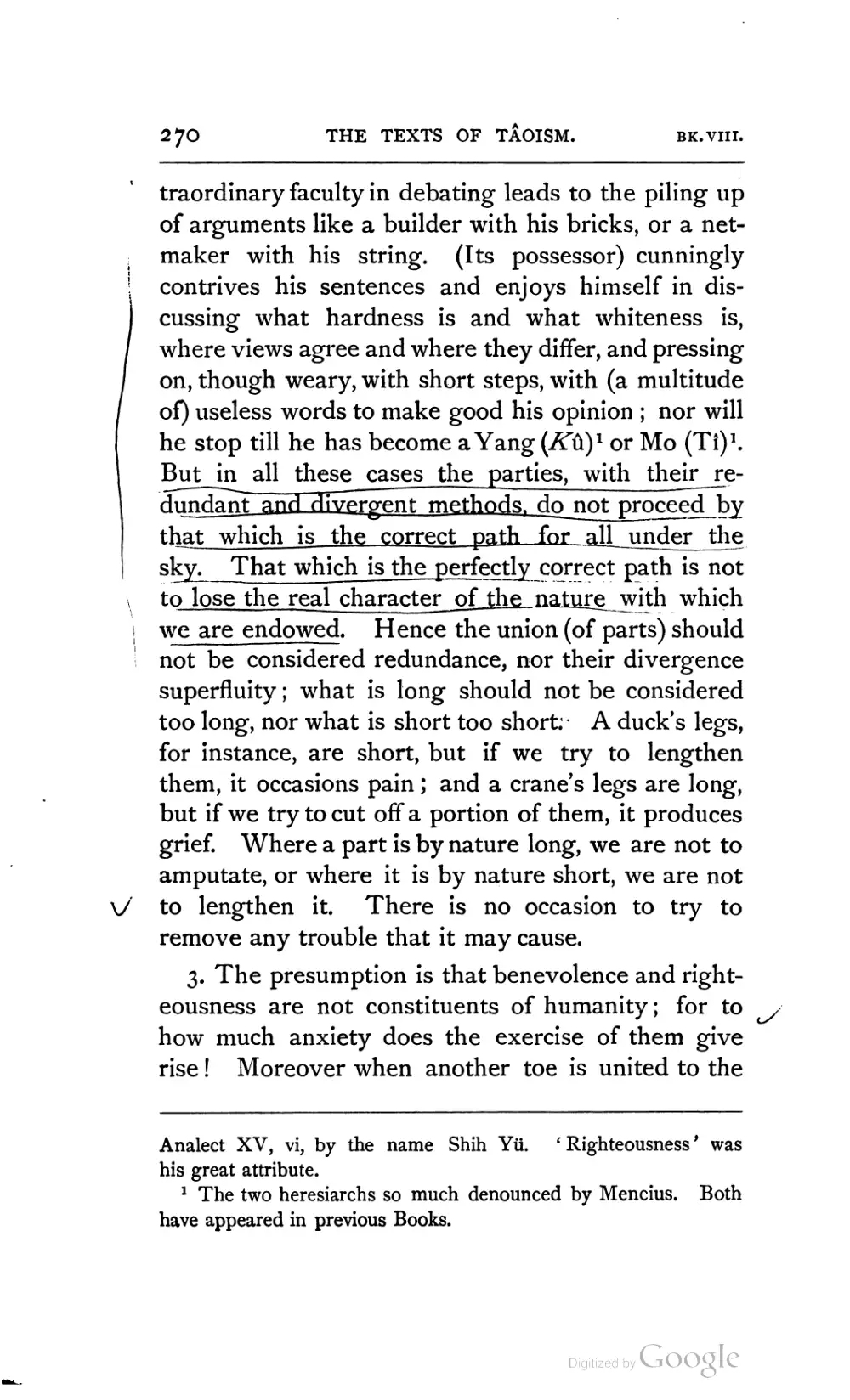
traordinary faculty in debating leads to the piling up of arguments, like a builder with his bricks or a net-maker with his string. (Its possessor) cunningly contrives his sentences and amuses himself discussing what hardness is and what whiteness is, where views agree and where they differ, pressing on, though weary, with short steps and (a multitude of) useless words to make good his opinion; nor will he stop until he has become a Yang (Kû) or a Mo (Ti)1. But in all these cases the parties, with their redundant and divergent methods, do not proceed by the path that is correct for all under the sky.
The perfectly correct path is not to lose the real character of the nature with which we are endowed. Hence the union (of parts) should not be considered redundancy, nor their divergence superfluity; what is long should not be considered too long, nor what is short too short. A duck’s legs, for instance, are short, but if we try to lengthen them, it causes pain; and a crane’s legs are long, but if we try to cut off a portion of them, it causes grief. Where a part is by nature long, we are not to amputate it; where it is by nature short, we are not to lengthen it. There is no occasion to try to remove any trouble that it may cause.
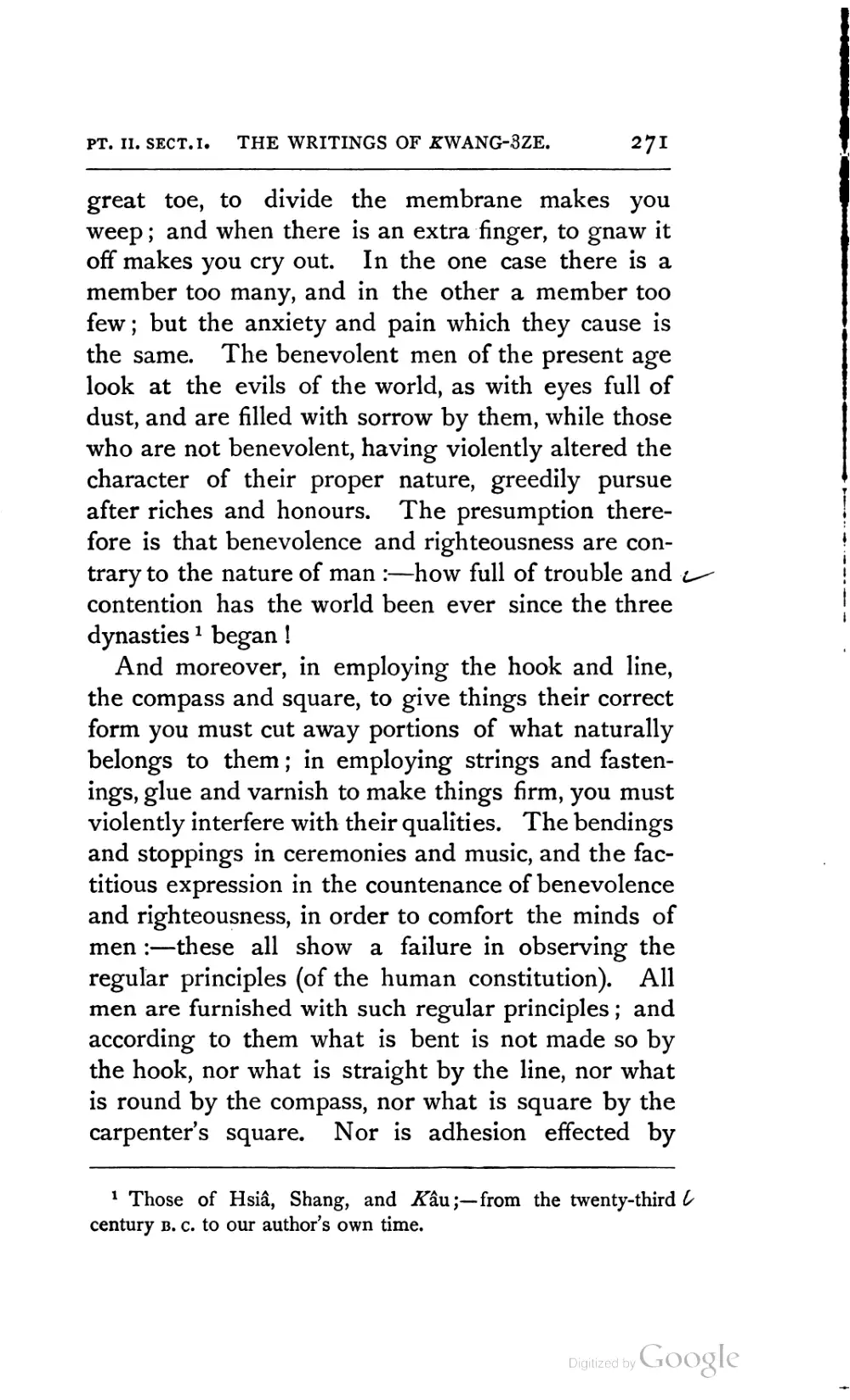
3. The presumption is that benevolence and righteousness are not constituents of humanity; for how much anxiety their exercise gives rise to! Moreover, when another toe is united to the great toe, to divide the membrane makes you weep; and when there is an extra finger, to gnaw it off makes you cry out. In the one case there is a member too many, and in the other a member too few; but the anxiety and pain they cause are the same.
The benevolent men of the present age look at the evils of the world as if with eyes full of dust, and are filled with sorrow by them, while those who are not benevolent, having violently altered the character of their proper nature, greedily pursue riches and honours. The presumption therefore is that benevolence and righteousness are contrary to the nature of man:—how full of trouble and contention the world has been ever since the three dynasties1 began!
1 The two heresiarchs so much denounced by Mencius. Both have appeared in previous Books.
Legge calls Yang and Mo ‘the two heresiarchs so much denounced by Mencius,’ a word from church history that takes Mencius’s side. The author’s own treatment differs: he ranks them with the Confucian disciples Ȝăng and Shih as men of excess, not as deviants from an orthodoxy (p. 287 gags all four together). The note imports a frame of heresy that a text rejecting all the schools alike does not share.