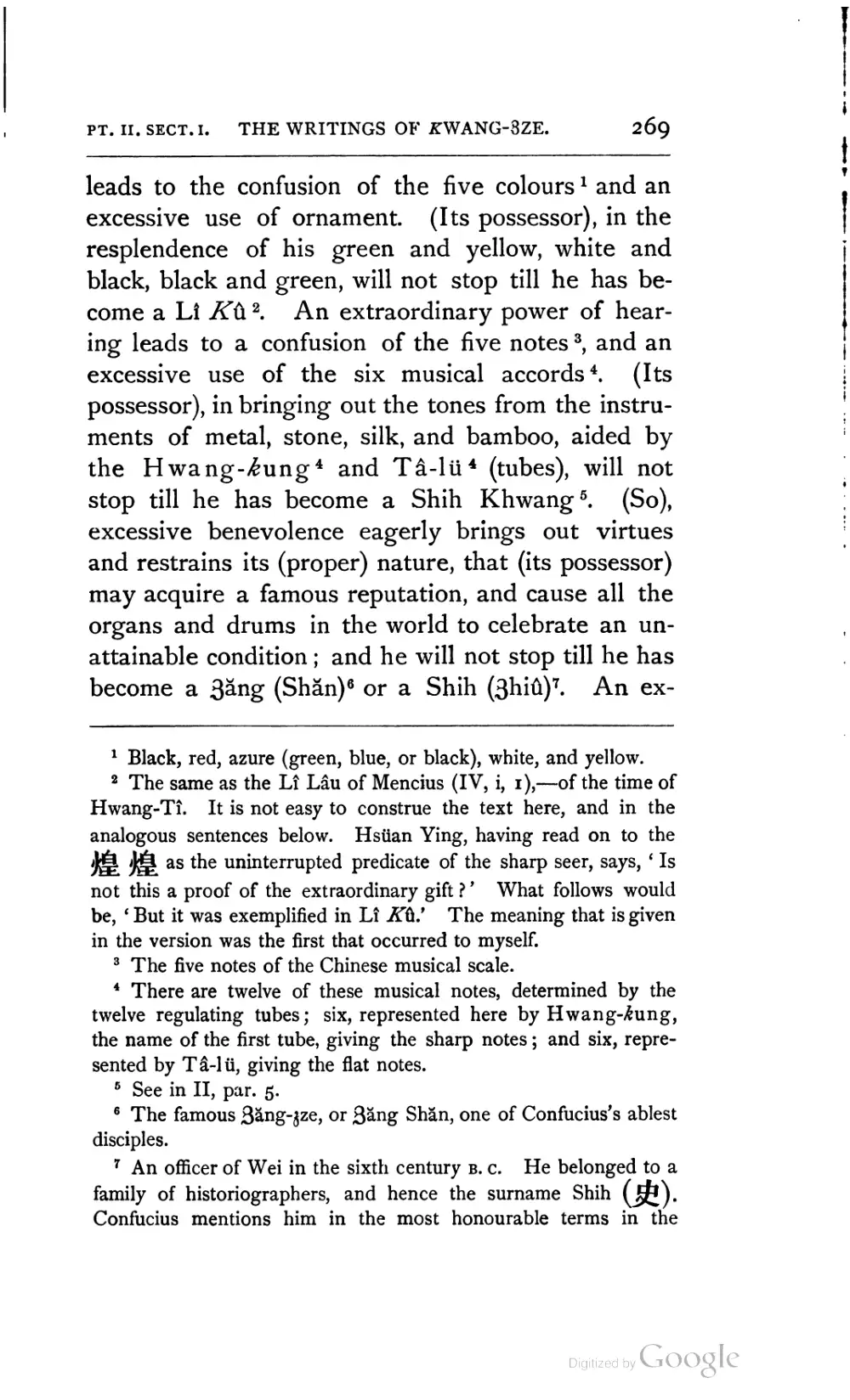
Legge is candid about the Li Kû sentence: Hsüan Ying reads the colours as a predicate proving the sharp-sighted man’s gift, and Legge admits his own version ‘was the first that occurred to myself.’ The reader is told that the English here rests on the translator’s first reading against a named commentator’s. The rendering may stand, but it stands on his judgment, not on a commentary.
The Tâo Teh King — Sacred Books of China Part I, SBE Vol. 39 (trans. James Legge, 1891)
Open to all
page 269
No image is selected for this page; its own page image is shown.
page 269
1 Black, red, azure (green, blue, or black), white and yellow.
2 The same as the Li Lau of Mencius (IV, i, 1),—of the time of Hwang-Tî. It is not easy to construe the text here, or in the analogous sentences below. Hsüan Ying, having read on to the 煌煌 [Press: brilliant, dazzling] as the uninterrupted predicate of the sharp-sighted seer, says, ‘Is this not a proof of the extraordinary gift?’ What follows would be, ‘But it was exemplified in Li Kû.’ The meaning given in the version was the first that occurred to me.
3 The five notes of the Chinese musical scale.
4 There are twelve of these musical notes, determined by the twelve regulating tubes: six, represented here by Hwang-kung, the name of the first tube, giving the sharp notes; and six, represented by Tâ-lü, giving the flat notes.
5 See in II, par. 5.
6 The famous Ȝăng-ȝze, or Ȝăng Shan, one of Confucius’ ablest disciples.
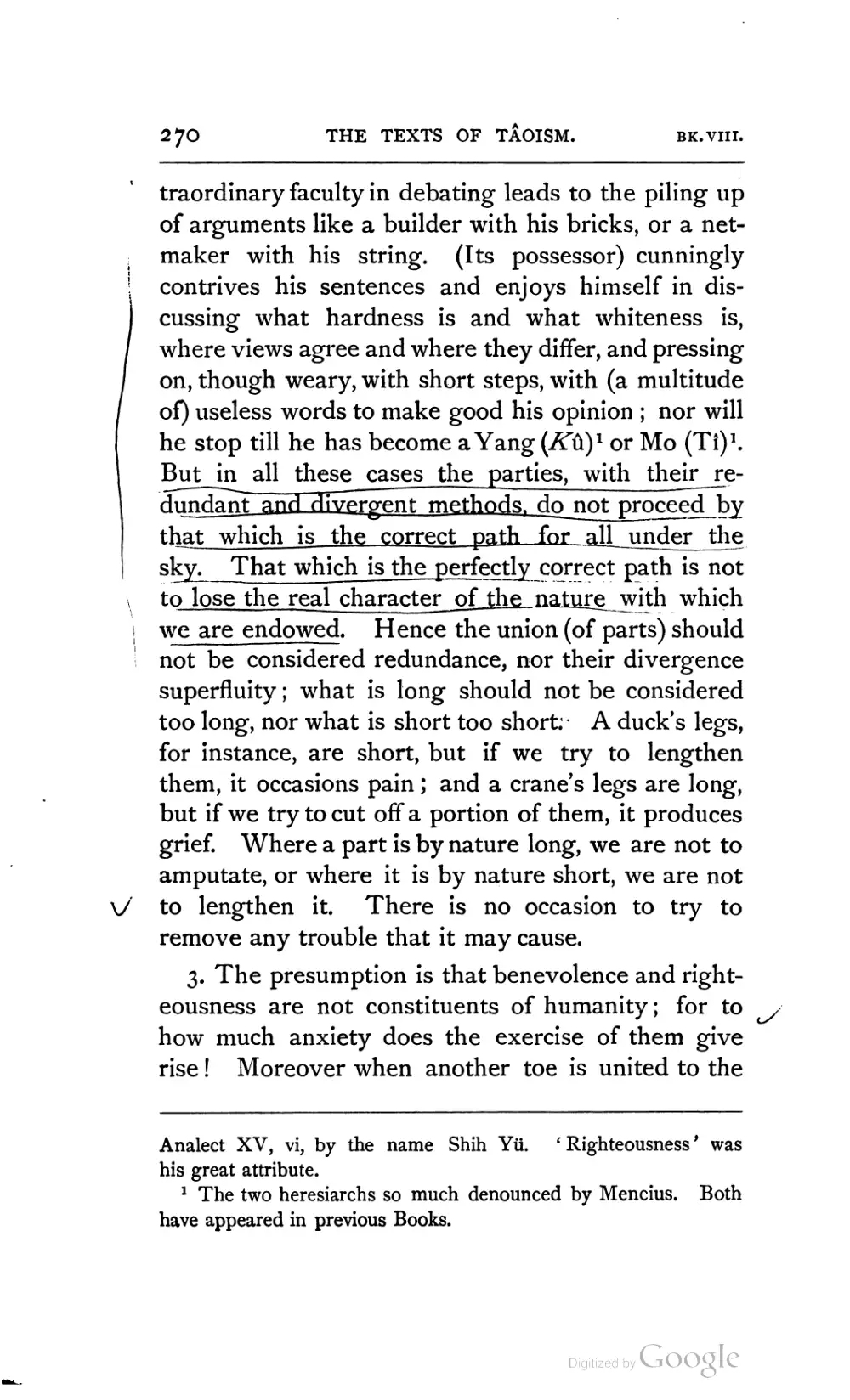
7 An officer of Wei in the sixth century B.C. He belonged to a family of historiographers, hence the surname Shih (史). Confucius mentions him in the most honourable terms in the Analects XV, vi, under the name Shih Yi. ‘Righteousness’ was his great attribute.
Shih Yü, set beside Ȝăng Shan as a man of excessive benevolence, is by Legge’s note one whom Confucius ‘mentions in the most honourable terms.’ The choice is pointed: the author’s examples of virtue as an excrescence are the exemplars of the rival school, a leading disciple and an officer its master praised. The attack is aimed at the best the Confucians could show, not at hypocrites.