Legge reads the four opening members as indicative statements about non-action, and admits the first ‘seems anti-Taoistic’ on that reading. Each begins with 無為, which can equally be taken as an imperative, ‘do not be’ the lord of fame, the treasury of plans and so on, and on that reading the difficulty he labours over disappears. His own remark that the sentences ‘occasion the translator no small trouble’ is the best evidence that his construction strains.
The Tâo Teh King — Sacred Books of China Part I, SBE Vol. 39 (trans. James Legge, 1891)
Open to all
page 266
No image is selected for this page; its own page image is shown.
page 266
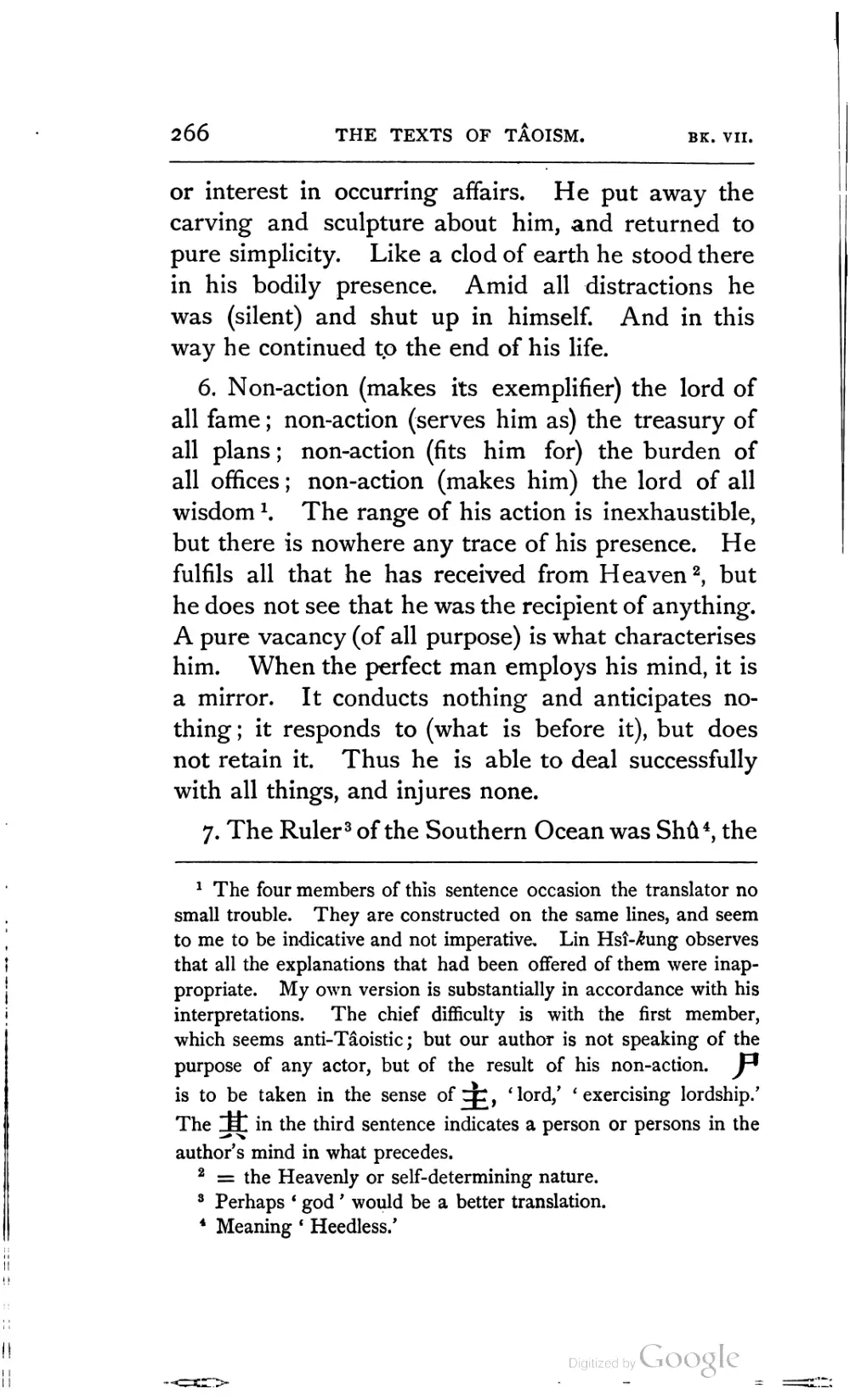
6. Non-action (makes its exemplifier) the lord of all fame; non-action (serves him as) the treasury of all plans; non-action (fits him for) the burden of all offices; non-action (makes him) the lord of all wisdom1. The range of his action is inexhaustible, but there is nowhere any trace of his presence. He fulfils all that he has received from Heaven2, but he does not see that he was the recipient of anything. A pure vacancy (of all purpose) is what characterises him. When the perfect man uses his mind, it is a mirror. It conducts nothing and anticipates nothing; it responds to (what is before it), but does not retain it. Thus he is able to deal successfully with all things, and injures none.
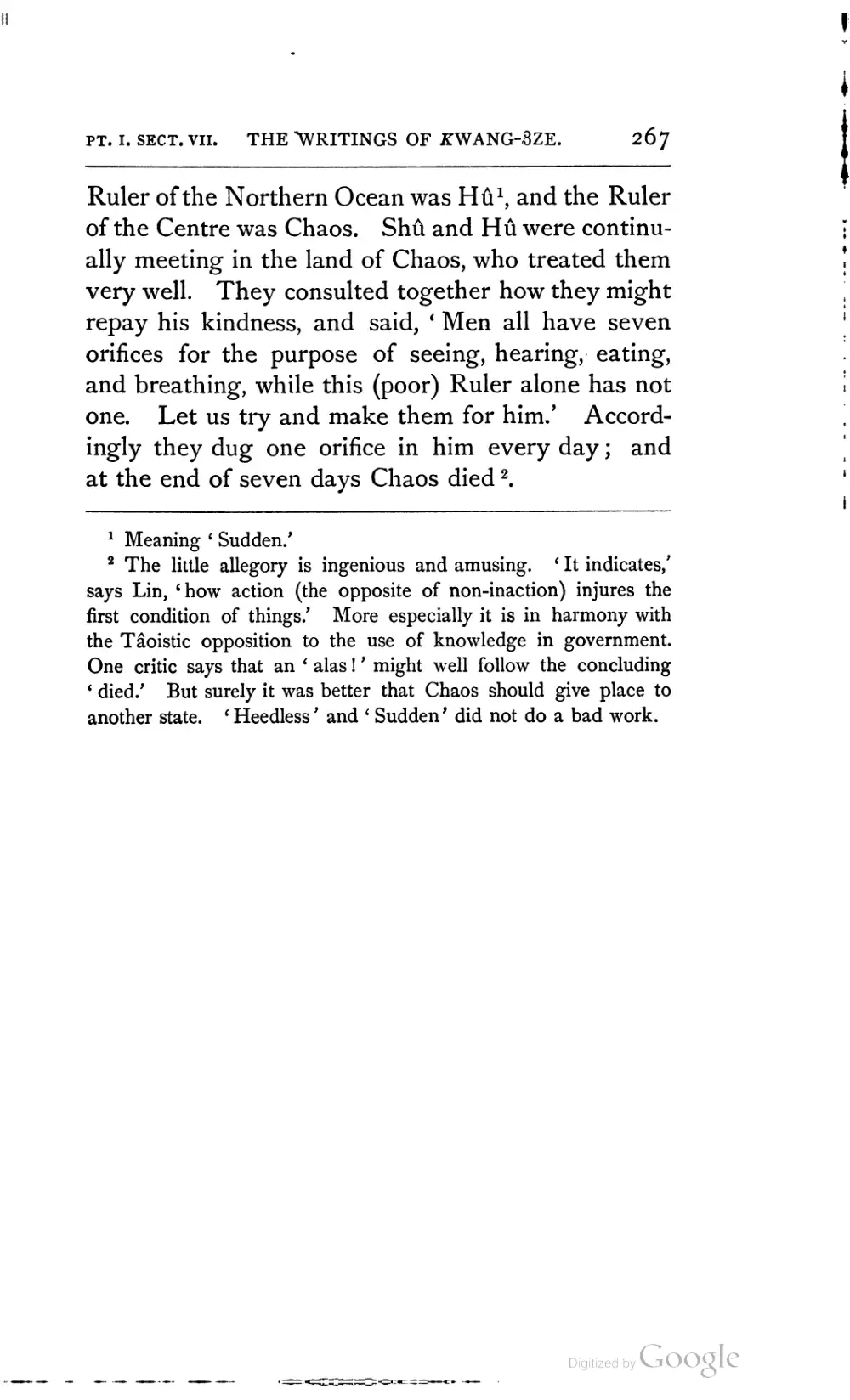
7. The Ruler3 of the Southern Ocean was Shû4, the Ruler of the Northern Ocean was Hû1, and the Ruler of the Centre was Chaos. Shû and Hû were continually meeting in the land of Chaos, who treated them very well. They consulted together how they might repay his kindness, and said, ‘Men all have seven orifices for the purpose of seeing, hearing, eating, and breathing, while this (poor) Ruler alone has not one. Let us try and make them for him.’ Accordingly they dug one orifice in him every day; and at the end of seven days Chaos died2.
says Lin, ‘how action (the opposite of non-action) injures the
1 The four members of this sentence give the translator no small trouble. They are constructed on the same lines, and seem to me to be indicative and not imperative. Lin Hsî-kung observes that all the explanations that had been offered of them were inappropriate. My own version is substantially in accordance with his interpretations. The chief difficulty is with the first member, which seems anti-Taoist; but our author is not speaking of the purpose of any actor, but of the result of his non-action. 尸 is to be taken in the sense of 主, ‘lord,’ ‘exercising lordship.’ The 其 [Press: his, their] in the third sentence indicates a person or persons in the author’s mind in what precedes.
2 That is, the Heavenly or self-determining nature.
3 Perhaps ‘god’ would be a better translation.
4 Meaning ‘Heedless.’ first condition of things.’ More especially it is in harmony with the Taoist opposition to the use of knowledge in government. One critic says that an ‘alas!’ might well follow the concluding ‘died.’ But surely it was better that Chaos should give place to another state. ‘Heedless’ and ‘Sudden’ did no bad work.
Legge declines the parable’s verdict: ‘surely it was better that Chaos should give place to another state,’ and the two rulers ‘did not do a bad work.’ The story says the opposite. The orifices were made as a kindness, on the model of what ‘men all have,’ and the kindness killed. It is the last paragraph of the seven Books of Part I, and the preference for an ordered world over the undivided one is the translator’s frame, not the text’s.