Legge’s note spends itself on the creature, the dugong and ‘perhaps the idea of the mermaid,’ but the image turns on the water. An eddy round a creature, an eddy from arrested water and one in water still flowing each make ‘an abyss,’ as the displays were different states with the same depth behind them. The identity of the animal matters less than that different movements make the same deep.
The Tâo Teh King — Sacred Books of China Part I, SBE Vol. 39 (trans. James Legge, 1891)
Open to all
page 265
No image is selected for this page; its own page image is shown.
page 265
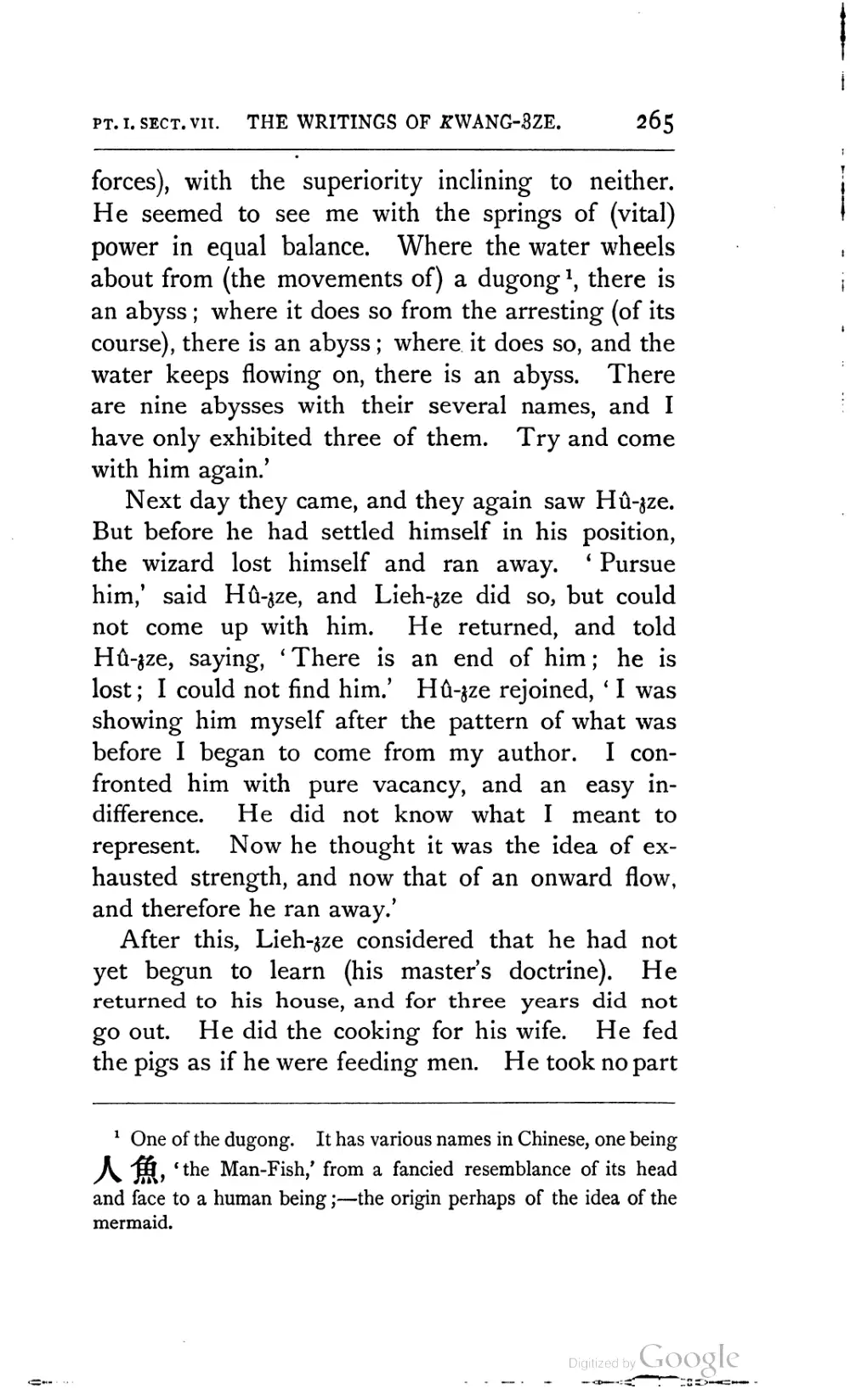
Next day they came, and again saw Hû-ȝze. But before he had settled himself in his position, the wizard lost his nerve and ran away. ‘Pursue him,’ said Hû-ȝze, and Lieh-ȝze did so, but could not catch up with him. He returned and told Hû-ȝze, saying, ‘There is an end of him; he is lost; I could not find him.’ Hû-ȝze rejoined, ‘1 was showing myself to him after the pattern of what was before I began to come from my author. I confronted him with pure vacancy and an easy indifference. He did not know what I meant to represent. Now he thought it was the idea of exhausted strength, and now that of an onward flow, and so he ran away.’
After this, Lieh-ȝze considered that he had not yet begun to learn (his master’s doctrine). He returned to his house, and for three years did not go out. He did the cooking for his wife. He fed the pigs as if he were feeding men. He took no part or interest in current affairs. He put away the carving and sculpture about him, and returned to pure simplicity. Like a clod of earth he stood there in his bodily presence. Amid all distractions he was (silent) and shut up in himself. And in this way he continued to the end of his life.
1 One of the dugongs. It has various names in Chinese, one being 人魚, ‘the Man-Fish,’ from a fancied resemblance of its head and face to a human being;—perhaps the origin of the idea of the mermaid.
Lieh-ȝze’s conversion is told in household terms: three years indoors, cooking for his wife, putting away the carving and sculpture about him. The sign of learning is a reversal of standing and a loss of ornament, not a feat of discipline or a new doctrine. It fits what Hû-ȝze showed: the wizard could not read ‘pure vacancy, and an easy indifference,’ and the pupil answers by becoming as unreadable, ‘like a clod of earth.’