Legge dates Yâo B.C. 2357-2257 and calls him the sovereign “with whom the documents of the Shû King commence.” The Shû already holds the germ of this scene: in the Canon of Yâo the ruler, seventy years on the throne, offers to resign it to his chief minister, who declines as unworthy, and the search that follows finds Shun. Kwang-ȝze keeps the offer and changes the refusal: Hsü Yû declines because the throne is only a name, “the guest of the reality.” The classic's act of abdication becomes an argument against wanting rule at all. The dates are the traditional chronology, not a measured one.
The Tâo Teh King — Sacred Books of China Part I, SBE Vol. 39 (trans. James Legge, 1891)
Open to all
page 169
No image is selected for this page; its own page image is shown.
page 169
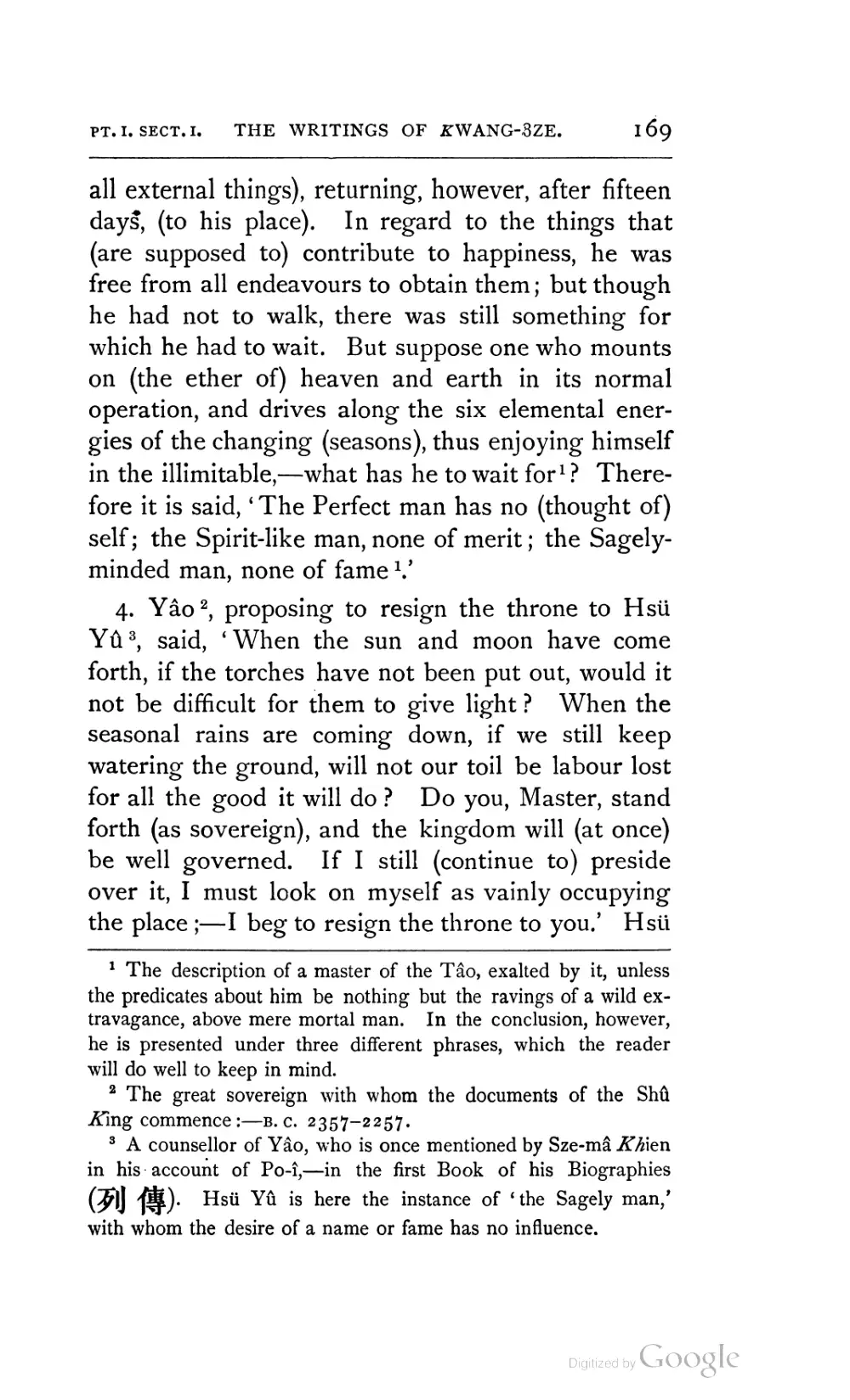
4. Yâo2, proposing to resign the throne to Hsü Yû3, said, ‘When the sun and moon have come out, if the torches have not been put out, would it not be difficult for them to give light? When the seasonal rains are coming down, if we still keep watering the ground, will our toil not be labour lost, for all the good it will do? If you, Master, stand forth (as sovereign), the kingdom will (at once) be well governed. If I still (continue to) preside over it, I must look on myself as vainly occupying the place;—I beg to resign the throne to you.’
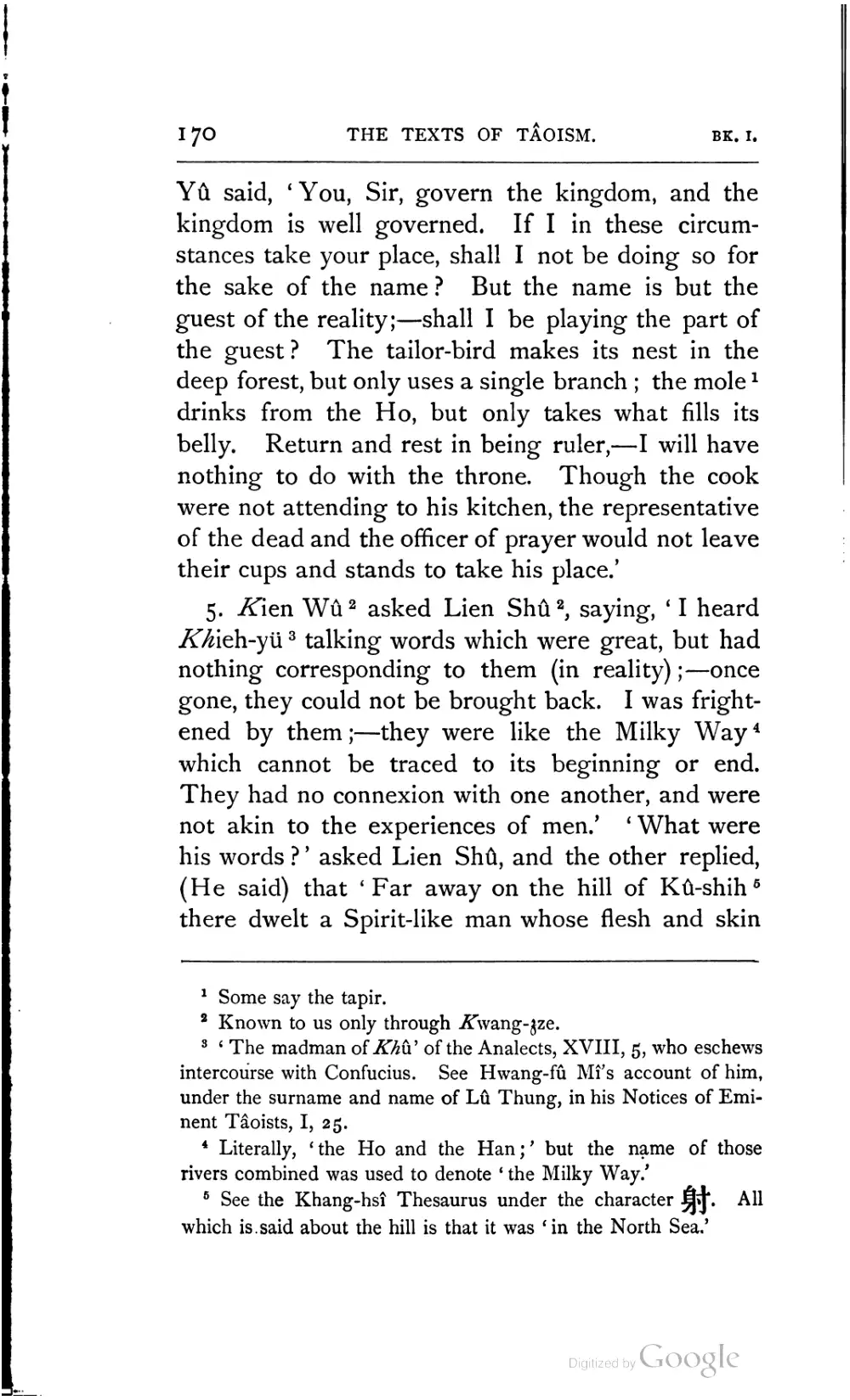
Hsü Yû said, ‘You, Sir, govern the kingdom, and the kingdom is well governed. If I take your place in these circumstances, shall I not be doing it for the sake of the name? But the name is only the guest of the reality;—shall I play the part of the guest? The tailor-bird makes its nest in the deep forest, but uses only a single branch; the mole1 drinks from the Ho, but takes only what fills its belly. Go back and rest in being ruler,—I will have nothing to do with the throne. Even if the cook were not attending to his kitchen, the representative of the dead and the officer of prayer would not leave their cups and stands to take his place.’
1 The description of a master of the Tao, raised by it above mere mortal man, unless what is said of him is nothing but the raving of a wild extravagance. In the conclusion, however, he is presented under three different phrases, which the reader will do well to keep in mind.
2 The great sovereign with whom the documents of the Shû King begin:—B.C. 2357-2257.
8 A counsellor of Yao, mentioned once by Sze-ma Khien in his account of Po-i, in the first Book of his Biographies (列傳). Hsü Yû is here the example of ‘the Sagely man,’ on whom the desire for a name or for fame has no influence.