In Book XII Legge takes “Heaven” as “purposeless spontaneity which yet is so powerful”, the sense he gave it in Lâo-ȝze's chapter 59, where it was no personal Power but the heavenly element in our nature. The gloss is right for both texts, and it is the one to hold against his more personal English at chapter 73. Kwang-ȝze's Heaven and Earth, powers whose influence goes forth without intent, give the reader the steadier key.
The Tâo Teh King — Sacred Books of China Part I, SBE Vol. 39 (trans. James Legge, 1891)
Open to all
page 143
No image is selected for this page; its own page image is shown.
page 143
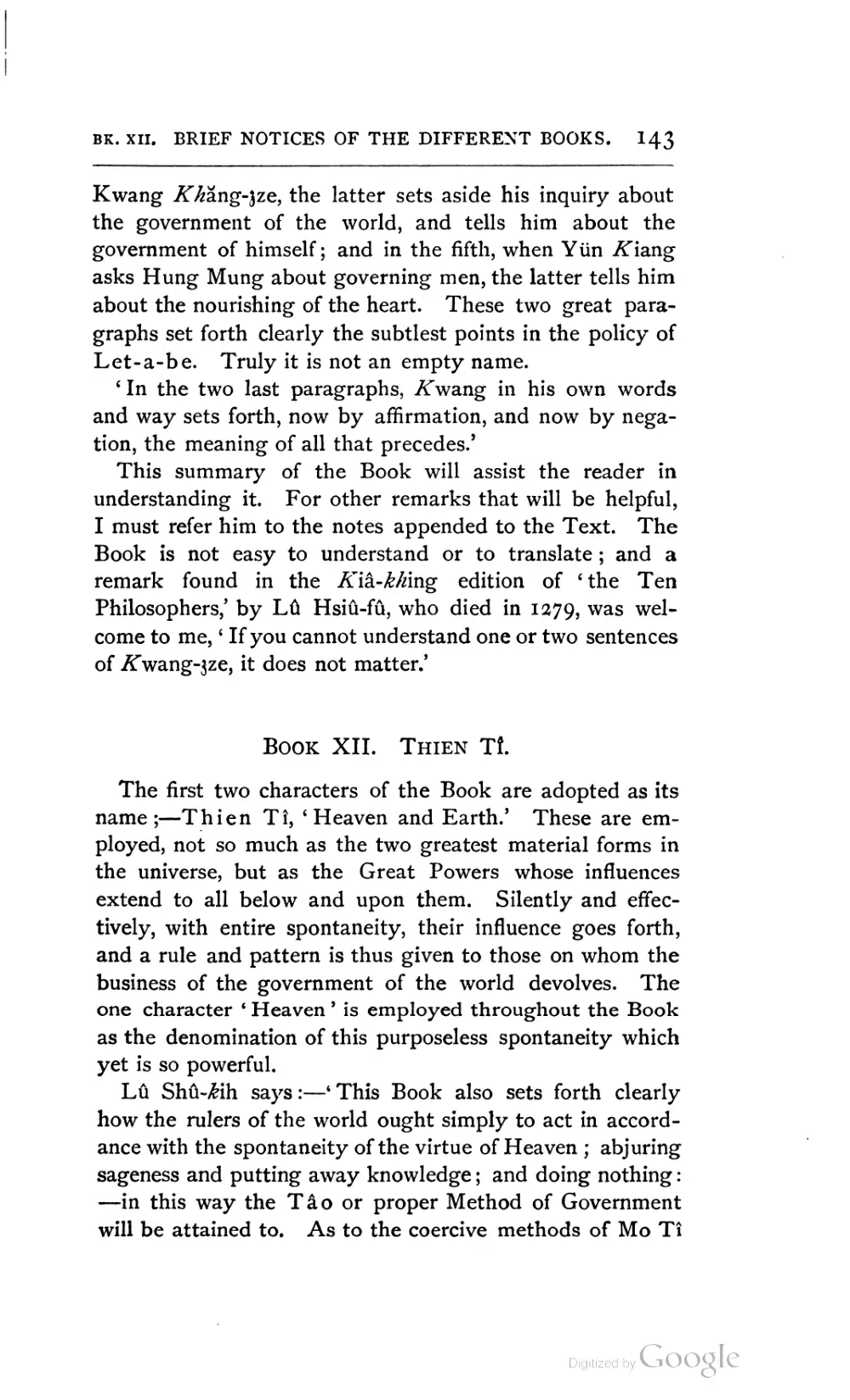
‘In the last two paragraphs Kwang, in his own words and his own way, sets forth, now by affirmation and now by negation, the meaning of all that precedes.’
This summary of the Book will help the reader to understand it. For other helpful remarks I must refer him to the notes appended to the Text. The Book is not easy to understand or to translate; and a remark found in the Kia-khing edition of ‘the Ten Philosophers,’ by Li Hsit-fa, who died in 1279, was welcome to me: ‘If you cannot understand one or two sentences of Kwang-ȝze, it does not matter.’
Book XII. THIEN Ti.
The first two characters of the Book are adopted as its name: Thien Ti, ‘Heaven and Earth.’ These are used not so much as the two greatest material forms in the universe as for the Great Powers whose influences extend to all below and upon them. Silently and effectively, with entire spontaneity, their influence goes forth, and a rule and pattern is thus given to those on whom the business of governing the world devolves. The single character ‘Heaven’ is used throughout the Book as the name of this purposeless spontaneity, which is nevertheless so powerful.
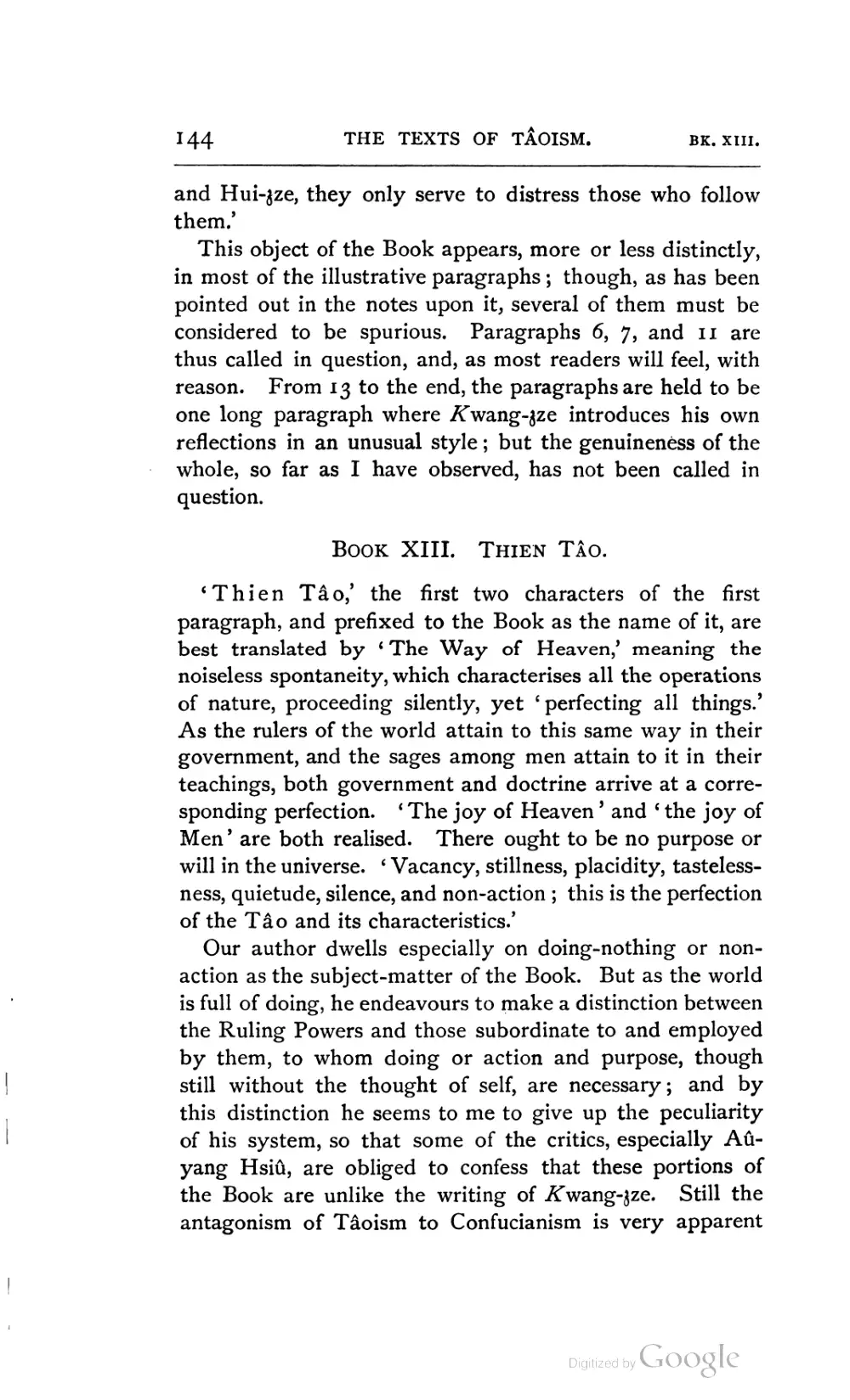
Lû Shû-kih says: ‘This Book also sets forth clearly how the rulers of the world ought simply to act in accordance with the spontaneity of the virtue of Heaven, renouncing sageness, putting away knowledge, and doing nothing; in this way the Tao, or proper Method of Government will be attained. As to the coercive methods of Mo Ti and Hui-ȝze, they only serve to distress those who follow them.’