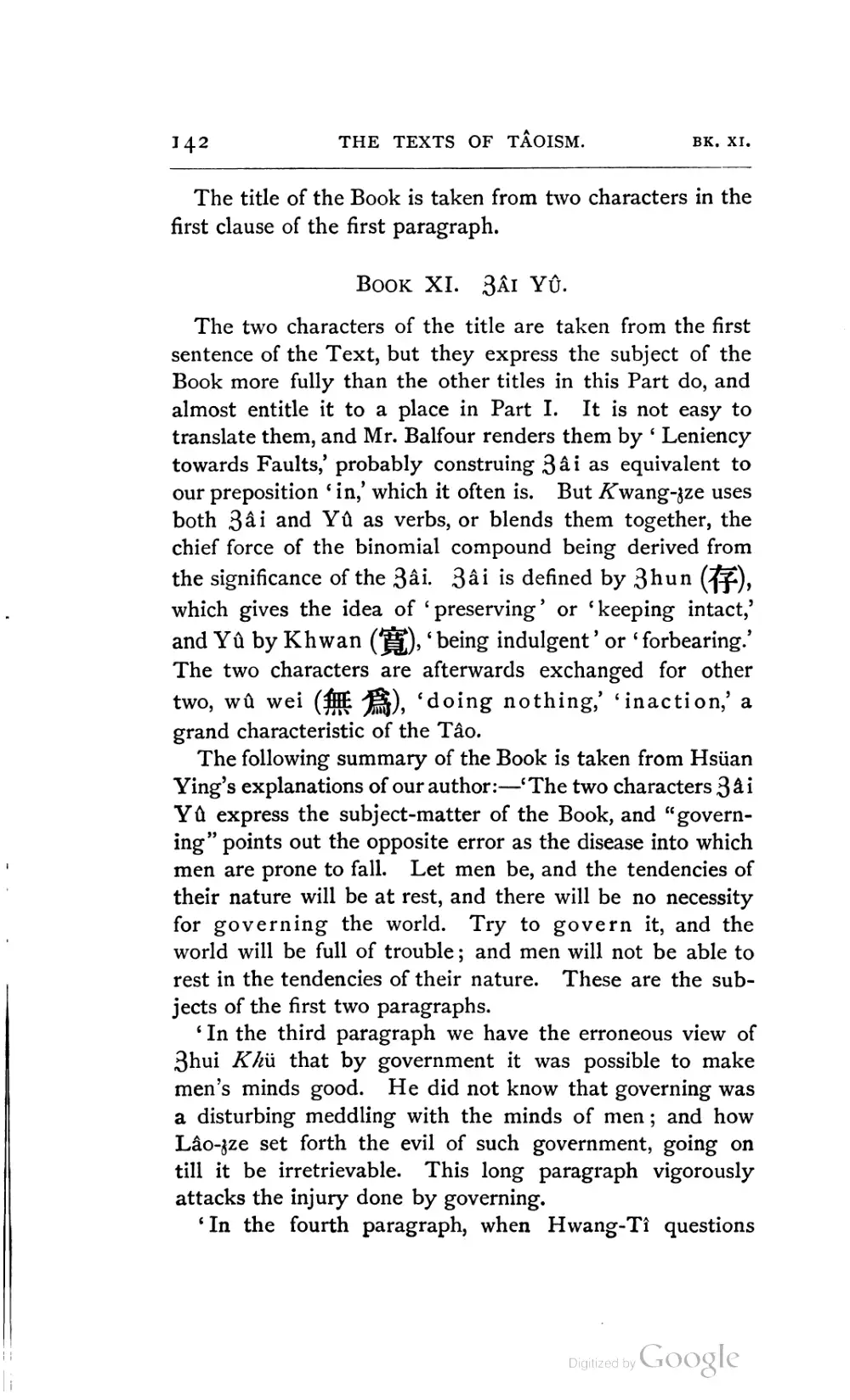
Against Balfour's “Leniency towards Faults”, Legge reads both characters of the title as verbs, keeping intact and forbearing, and his decisive evidence is in the Book itself: the pair is later exchanged for wû wei, “doing nothing”. A title that can be swapped for non-action means letting alone, not a lenient view of faults, and Legge's “Let-a-be” follows the text's own substitution.
The Tâo Teh King — Sacred Books of China Part I, SBE Vol. 39 (trans. James Legge, 1891)
Open to all
page 142
No image is selected for this page; its own page image is shown.
page 142
The title of this Book is taken from two characters in the first clause of the first paragraph.
Book XI. 3Ar1 YO.
The two characters of the title are taken from the first sentence of the Text, but they express the subject of the Book more fully than the other titles in this Part do, and almost entitle it to a place in Part I. They are not easy to translate. Mr. Balfour renders them ‘Leniency towards Faults,’ probably construing Ȝâi as equivalent to our preposition ‘in,’ which it often is. But Kwang-ȝze uses both Ȝâi and Yû as verbs, or blends them together, the chief force of the binomial compound coming from the meaning of the ȝâi. Ȝâi is defined by ȝhun (存), which gives the idea of ‘preserving’ or ‘keeping intact,’ and Yû by Khwan (寬), ‘being indulgent’ or ‘forbearing.’ The two characters are afterwards exchanged for another two, wû wei (無爲), ‘doing nothing,’ ‘inaction,’ a grand characteristic of the Tao.
The following summary of the Book is taken from Hsüan Ying’s explanations of our author: ‘The two characters Ȝâi Yû express the subject-matter of the Book, and “governing” points out the opposite error, the disease into which men are prone to fall. Let men be, and the tendencies of their nature will be at rest, and there will be no need to govern the world. Try to govern it, and the world will be full of trouble, and men will not be able to rest in the tendencies of their nature. These are the subjects of the first two paragraphs.
‘In the third paragraph we have the mistaken view of Shui Khü that by government it was possible to make men’s minds good. He did not know that governing was a disturbing interference with the minds of men; and how Lâo-ȝze set forth the evil of such government, going on until it becomes irretrievable. This long paragraph vigorously attacks the injury done by governing.
‘In the fourth paragraph, when Hwang-Ti questions Kwang Khăng-ȝze, the latter sets aside his inquiry about governing the world and tells him about governing himself; and in the fifth, when Yün Kiang asks Hung Mung about governing men, the latter tells him about nourishing the heart. These two great paragraphs set forth clearly the subtlest points in the policy of Let-a-be. Truly it is not an empty name.