Legge's summary of Book II puts Kwang-ȝze into the questions of nineteenth-century theology: whether the Tao is “a Personal name”, whether a ruler stands behind things whose form we do not see, whether “any proof of Creation” can be advanced. Those terms are his, and they tilt the Book toward the agnosticism he names next. The Book's own question is narrower, how disputants each sure of his view can be brought to rest, and its doubts about origins serve that end rather than stand as a doctrine.
The Tâo Teh King — Sacred Books of China Part I, SBE Vol. 39 (trans. James Legge, 1891)
Open to all
page 129
No image is selected for this page; its own page image is shown.
page 129
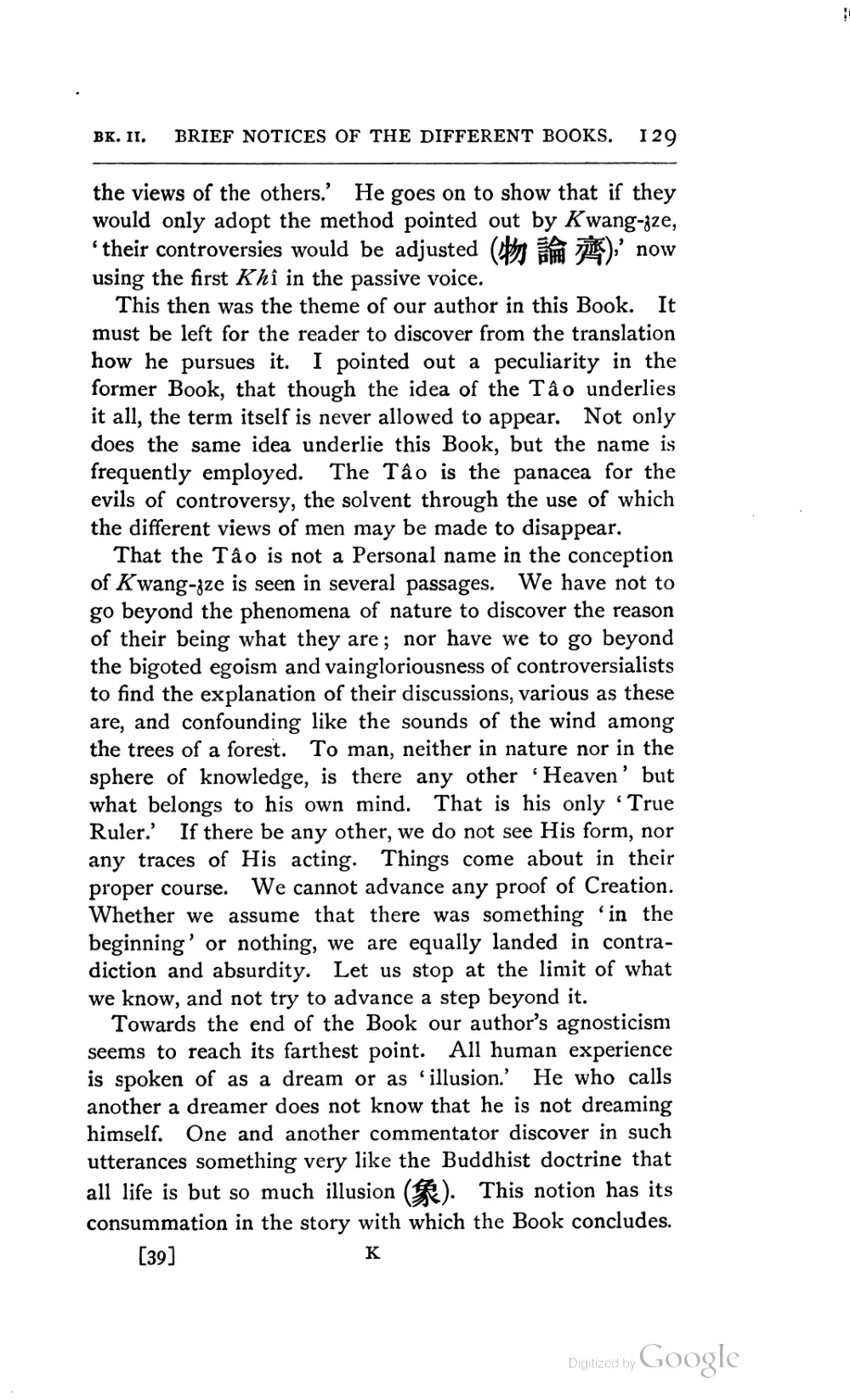
This, then, was our author’s theme in this Book. It must be left to the reader to discover from the translation how he pursues it. I pointed out a peculiarity in the former Book: that though the idea of the Tâo underlies all of it, the term itself is never allowed to appear. Not only does the same idea underlie this Book, but the name is used frequently. The Tâo is the cure-all for the evils of controversy, the solvent through which the different views of men may be made to disappear.
That the Tao is not a Personal name in Kwang-ȝze’s conception is seen in several passages. We do not have to go beyond the phenomena of nature to discover the reason why they are what they are; nor do we have to go beyond the bigoted egoism and vainglory of controversialists to find the explanation of their discussions, varied as these are, and as confusing as the sounds of the wind among the trees of a forest. For man, neither in nature nor in the sphere of knowledge is there any other ‘Heaven’ than what belongs to his own mind. That is his only ‘True Ruler.’
If there is any other, we do not see His form, nor any traces of His acting. Things come about in their proper course. We cannot advance any proof of Creation. Whether we assume that there was something ‘in the beginning’ or nothing, we land equally in contradiction and absurdity. Let us stop at the limit of what we know, and not try to go a step beyond it.
Towards the end of the Book our author’s agnosticism seems to reach its farthest point. All human experience is spoken of as a dream or as ‘illusion.’ He who calls another a dreamer does not know that he is not dreaming himself. One commentator and another find in such utterances something very like the Buddhist doctrine that all life is only so much illusion (象). This notion has its consummation in the story with which the Book concludes.
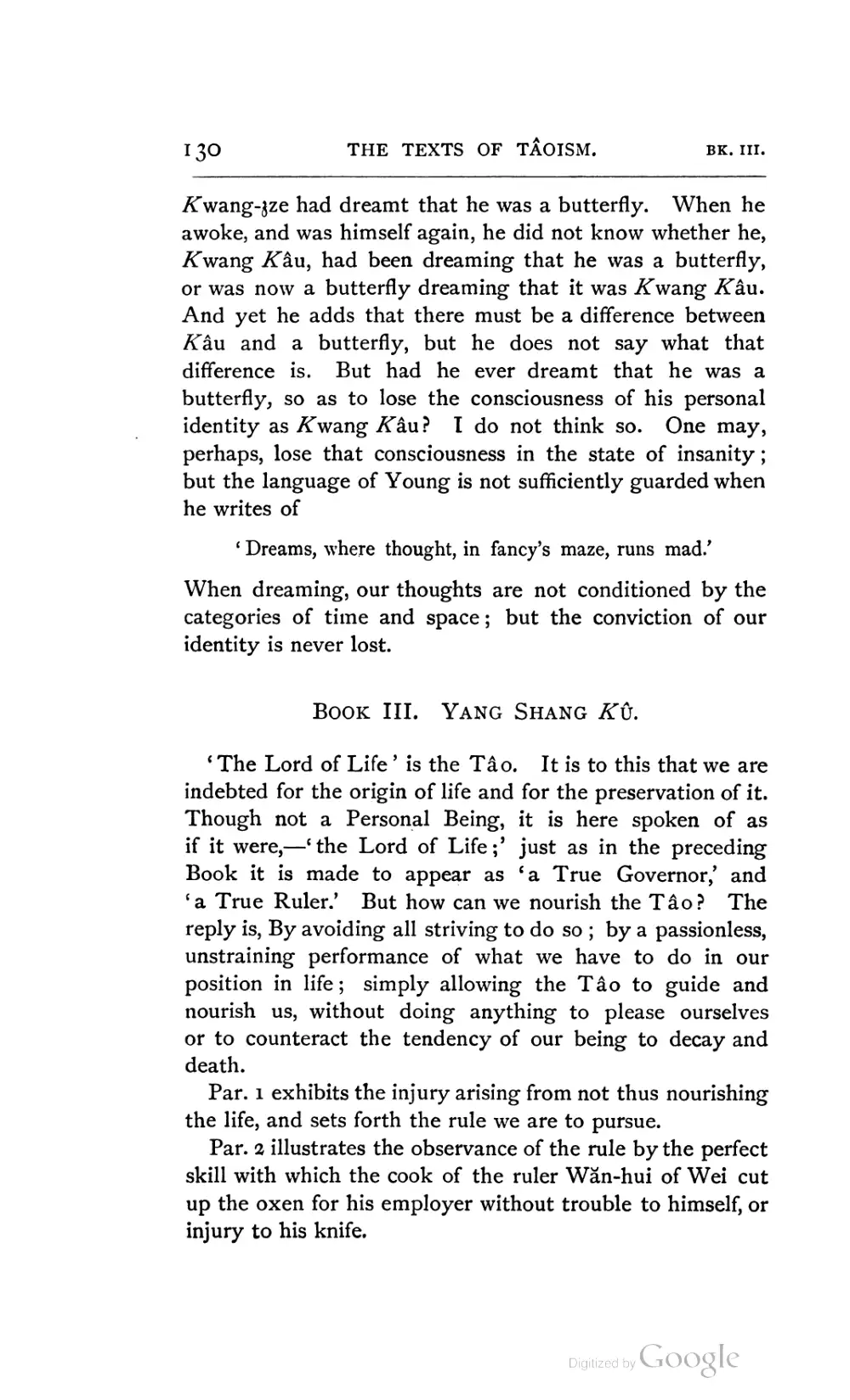
Kwang-ȝze had dreamt that he was a butterfly. When he woke, and was himself again, he did not know whether he, Kwang Kau, had been dreaming that he was a butterfly, or was now a butterfly dreaming that it was Kwang Kau. And yet he adds that there must be a difference between Kau and a butterfly, but he does not say what that difference is.
But had he ever dreamt that he was a butterfly, so as to lose the consciousness of his personal identity as Kwang Kau? I do not think so. One may perhaps lose that consciousness in a state of insanity; but the language of Young is not sufficiently guarded when he writes of