Legge rejects Balfour's “Uniformity of All Things” and claims the Chinese critics are all with him in reading the title as the adjusting of controversies. The evidence he gives is one Ming commentator, Mr. Kang, whose 物論齊 takes 物論, discussions about things, as a single noun. That parsing settles it for Legge, but one commentator is not all the critics, and the other grouping, things made equal and the discussions with them, is the one Balfour followed. The Book argues both.
The Tâo Teh King — Sacred Books of China Part I, SBE Vol. 39 (trans. James Legge, 1891)
Open to all
page 128
No image is selected for this page; its own page image is shown.
page 128
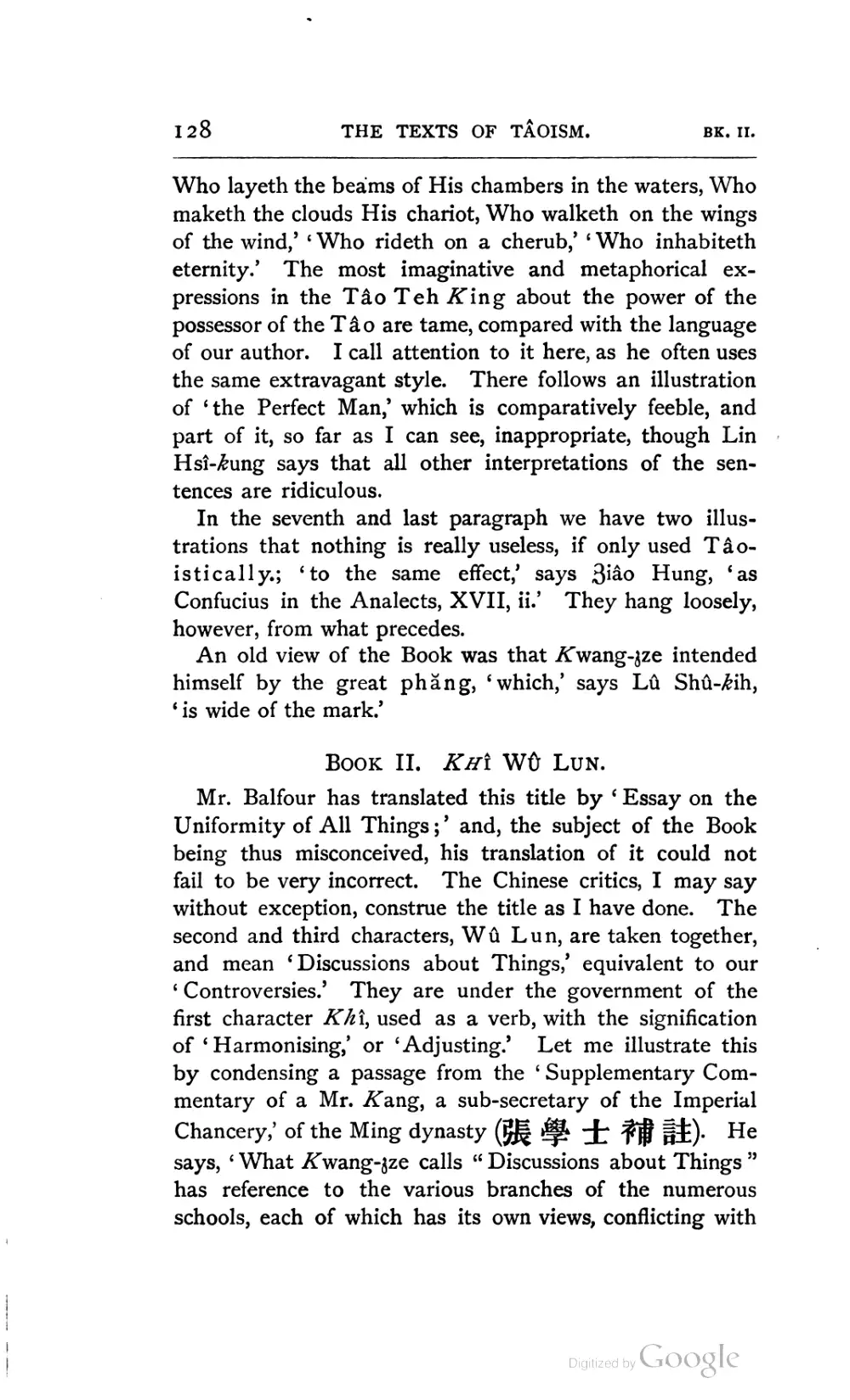
In the seventh and last paragraph we have two illustrations that nothing is really useless, if only it is used Taoistically; ‘to the same effect,’ says Ȝiâo Hung, ‘as Confucius in the Analects, XVII, ii.’ They hang loosely, however, from what precedes.
An old view of the Book was that Kwang-ȝze meant himself by the great phang, ‘which,’ says Lai Shd-Zih, ‘is wide of the mark.’
Book II. Kat WO Lun.
Mr. Balfour has translated this title as ‘Essay on the Uniformity of All Things;’ and, the subject of the Book being misconceived in this way, his translation of it could not fail to be very incorrect. The Chinese critics, I may say without exception, construe the title as I have done. The second and third characters, Wû Lun, are taken together, and mean ‘Discussions about Things,’ equivalent to our ‘Controversies.’ They are governed by the first character, Khî, used as a verb, with the meaning of ‘Harmonising’ or ‘Adjusting.’
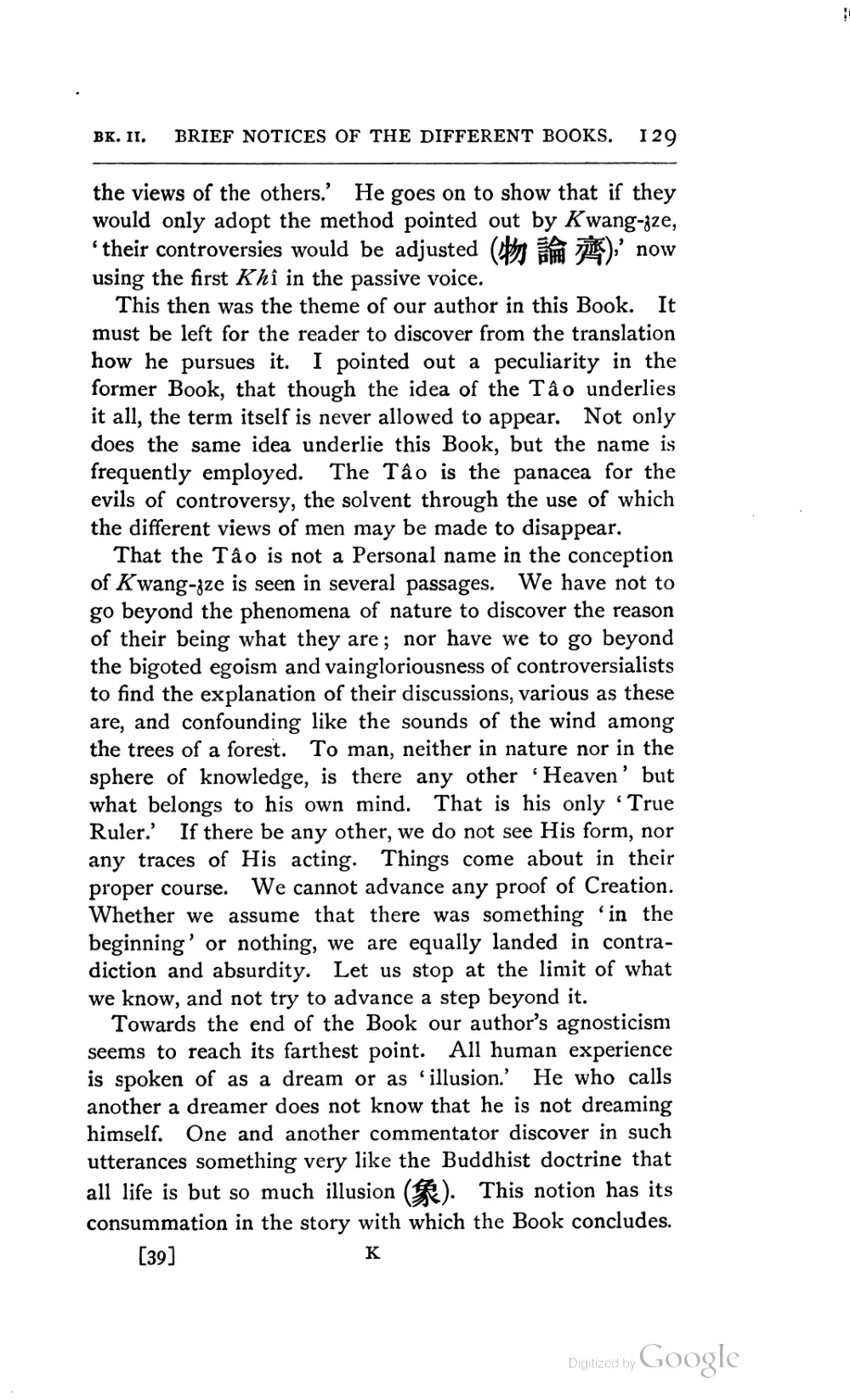
Let me illustrate this by condensing a passage from the ‘Supplementary Commentary of a Mr. Kang, a sub-secretary of the Imperial Chancery,’ of the Ming dynasty (張學士補註 [Press: Supplementary Notes of Chang the Academician]). He says, ‘What Kwang-ȝze calls “Discussions about Things” has reference to the various branches of the numerous schools, each of which has its own views, conflicting with the views of the others.’ He goes on to show that if they would only adopt the method pointed out by Kwang-ȝze, ‘their controversies would be adjusted (物論齊),’ now using the first character, Khî, in the passive voice.