Legge glosses the stock phrase as “the Three Teachings, or systems of instruction”, and the gloss is more exact than the “Three Religions” he uses for the heading. The word he chooses leaves open a question he answers only in Chapter V, whether the old Taoism was a religion at all; there he concludes that for Lâo and Kwang it was not. The heading prejudges what the gloss leaves open.
The Tâo Teh King — Sacred Books of China Part I, SBE Vol. 39 (trans. James Legge, 1891)
Open to all
page 1
No image is selected for this page; its own page image is shown.
page 1
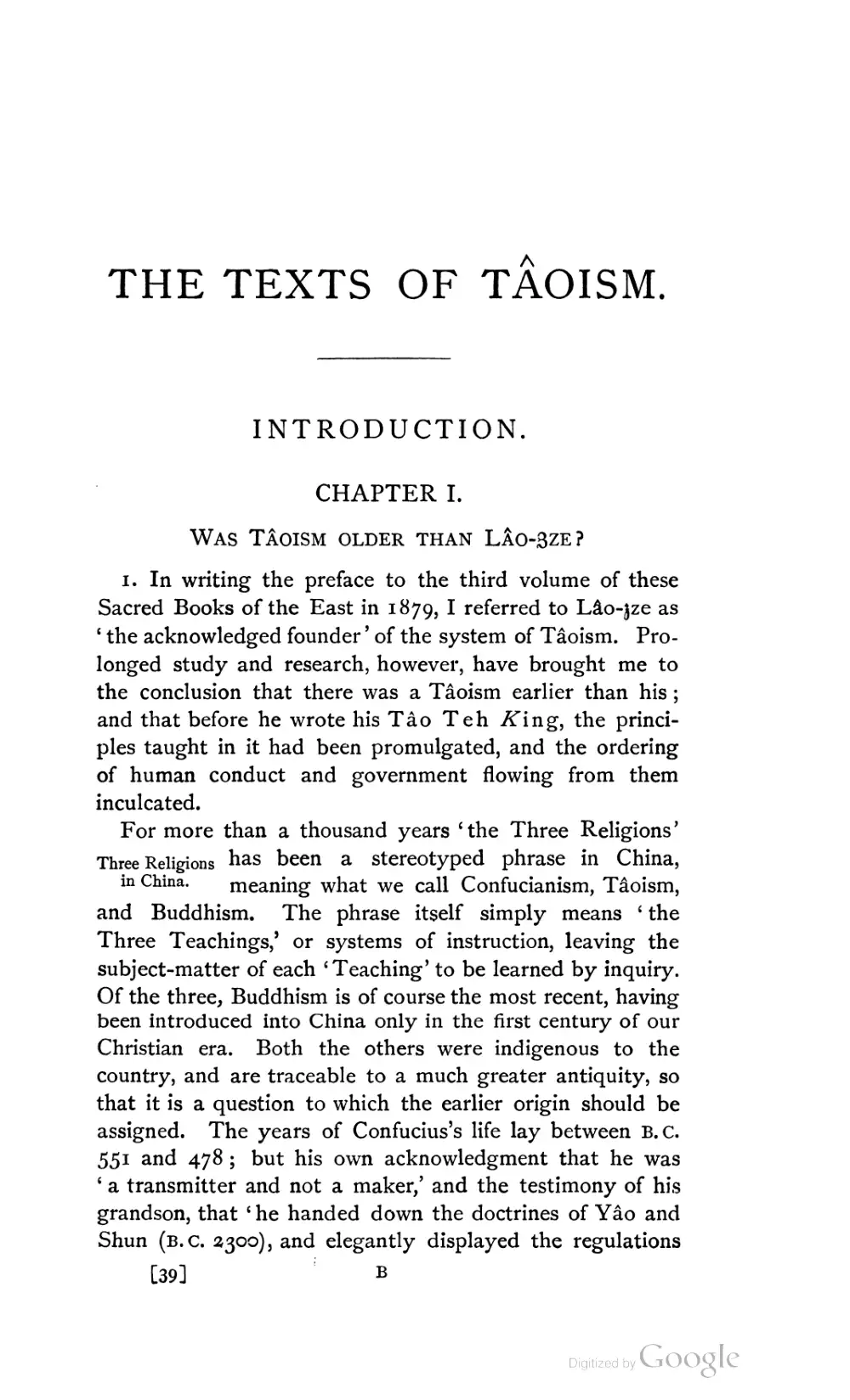
THE TEXTS OF TAOISM.
INTRODUCTION.
CHAPTER I.
WAS TAOISM OLDER THAN LÂO-ȜZE?
1. In writing the preface to the third volume of these Sacred Books of the East in 1879, I referred to Lâo-ȝze as ‘the acknowledged founder’ of the system of Taoism. Prolonged study and research, however, have brought me to the conclusion that there was a Taoism earlier than his; and that before he wrote his Tao Teh King, the principles taught in it had been promulgated, and the ordering of human conduct and government that flows from them had been inculcated.
For more than a thousand years ‘the Three Religions’ has been a stock phrase in China, meaning what we call Confucianism, Taoism, and Buddhism. The phrase itself simply means ‘the Three Teachings,’ or systems of instruction, leaving the subject-matter of each ‘Teaching’ to be learned by inquiry. Of the three, Buddhism is of course the most recent, having been introduced into China only in the first century of our Christian era. Both the others were native to the country and can be traced to a much greater antiquity, so that it is a question to which of them the earlier origin should be assigned.
The years of Confucius’s life lay between B.C. 551 and 478; but his own acknowledgement that he was ‘a transmitter and not a maker,’ and the testimony of his grandson, that ‘he handed down the doctrines of Yao and Shun (B.C. 2300), and elegantly displayed the regulations of Wan and Wû (B.C. 1200), taking them as his model,’ are well known.
Three Religios inChina.
Legge opens by withdrawing his own phrase from the 1879 Preface to the Shû King, where he called Lâo-ȝze “the acknowledged founder” of Taoism. The change is substantial: if the book's principles had been “promulgated” before Lâo-ȝze wrote, the Tao Teh King becomes a transmission, nearer to Confucius's description of himself as “a transmitter” than to a founder's manifesto. Legge's later notes, which find Lâo-ȝze quoting “earlier sages”, follow from this premise.