La Iniciación: Mensuario del Grupo Independiente de Estudios Esotéricos
The Initiation: Monthly of the Independent Group of Esoteric Studies
La Iniciación · Año V, Nº 49 · May 1946
Gate passedSeeker and aboveModern transcription — not a facsimileGIDEE / Orden Martinista de América del SurOperator ruling: no copyright implications asserted for this work. Uruguay life+50 (Leo d. 1970 → PD 2020); US URAA restoration assessed at ~2041 in the collection plan and overridden by the operator.319 of 319 segments translated · 24 ppsha f86cc967c6ab…
primary
derivedpage 22
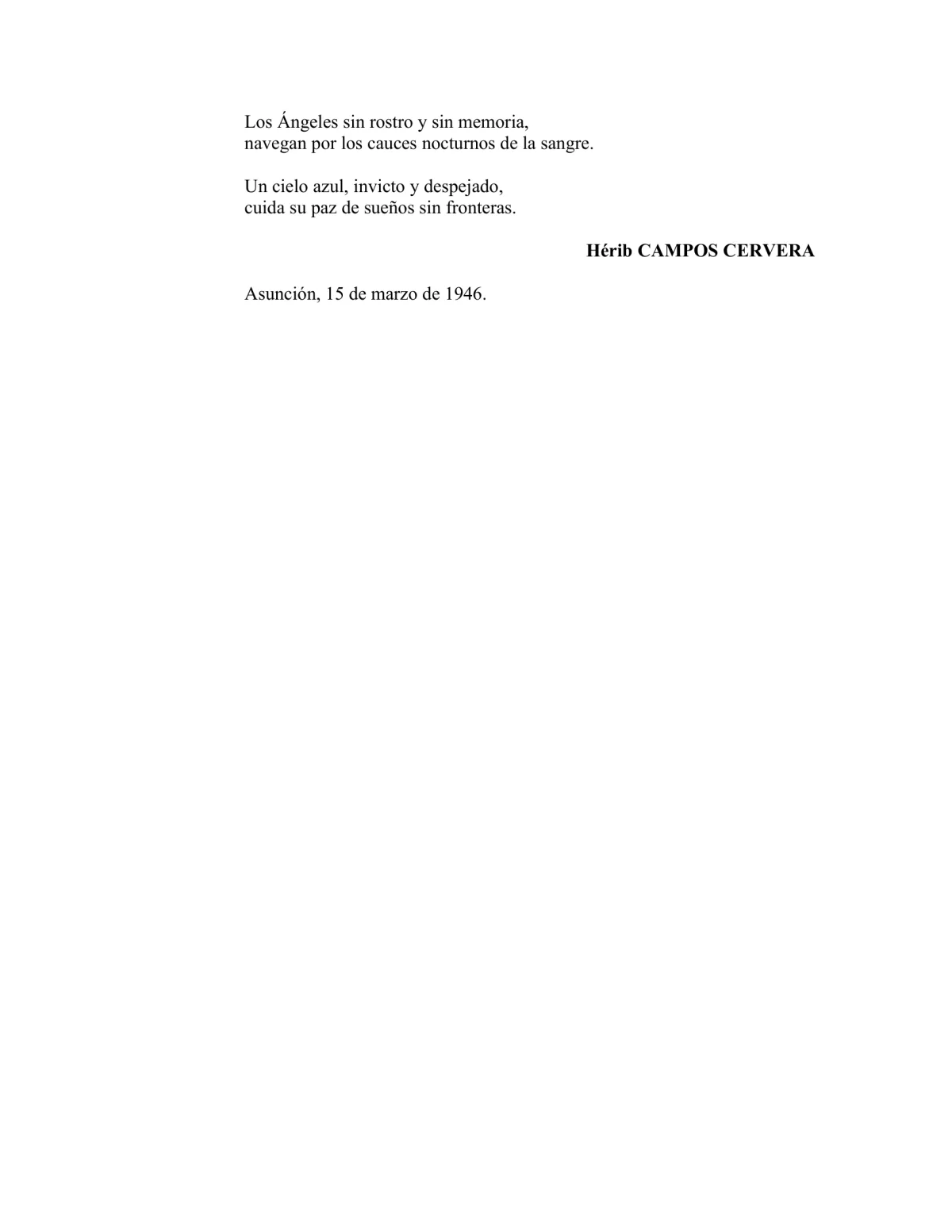
1The Angels, faceless and memoryless, sail through the nocturnal channels of the blood.
2A blue sky, unvanquished and clear, guards their peace of dreams without frontiers.
3Hérib CAMPOS CERVERA Asunción, 15 March 1946.
Our translation, period-faithful. Citable as our translation, never as the source.
Commentarywhole issue ·
Historical[P-V]ini:5.49:1:003
Nº 49 is a devotional issue: Jehel's essay on Prayer opens it, the Suddha Dharma pages call the whole community to pray for a pilgrim in India, and the literary section closes with an elegy for a dead child. The doctrinal serials — Guénon's Demiurge (concluded) and the chromotherapy course — run between.
Historical[P-V]ini:5.49:2:001
Masthead unchanged from Nº 47: the collective collaborators formula, the exchange-control notice, the 1.80-dollar overseas price.
Historical[P-V]ini:5.49:3:001
The SUMARIO shows two of the masthead's fraternal orders now writing under their own banners — Suddha Dharma Mandalam and Maha Boddhi Sangha each head their own section — the review functioning as the shared organ of Montevideo's several Eastern-rite groups.
Historical[P-V]ini:5.49:4:001
Jehel's 'La Oración' proceeds by numbered conclusions from a single epigraph by 'Sevananda' — prayer as the murmur of Divine Love in the heart. The essay's method — seven deductions, then a litany — is scholastic in form and devotional in content, the director's characteristic register.
Cross-estate[P-V]citesini:5.49:4:008
The 'final key' is given by Zanoni's words to his wife — 'There are beings whose thoughts and feelings are constant prayers' — from Bulwer-Lytton's initiatic novel, which the circle knew intimately: Sevaka's own 'El Hijo de Zanoni' (a sequel) heads the Kier list on this issue's back cover.
→ thread:zanoni_bulwer_lytton
Historical[P-V]ini:5.49:5:013
The closing rollcall — 'Masters like Papus, Philippe (AMO), Ramakrishna' — names Maître Philippe of Lyon (Nizier Anthelme Philippe, 1849–1905), Papus's own spiritual master, under the initials AMO by which the Martinist tradition and this review's earlier lineage diagrams designate him. The three names bind the essay's doctrine of prayer to the run's twin lineages, French and Hindu.
Historical[P-V]ini:5.49:6:002
The astrology course pivots from houses to signs: having finished the planets-in-houses cycle (Saturn through Neptune, Nºs 42–48), Surya begins the planets-in-signs cycle again with Saturn, 'the planet of sorrow'. The delineations remain in the Alan Leo textbook mould.
Historical[P-V]ini:5.49:7:006
'Situated at the 29 degrees of this sign, the seat of its exaltation' — Saturn's exaltation degree in Libra (the classical 21st degree is often given as 29 in Spanish-language manuals of the period); the course keeps the traditional dignities alongside its modern psychological vocabulary.
Historical[P-V]ini:5.49:8:005
'The Pilgrim of the Full Moon' interrupts the Gita commentary by editorial decision — Jehel's footnote says so — to relay news from 'The Suddha Dharma' (Madras, last quarter of 1945): Sri Vasudeva Row, President of the Suddha Dharma Mandalam, was renouncing his office to walk into the interior of India seeking the order's hidden Elders.
Historical[P-V]ini:5.49:9:009
The response in Montevideo: collective petitions and meditations in the 'little Temple' of the Guru Subrahmanyananda Ashrama — the Suddha community in Montevideo and Buenos Aires organised as an ashrama under the deceased founder's continuing patronage, with reported manifestations of his presence and a message from Vasudeva Row himself. The page is primary evidence of the group's devotional practice, not just its reading.
Comparative[P-V]ini:5.49:10:006
The appointed night is 'the Full Moon of May' — Wesak, the Buddha's festival, which the theosophical world held to be the annual convergence of the Masters. Jehel dates the piece 14-4-46, one lunar month ahead: the review is coordinating a hemisphere-distant act of collective prayer to a precise astronomical hour, the same time-discipline its planetary-hours praxis teaches.
Historical[P-V]ini:5.49:11:001
Upasika's 'The Way of the Buddha' brings her G∴E∴I∴D∴E∴ course ('The doctrine of the Buddha', on the back-cover roster since Nº 45) into print under the Maha Boddhi Sangha banner, signed 'Bikku'. The opening moves — Buddhism as philosophy not religion, Buddhagama, Vibhajja 'those who analyse' — frame the Dhamma in the review's analytic idiom.
Comparative[P-V]ini:5.49:12:011
The space-meditation — suspend the senses, hold 'Nothing now exists for me', then eliminate space itself — walks the reader through the formless-jhana sequence (infinite space, then nothingness) as a reasoned psychological experiment rather than a scriptural citation: the course's signature translation of contemplative technique into introspective argument.
Comparative[P-V]ini:5.49:13:009
'I am not an organism; I possess an organism' — the anatta analysis lands on the vocabulary of the review's Western courses (the I as owner of its instrument), and the section closes with the Pali homage formula transliterated as the compositor could manage it: Namo Tassa Bhagavato...
Historical[P-V]ini:5.49:14:001
The Demiurge reaches its fourth and final section. Guénon draws the moral consequence — morality is real within the Demiurge's domain and meaningless beyond it — and reaches for the Taoist wu wei: the Sage's non-action that is the plenitude of activity. In La Gnose this essay ended Guénon's debut sequence; the review has now serialised it entire, across four numbers.
Comparative[P-V]ini:5.49:15:002
'Nirvana, very far from being annihilation… is the plenitude of Being' — the conclusion the review's Buddhist course (three pages earlier in this same issue) will need: the two serials, gnostic and Buddhist, converge on the same doctrine of the formless, and the issue's architecture lets the reader watch them agree.
Historical[P-V]ini:5.49:16:003
The chromotherapy course turns clinical: diagnosis before treatment, with the aura as the ideal instrument and — for those without astral vision — face, nails, sclerotic, urine and faeces as colour-indicators. The Mars-red / opposite-blue example applies the planetary correspondences the course laid down in earlier instalments.
Historical[P-V]ini:5.49:17:005
The physical methods catalogue is the practical heart of the series: painted rooms, coloured dress, window glass, mineral-salt crystals, colour-corresponding foods, and solarised water — bottles exposed 4 hours minimum, dosed 30 grammes each half hour — the Babbitt/Phasad Jha technique of Nº 48 now given posology.
Historical[P-V]ini:5.49:18:011
Astral and mental chromotherapy — projecting visualised colour or dynamised thought into the patient's aura — are underwritten by Calligaris again: his 'Telepatía e radio-onde cerebrali' is cited with page numbers for the plaque that transmits red from 1 metre to 10 kilometres. The course wants its subtle-plane therapeutics to stand on laboratory paper.
Comparative[P-V]ini:5.49:19:006
The colour-blocking experiments yield an affect-lexicon — violet for pain, blue for pleasure, dark red spotted for excitation, grey for calm — which the course reads as proof that feeling, thought and colour are one vibratory fact: the theoretical bridge to the ten conclusions that follow.
Historical[P-V]ini:5.49:20:005
'Pasan los Ángeles' is by Hérib Campos Cervera (1905–1953), the great Paraguayan poet of the Generación del 40, writing from Asunción with an epigraph from Pablo Neruda; the dedication — 'for Lydia and Augusto, in the hour of the passing of their Son' — makes it a consolation elegy. That the review could print a new poem by the leading Paraguayan modernist, dated two months before publication, shows its literary reach across the Río de la Plata.
Comparative[P-V]ini:5.49:21:003
'The Angels are ours; they are our broken wings' — the poem's angels are the dead and the unlived selves at once, sailing 'the nocturnal channels of the blood'. Its placement after the chromotherapy course's aura-doctrine is an editorial rhyme: the issue ends where clinical vibration turns into elegy.
Historical[P-V]ini:5.49:22:003
Signed at Asunción, 15 March 1946 — six weeks before this May number; the review's literary section is running on a fast exchange with the Paraguayan capital.
Historical[P-V]ini:5.49:23:001
The G∴E∴I∴D∴E∴ plate unchanged; Upasika's course, whose print debut fills this issue's Buddhist pages, still stands on the roster.
Historical[P-V]ini:5.49:24:001
Back cover unchanged: the Ateneo Martinist list and the Kier Rose Cross list — the latter's 'El Hijo de Zanoni' by Sevaka closing the loop with the Zanoni quotation in this issue's opening essay.