June 1945; the wrapper prints "Nº." with its period displaced this month — the smallest of the compositor's wanderings, mirrored as printed.
→ ini:4.37
Fetching
One moment.
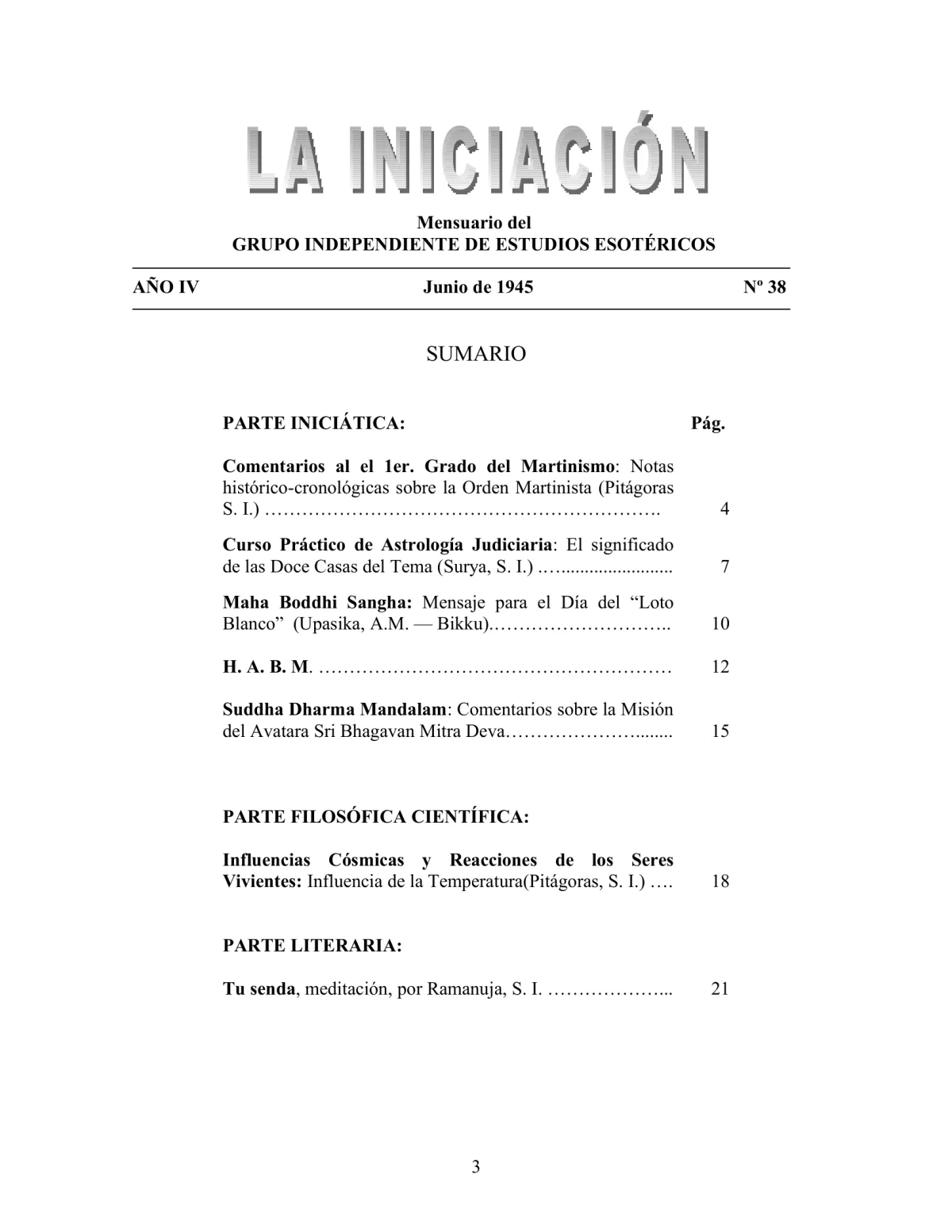
1Monthly of the INDEPENDENT GROUP OF ESOTERIC STUDIES YEAR IV June 1945 No. 38 SUMMARY INITIATIC PART: Page
2Commentary on the 1st. [Sic: the Spanish prints al el.]
3Degree of Martinism: Historical-chronological notes on the Martinist Order (Pitágoras S. I.) ……………………………………………………….
44 Practical Course of Judicial Astrology: The meaning of the Twelve Houses of the Figure (Surya, S. I.) .…........................
57 Maha Boddhi Sangha: Message for the Day of the "White Lotus" (Upasika, A.M. — Bikku).………………………..
610 H. A. B. M. ………………………………………………… 12 Suddha Dharma Mandalam: Commentaries on the Mission of the Avatara Sri Bhagavan Mitra Deva…………………........
715 PHILOSOPHICAL SCIENTIFIC PART: Cosmic Influences and Reactions of Living Beings: Influence of Temperature (Pitágoras, S. I.) ….
818 LITERARY PART: Thy path, a meditation, by Ramanuja, S. I. ………………...
921 · 3
Our translation, period-faithful. Citable as our translation, never as the source.
June 1945; the wrapper prints "Nº." with its period displaced this month — the smallest of the compositor's wanderings, mirrored as printed.
→ ini:4.37
Masthead stereotype unchanged.
Seven articles; the number pairs its two fraternity pages — the White Lotus memorial and the Shamballa foundation myth — around the twelve houses.
The Profession's secrecy anatomised: the degree itself to be unknown, its name borrowed from a mere dignity as camouflage, Joly quoted on the "delicate task" of grafting Reintegration doctrine into rituals not destined for Cohens — while the Cohens alone kept "the secret of its singular cult… its marvellous theurgy".
→ ini:4.37
The dissident Cohens speak: Pierre Jacques's 1774 letter ("You yourself ought to withdraw from it"), Antonio's 1777 indictment of Hundt's "schisms" and "very chimerical or very veiled" purposes, Saint-Martin's reluctant name on the 1773 petition — the column prints the opposition's correspondence at length, and lets Willermoz be wrong before he is right.
The verdict, balanced: despite the Strict Observance's decadence, the Profession "made it possible to diffuse a parcel of the Master's doctrine" — the chronology's justification of Willermoz, delivered only after his critics have had their full say.
The twelve houses: the course pivots from signs to houses — Julevno's meanings with Jehel's additions printed inline: the 2nd house extended to education, the 8th to "occult inheritance… contact with the true occult traditions", the 12th to "all the Occult Centres of Initiation". The house system esotericised by the editorial desk itself.
Jehel's 12th-house gloss — secret societies read astrologically, "which explains the importance of its astrological relations with the ninth" — the course's most explicit self-reference: the Order reading its own kind in the heavens.
The White Lotus message: Blavatsky memorialised as Upasika with her three books named — The Secret Doctrine "will only be understood and valued at the end of this century" — and Olcott honoured beside her; the Foundation date 17 November 1875 printed. The review's fullest act of theosophical filiation.
→ ini:4.35
The memorial's closing prayer transforms Blavatsky's enemies' "calumnies, envies and lies… into beautiful and perfumed lotus flowers" — the wounds of the Coulomb era remembered fifty years on, and answered with flowers.
The Shamballa foundation myth in verse and prose: the Regal Chariot from Venus, the Lords of the Flame, Kriyashakti bodies immutable for millions of years — the H.A.B.M. page delivering the Theosophical cosmogony (Sanat Kumara's descent) in its own liturgical register.
The borrowed-body doctrine applied to named figures: Jesus "at present occupies the body of a great Master living in the Middle East"; Buddha's prior lives as Vyasa, Hermes, the first Zoroaster, Orpheus; Ramakrishna and the Maharishi among the recent envoys — and the page ends on the war: blessings "over the sorrowing mothers whose sons were sacrificed by the egoism of men".
The Krishnamurti question, addressed by name: does Mitra Deva's "Instructor of the World" clash with the title "already borne by the Beloved Krishnamurti"? The reply — "The sacred admits no polemic" — declines the fight while the whole article answers it doctrinally: hierarchies of Lord, Amsa, Instructor, disciple. The run's only direct engagement with the Order of the Star controversy.
The sixteen-Krishna scheme: Mitra Deva first of NINE Great Masters before the sixteenth Krishnavatara "12,000 years from then" — the Mandala's deep-time table printed with its Devi Bhagavata citation; a footnote corrects the circular's date and reports the Avatara "has at times come down from the Himalayas".
Jehel's synthesis joins the estates: Iodhevauhe and Adam-Eve beside Nara — "each human being is also the partial amsa of Nara" — and "Suddhas and Martinists, among others, raise their Mystic Song to the Unity of Life": the review's two doctrinal families formally married, signed 8 May 1945 — VE Day.
The burn-degree table with its survival arithmetic (half the body: death in 6-16 hours; an eighth: after 92) — period surgical pathology, and the serial's coda that heat "is neither beneficent nor maleficent": the energy-neutrality doctrine applied to trauma medicine.
Pictet's frozen fish revived from -15°, frogs at -28°, bacteria at -100° — the cold-tolerance ladder mirroring last month's heat ladder; the serial's symmetry across polarities is deliberate architecture.
"Like heat, cold is in itself indifferent" — the paired conclusion, with cryotherapy and thermocautery as the proof that the same energy heals or destroys by circumstance: the column's recurring monism of energy.
Ramanuja's "Thy Path", June 1945: "The very people who vociferate against the dictators… have not yet been capable of understanding that true liberty depends only in the smallest degree on external causes" — the review's sole, oblique acknowledgment of the war's end: liberation read inward.
The meditation's close — marching "with a pure heart and a mind ample and exempt from prejudices" — ends the number on the individual path, as the run's literary part has done since its first issue.
GIDEE prospectus stereotype at page 23.
→ ini:3.30
Library back cover and imprint close the number.