Census: 92 → 93 (Argentina 50, Brazil 11, Uruguay 32); May protocol 964–999 — the thousandth document falls due next month.
→ ini:3.26:19:005
Fetching
One moment.
11.
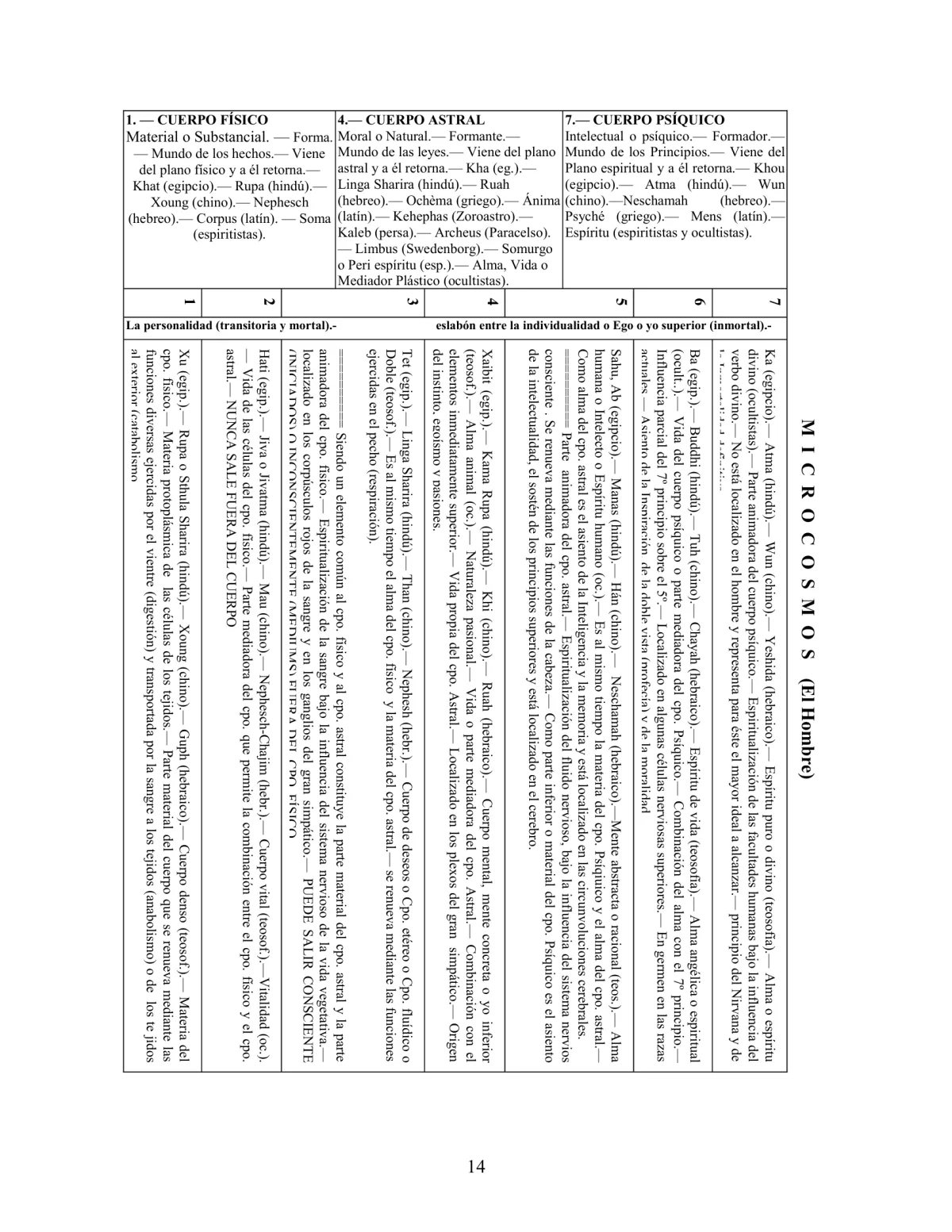
2— PHYSICAL BODY — Material or Substantial.
3— Form.
4— World of facts.— Comes from the physical plane and returns to it.— Khat (Egyptian).— Rupa (Hindu).— Xoung (Chinese).— Nephesch (Hebrew).— Corpus (Latin).
5— Soma (spiritists).
64.— ASTRAL BODY — Moral or Natural.— Formant.— World of laws.— Comes from the astral plane and returns to it.— Kha (Eg.).— Linga Sharira (Hindu).— Ruah (Hebrew).— Ochema (Greek).— Anima (Latin).— Kehephas (Zoroaster).— Kaleb (Persian).— Archeus (Paracelsus).
7— Limbus (Swedenborg).— Somurgo or Perispirit (spir.).— Soul, Life or Plastic Mediator (occultists).
87.— PSYCHIC BODY — Intellectual or psychic.— Formator.— World of Principles.— Comes from the spiritual Plane and returns to it.— Khou (Egyptian).— Atma (Hindu).— Wun (Chinese).— Neschamah (Hebrew).— Psyche (Greek).— Mens (Latin).— Spirit (spiritists and occultists).
91 2 3 4 5 6 7 — The personality (transitory and mortal) — link between it and the individuality or Ego or higher I (immortal).— Xu (Egyp.).— Rupa or Sthula Sharira (Hindu).— Xoung (Chinese).— Guph (Hebraic).— Dense body (theosoph.).— Matter of the physical body.— Protoplasmic matter of the cells of the tissues.— Material part of the body, which is renewed by the diverse functions exercised by the belly (digestion) and transported by the blood to the tissues (anabolism) or from the tissues to the exterior (catabolism). — Hati (Egyp.).— Jiva or Jivatma (Hindu).— Mau (Chinese).— Nephesch-Chajim (Hebr.).— Vital body (theosoph.).— Vitality (oc.).
10— Life of the cells of the physical body.— Mediating part of the body that permits the combination between the physical body and the astral body.— NEVER GOES OUT OF THE BODY. — Tet (Egyp.).— Linga Sharira (Hindu).— Than (Chinese).— Nephesh (Hebr.).— Desire body or Etheric body or Fluidic body or Double (theosoph.).— It is at once the soul of the physical body and the matter of the astral body.— It is renewed by the functions exercised in the chest (respiration).
11========== Being an element common to the physical body and the astral body, it constitutes the material part of the astral body and the animating part of the physical body.— Spiritualisation of the blood under the influence of the nervous system of vegetative life.— Localised in the red corpuscles of the blood and in the ganglia of the great sympathetic.— CAN GO OUT OF THE PHYSICAL BODY CONSCIOUSLY (INITIATES) OR UNCONSCIOUSLY (MEDIUMS). — Xaibit (Egyp.).— Kama Rupa (Hindu).— Khi (Chinese).— Ruah (Hebraic).— Mental body, concrete mind or lower self (theosoph.).— Animal soul (oc.).— Passional nature.— Life or mediating part of the astral body.
12— Combination with the immediately higher element.— Life proper of the astral body.
13— Localised in the plexuses of the great sympathetic.— Origin of instinct, egoism and the passions.
14Sahu, Ab (Egyptian).— Manas (Hindu).— Hán (Chinese).— Neschamah (Hebraic).— Abstract or rational mind (theos.).— Human soul or Intellect or human Spirit (oc.).— It is at once the matter of the psychic body
15and the soul of the astral body.— As soul of the astral body it is the seat of Intelligence and memory, and is localised in the cerebral convolutions.
16========== Animating part of the astral body.— Spiritualisation of the nervous fluid, under the influence of the conscious nervous system.
17It is renewed by the functions of the head.— As lower or material part of the psychic body,
18it is the seat of intellectuality, the support of the higher principles, and is localised in the brain.
19Ba (Egyp.).— Buddhi (Hindu).— Tuh (Chinese).— Chayah (Hebraic).— Spirit of life (theosophy).— Angelic or spiritual soul (occult.).— Life of the psychic body or mediating part of the psychic body.
20— Combination of the soul with the 7th principle.— Partial influence of the 7th principle upon the 5th.— Localised in some higher nerve cells.— In germ in the present races.— Seat of Inspiration, of second sight (prophecy) and of morality. — Ka (Egyptian).— Atma (Hindu).— Wun (Chinese).— Yeshida (Hebraic).— Pure or divine spirit (theosophy).— Divine soul or spirit (occultists).— Animating part of the psychic body.— Spiritualisation of the human faculties under the influence of the divine word.— Not localised in man, and represents for him the highest ideal to attain.— principle of Nirvana and of definitive Immortality — MICROCOSM (Man) · 14
Our translation, period-faithful. Citable as our translation, never as the source.
Census: 92 → 93 (Argentina 50, Brazil 11, Uruguay 32); May protocol 964–999 — the thousandth document falls due next month.
→ ini:3.26:19:005
July 1944; the redesigned wrapper of Nº 26 carries forward.
→ ini:3.26
Masthead unchanged from Nº 26, N. City Bank line included.
The SUMARIO misprints the author of the lead poem as "Mahanuja"; the article signs RAMANUJA — a Brother writing from the United States, the run's first contributor on North American soil.
Ramanuja's ¡Despierta! argues the primacy of feeling over reasoning — "the marvellous tool of pain" as converter — an A∴M∴ manifesto in the direct second person, unusual for the run's courses.
*Victor-Émile Michelet's Incantation of the Ten Divine Names in Spanish* — the French Symbolist poet of Papus's circle (the footnote identifies him only as "man of letters and Martinist Initiate of the epoch of Papus"). The prose-poem walks the ten Sephirothic god-names with their archangels (Raziel, Zaphkiel, Zadkiel, Samael, Raphael, Anael, Michael, Gabriel) and their demons (Zazel, Barzabel, Sorath, Kedemel, Taphthartharat, Hasmodai) — the planetary spirits-and-intelligences table of Agrippa turned into liturgy. A significant translation: Michelet's occult poetry has next to no Spanish-language record.
Reviewed against the concealment mandate: "the races from which I sprang believed they saw your reflection…" is the poet's self-genealogy introducing the Crucified — devotional first-person, no claims about living peoples; it stands. The other two candidates (astral storms; the synoptic table's "in germ in the present races") cleared on the same reading.
The incantation ends at Malkuth with Pan alive and the Eleusinian cup — "I absorbed pain and drank remembrance" — the Symbolist's Greece and the kabbalist's Tree fused in one closing cadence.
Taurus follows Aries: Aphrodite's horns read as Venus not Luna, Apis, Issachar's blessing, the agate talisman — and the era's vernacular slipping in ("what today is called 'sex-appeal'").
→ ini:3.26:11:002
The course names its own ambition: "a true Treatise of Interpretation… APPLY this knowledge" — the zodiac series is being written as a manual, not a column.
The Androgony series closes its first-degree arc with the synoptic table credited to Pitágoras — "the patient labour of the dear Brother" — and announces the next theme: the Quaternary Character of Martinism.
The synoptic table of the sevenfold constitution: Egyptian, Hindu, Chinese, Hebrew, Greek, Latin, Zoroastrian, Persian, Paracelsian, Swedenborgian, spiritist and Theosophical terms aligned across the 3×3→7 scheme the course built over six numbers — with the operational notes (the vital body "NEVER goes out"; the astral "CAN go out consciously (INITIATES) or unconsciously (MEDIUMS)"). The run's densest single doctrinal object, kept whole in the transcription.
The Vaishakh report names the officiants: Swami Asuri Kapila, Jehel, and Sister Upasika "representative of the Maha Boddhi-Shanga" — the new Buddhism teacher of the Nº 26 prospectus appears in ceremony, and Kapila now carries the Swami title in the run's own pages.
Brother Giordano Bruno has translated the Bhagavad Gita — "a beautiful work of more than a year's labour" — now read with commentary in the Montevideo ashrama's small Suddha temple. A second in-house Gita alongside the Chilean official translation announced in Nº 24; the masthead's Giordano gains a full lodge-name.
Janardam's polemic strikes near targets: "Hinduism" called "a name most repugnant", the Vedanta schools "bellicose elements" — and "a Master, of Pondicherry" who "claims to be the inaugurator of a new system of Yoga" — an unmistakable swipe at Sri Aurobindo, printed in Montevideo. The Suddha column's exclusivism ("the only one that leads the aspirant to the Divine Presence") is at its sharpest here, sitting oddly beside the run's own eclecticism — a tension the editors leave unresolved.
The Mitra Deva mantra printed for daily recitation, with its seed-syllables ("JRIM IM NAM NAMAH") — the run's messianic liturgy made practical; the praxis layer carries it.
Johnny Coulon, "the unliftable man" — the Chicago bantamweight whose 1920 Paris demonstrations (unliftable while touching wrist and carotid, liftable on ebonite) ran through Foveau de Courmelles and Régnault's papers, cited here with full bibliography. The science column's most vivid case, marshalled for the earth-contact doctrine.
The 160-volt head-to-feet gradient, the brushed subject firing a frog's gastrocnemius, de Vita's electrometer registering a stroked cat at 6–15 metres — the column's electro-physiology at its most theatrical, all in service of grounding (in both senses).
The sexed polarity doctrine — left hand negative in man, everything inverse in woman — connects the science serial to the magnetism course the GIDEE teaches; Achéff's novel S.O.S. supplies the modern anxiety (rubber tyres, linoleum) and the earthed bracelet its remedy.
Régnault's 1927 "Pantin aux réflexes", Tchijevsky's caged rats, the German terrain-radiation cancer studies, Larvaron's plants at Rennes — the serial closes its earth-contact instalment with its densest apparatus roll-call.
The rebuilt prospectus of Nº 26 (teachers by name, Upasika's Buddhism chair) repeats unchanged.
→ ini:3.26:26:003
Both library advertisements (Ateneo and Editorial Kier) and the Castro y Cía imprint repeat.
Each Name arrives with its full ritual kit — Saturn's black cape and garnets and burning sulphur, Jupiter's tin and topazes, Mars's steel and storax, the Moon's silver crescent and myrrh — Michelet versifying the planetary correspondences the course teaches in prose.
Julevno's Taurus with the era's own voice — "sex-appeal" in quotation marks, sans-façon — the 1944 translation layer visible inside the 1900s French source.
The Venus section's definition — "to possess an ideal is to modify the form of one's life as profoundly as by death" — and the lost half of the androgyne asked back from Lilith and Nahemah: Michelet's erotic kabbalism at its most personal.
Menkar and the "Jaw of the Whale" threatening dangers from large animals; the 15th degree redeeming — Taurus's face-lore keeps the fixed-star layer running through the treatise.