La Iniciación: Mensuario del Grupo Independiente de Estudios Esotéricos
The Initiation: Monthly of the Independent Group of Esoteric Studies
La Iniciación · Año II, Nº 9 · January 1943
Gate passedSeeker and aboveModern transcription — not a facsimileGIDEE / Orden Martinista de América del SurOperator ruling: no copyright implications asserted for this work. Uruguay life+50 (Leo d. 1970 → PD 2020); US URAA restoration assessed at ~2041 in the collection plan and overridden by the operator.198 of 198 segments translated · 12 ppsha c32d8b329f53…
primarypage 6
1Comentarios sobre el Primer Grado del Martinismo (Continuación) Enseñanzas de Jehel, S. I.
2Sigo comentando el Ceremonial de Iniciación al Tercer Grado de la Masonería, o sea, el de Maestro Masón: 34º) – Vemos que quince compañeros, es decir, “quince”, para referirse a la 15ª lámina del Tarot: “El Diablo”, la tentación de orgullo que amenaza a cualquier Iniciado, por elevado que sea y mientras sea Iniciado, aún no Adepto, es decir, mientras su “alma” (sentimientos personales) sigue haciéndole pasar constantes pruebas de “renunciación”, de “despersonalización”.
3Son quince y son “Compañeros”, es decir, como ya explique en el ítem 29 (véase número anterior de “LA INICIACIÓN”) deben aún cultivar el sentir Devocional y “merecer” una elevación, no “exigirla” por medios irreverentes o violentos.
4La Iniciación de Elevación, es siempre y solamente fruto del SABER inculcado al Calor del Amor, de la Mansedumbre y de la Devoción.
535º) – De los quince conspiradores, doce, es decir, la parte que siente la armonía natural, la ley cósmica y zodiacal, renuncian al atentado que se proyecta, pero tres, imagen de los principios inferiores, insisten y lo llevan a cabo.
636º) – Es muy notable que, para atacar a Hiram, aguardan la hora en que éste va a orar, mientras los trabajadores comen y descansan.
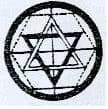
El sello de la Orden: estrella de seis puntas con un triángulo invertido inscrito, ceñida por un círculo punteado y encerrada en una banda gruesa. Es el emblema de la casa, grabado para varios números y colocado a la cabeza de los artículos iniciáticos.La Iniciación (GIDEE, Montevideo), page 6
7Hermoso símbolo de que, si la gran mayoría olvida, desprecia o descuida la parte devocional o espiritual de la vida para “comer y descansar” – imagen del interés, de la indiferencia y de la pereza – eso mismo hace necesario que el verdadero Iniciado, como Hiram, vaya a orar y trabajar en el Templo, para que su sacrificio compense y redima el desinterés de la masa.
8Es la imagen del Karma Colectivo rescatado, por lo menos parcialmente, por aquellos que se dedican tanto y tan sin interrupción, que el Servicio Superior queda realizado a pesar de todos.
937º) – Vimos en la Leyenda de Hiram que, uno después de otro, cada compañero traidor exige a Hiram la Palabra de Maestro, o sea, el Conocimiento y el Poder del Adepto.
10Vimos también la respuesta dada por Hiram y que fue siempre igual: “No la conseguiréis por la violencia sino por el trabajo desinteresado – Completad vuestro tiempo de Compañero”.
1138º) – Vimos aún que cada uno de los tres ambiciosos hirió a Hiram y que los golpes fueron dirigidos, sucesivamente: con la regla a la garganta, con la escuadra al pecho, con el mazo a la cabeza.
12Interpretamos: El primer atacante, Jubelas, simboliza la IGNORANCIA, siempre pretenciosa y que, no pudiendo obtener la revelación, corrompe la Verdad, atacándola en su forma (VERBO-GARGANTA) y difunde como verdades la interpretaciones hechas “sobre una sola dimensión”, que es lo que muestra la regla, dividida en 24 pulgadas, imagen de la relatividad del tiempo y de la experiencia empírica humana, oriunda de la vida diaria (24 horas).
The source text as printed, transcribed diplomatically. Where the source language uses a non-Latin script that reaches us only through a Victorian romanisation, this layer is labelled transliteration, because that is what we hold.
derivedpage 6
1Commentaries on the First Degree of Martinism (Continued) — Teachings of Jehel, S∴I∴
2I continue my commentary on the Ceremonial of Initiation to the Third Degree of Masonry, that of Master Mason: 34th) – We see that there are fifteen fellows — that is, “fifteen”, referring to the 15th card of the Tarot, “The Devil”: the temptation of pride that threatens any Initiate, however elevated, so long as he is an Initiate and not yet an Adept — that is, so long as his “soul” (his personal feelings) keeps putting him through constant trials of “renunciation”, of “depersonalisation”.
3They are fifteen and they are “Fellows”, that is — as I explained in item 29 (see the previous number of “LA INICIACIÓN”) — they must still cultivate Devotional feeling and “merit” an elevation, not “demand” it by irreverent or violent means.
4The Initiation of Elevation is always and only the fruit of KNOWING instilled in the Warmth of Love, of Meekness and of Devotion.
535th) – Of the fifteen conspirators, twelve — that is, the part that feels natural harmony, the cosmic and zodiacal law — renounce the attempt that is being planned; but three, the image of the lower principles, persist and carry it out.
636th) – It is most notable that, in order to attack Hiram, they wait for the hour when he goes to pray, while the workmen eat and rest.
The Seal of Solomon, here the seal of the Order: a six-pointed star with a further inverted triangle set within it, ringed by a dotted circle and enclosed in a heavy band. The house device, cut for several issues and standing at the head of the initiatic articles. This is the symbol the review of the GIDEE exhibition in Nº 11 describes hanging above the Picture of the Adept, the Martinist Order being present in the rooms 'only through its marvellous symbol'.La Iniciación (GIDEE, Montevideo), page 6
7A beautiful symbol: that if the great majority forget, despise or neglect the devotional or spiritual part of life in order to “eat and rest” — the image of self-interest, indifference and sloth — that very thing makes it necessary for the true Initiate, like Hiram, to go and pray and work in the Temple, so that his sacrifice may compensate and redeem the indifference of the mass.
8It is the image of Collective Karma redeemed, at least in part, by those who devote themselves so fully and so without interruption that the Higher Service is accomplished in spite of everyone.
937th) – We saw in the Legend of Hiram that, one after another, each traitorous fellow demands of Hiram the Word of the Master — that is, the Knowledge and the Power of the Adept.
10We saw too the answer Hiram gave, which was always the same: “You will not obtain it by violence but by disinterested work — complete your time as a Fellow.”
1138th) – We saw further that each of the three ambitious men struck Hiram, and that the blows were directed successively: with the rule to the throat, with the square to the breast, with the mallet to the head.
12We interpret: the first attacker, Jubelas, symbolises IGNORANCE — always pretentious, and which, unable to obtain the revelation, corrupts the Truth by attacking it in its form (THE WORD — THE THROAT), and spreads as truths those interpretations made “upon a single dimension”, which is what the rule shows, divided into 24 inches, the image of the relativity of time and of empirical human experience, drawn from daily life (24 hours).
Our translation, period-faithful. Citable as our translation, never as the source.
Commentarywhole issue ·
Comparative[I]ini:2.9:5:013
The column ends by promising the subject a "sure improvement" and a cure that is "total and general". Set beside the same magazine's repeated insistence that readers verify rather than believe, the contrast is sharp: nothing here is offered for checking.
Cross-estate[P-V]ini:2.9:1:003
The second year opens by naming the model outright: Papus founded and directed L'Initiation in Paris, and it ran to a hundred pages a number. The Press now holds that review complete — 284 issues, 1888 to 1912 — so the comparison the editors draw can be checked. Their own first year was mimeographed at 250 copies; the Paris parent was a printed monthly of a hundred pages. The ambition is stated as a measurement, not a boast.
Historical[P-V]ini:2.9:1:010
"In whose image and likeness our own was founded." This is the plainest statement of descent in the whole run: the Montevideo body is a deliberate refounding of Papus's Groupe Indépendant d'Études Ésotériques, publishing a review of the same name. Nº 6 p. 4 had named him as founder of both; here the magazine says what it is.
Historical[P-V]ini:2.9:1:008
A precise piece of publishing history: eight months mimeographed at an average run of 250 copies, and from this number printed, with the run doubled and the page count nearly so. The change in the object itself is visible in the source — the earlier issues are retypes because no printed original survives to photograph.
Cross-estate[P-V]ini:2.9:1:011
The four founders named — Guaita, Papus, Barlet, Péladan — were the actual founders of the Kabbalistic Order of the Rose-Cross in Paris in 1888. The Press now holds three of the four: Papus's two treatises, *Guaita's Le Serpent de la Genèse (1891) and Péladan's Istar (1888), both acquired for this issue. Only Barlet is still missing — and Istar is itself listed in the sommaire of L'Initiation*'s very first number, October 1888.
Historical[S-V]ini:2.9:2:002
The succession given — Guaita, then Barlet, then Papus — is accurate to the Order's own history, as is the role of Brother Teder (Charles Détré) as the link to the later French working under Bricaud and Chevillon. Note the date: Constant Chevillon was alive when this was printed in January 1943. He was murdered in March 1944, fourteen months later.
Historical[P-V]ini:2.9:2:004
Two foundation dates for South America, given precisely: Cedaior creates the basis of the Martinist Order of South America from 1920, and installs the Kabbalistic Order of the Rose-Cross at Curitiba on 22 March 1927 — the equinox. The magazine is careful with these dates in a way it is not always careful with its quotations.
Historical[I]ini:2.9:2:005
The barb is worth marking because it is evidence of a real quarrel: someone in Europe had written that Papus's work resembled "the class of the invertebrates" in the animal kingdom. The Montevideo editors cite it as their reason for independence — not doctrine, but an insult to the dead. Intra-Martinist politics surfacing in a magazine that usually keeps them out.
Cross-estate[P-V]ini:2.9:2:012
Lévi's tetrad again — knowing proved by willing, confirmed by daring, synthesised in keeping silent — here made the actual examination structure of the three Rose-Cross degrees, and glossed as an active silence. Its third appearance in the run, after Nº 3 p. 7 and Nº 6 p. 8, and the only one where it is put to administrative use.
Historical[C]ini:2.9:3:005
This passage was raised by the automated screen for "nuestra raza". Read in full, "our race" here means the human race — the Hierarchs are described as watching over its needs and helping suffering humanity. It carries no hierarchy among races and makes no claim about races in the plural, which is what distinguishes it from the Nº 8 passage that was withheld. Retained, and recorded so the decision is auditable.
Historical[S-V]ini:2.9:3:009
The Suddha Dharma Mandalam's public announcement of 1915 through Dr. Subramani Iyer is a real event, and the organisation is real, though its claim to an unbroken Himalayan hierarchy has been contested since it appeared. The dates given here — initiation 7 May 1915, further initiations in 1915 and 1923 — are the ones the movement's own literature gives.
Historical[P-V]ini:2.9:3:014
The admission is the interesting part: there is at present no External Initiator. Jehel states that the authority died with Subrahmaniayananda in December 1924 and has not been conferred again — and then, on the next page, that he cannot initiate anyone into the order himself. A magazine claiming a Himalayan hierarchy also telling its readers that the door is shut is not doing what puffery does.
Cross-estate[S-V]ini:2.9:4:007
"AMAUTA" is the president of the Rosicrucian Fraternity of Uruguay — the body whose founder-president was named in Nº 1 p. 4 as Julio C. Hirian Corda, when his book entered the Order's library. The same institutional thread runs from the first issue's bibliography to this contributor's byline.
Comparative[R]ini:2.9:4:011
The therapeutic claims on this and the following page — that complete breathing will effect an improvement and cure no drug can, that soured milk and wholemeal bread will disinfect the intestines, that planetary aspects show deficient oxygenation — are reproduced as printed and are not endorsed. This is astrological diagnosis of a named living person's illness, offered as treatment, and no part of it should be acted on.
Comparative[P-V]ini:2.9:6:002
The reading turns on a number: fifteen conspirators, and so the fifteenth card of the Tarot, the Devil — pride, the temptation that threatens an initiate for as long as he is only an initiate. The card is correctly identified, and the interpretative move is the article's standard one, reading a count in the legend as a reference to the trumps.
Comparative[I]ini:2.9:6:005
Of the fifteen, twelve withdraw — the zodiacal number, "the part that feels natural harmony" — and three persist. The article gets a whole doctrine out of 15 = 12 + 3, and it is candid that this is interpretation rather than narrative.
Comparative[P-V]ini:2.9:6:011
The three blows are correctly given in their ritual order — the rule to the throat, the square to the breast, the mallet to the head — and are then read as three orders of injury to truth: to its form, to its life and law, and to its very principle. It is the most sustained piece of symbolic reading in the instalment.
Comparative[I]ini:2.9:7:005
"JUBELAM (a plural ending — take note)" is the writer catching something real in the ritual names and making it carry weight: the third assassin stands not for an individual fault but for organised, conscious enmity — "the black Magi, the Venal or Corrupted Associations". Whether the grammar bears the reading is another matter.
Historical[C]ini:2.9:8:005
Raised by the automated screen for "LAS RAZAS". The sentence lists individuals, societies, nations and races as the kinds of agent that suffer the consequences of deforming truth. There is no hierarchy and no claim about races as such — the same reading on which the universalist passages of Nº 8 were retained. Retained, and recorded.
Comparative[I]ini:2.9:8:008
The instalment closes on a social reading of the legend: each stage of initiation is to bring the causes of social and individual ills to light and carry them before the powers, civil and initiatic, that can correct them. The Hiram story is being used as a warrant for public action, not withdrawal.
Comparative[P-V]ini:2.9:9:007
The classification is worked correctly against the chart built across Volume I: Jupiter and Venus in Cancer and the Wheel of Fortune in Capricorn give three bodies in cardinal signs; Sun, Moon and Mercury in Leo give three in fixed; Saturn, Uranus, Neptune and Mars fall in common signs. The elemental sort that follows agrees with it.
Comparative[C]ini:2.9:9:012
"The TEN PLANETS of modern Astrology — that is, including Neptune, Uranus and the Wheel of Fortune." The Wheel of Fortune is a calculated point, not a body, and Papus had been quoted in Nº 3 refusing Uranus and Neptune outright. The course keeps its own counsel and counts all ten, without remarking on the disagreement with its authority.
Comparative[P-V]ini:2.9:10:020
The five accidental dignities are the traditional ones — angularity, direct motion, nearness to the midheaven, rising before the Sun, and mutual reception — and the article is honest that it applies only the first in the worked example. Its closing caution is a good one: two planets may be dignified in the same house without sharing a sign.
Historical[P-V]ini:2.9:11:001
Wronsky returns — the byline that carried the Schopenhauer article in Nº 7 — now on transcendent psychology. Whoever wrote under it was the magazine's philosopher, and the two essays share a method: set two positions against each other, then dissolve the opposition by denying its terms.
Historical[C]ini:2.9:11:006
The attribution of the word psychology to Melanchthon is the common story and is at best partial. The term is generally traced to Marulić early in the sixteenth century and to Goclenius in 1590; Melanchthon used it in lecturing but did not coin it. The article states a contested point as settled.
Historical[P-V]ini:2.9:11:009
Wundt's Grundzüge der physiologischen Psychologie did appear in 1873–74, and taking it as the origin of psychology as a discipline is the orthodox view then and now. The roll of definitions that follows — Wundt, Roustan, Ladd, James, Lavaissière — is a real survey, not a decorative list.
Cross-estate[P-V]ini:2.9:12:009
And here the thread reaches Volume II. "It postulates the first hermetic principle, which says: The Universe is Mental" — the first Hermetic principle is the Kybalion's own phrasing for exactly this sentence. Wronsky is the same writer who in Nº 7 p. 20 credited it to the Emerald Tablet; here he uses the correct framing without naming the book. Across Nº 1, Nº 3, Nº 5, Nº 7 and now Nº 9, the magazine circles one borrowed maxim and lands on the right description at last.
Comparative[I]ini:2.9:12:013
The move is characteristic: where scientific psychology asks whether mind reaches object or object reaches mind, transcendent psychology answers that the question is malformed, since both are in one continuum. The same dissolution of a false alternative that the Schopenhauer article performed on subject and object in Nº 7.
Comparative[I]ini:2.9:12:022
The instalment ends on a genuine dilemma rather than an assertion: if the world is matter and energy and man contains life besides, then either life is in the world — in which case where did it come from — or man is something other than the world, which cannot be. It is left open, "to be continued".
Comparative[C]ini:2.9:7:010
The line given as Pythagoras's — "When injustice reigns, the wise man keeps silent and withdraws" — is not a quotation from the Golden Verses. The doctrine, however, is Pythagorean and the Press now holds it. The 1917 Golden Verses and Thomas Taylor's 1818 Life of Pythagoras were acquired for this issue; Iamblichus describes the school's discipline of silence, the subjugation of the tongue, and the arcana "kept with the greatest silence from being divulged to strangers", and quotes the Asclepius on the age in which "every divine voice is by a necessary silence dumb". That is precisely the writer's point — revelation withdraws where it cannot be rightly rendered. Greek to Latin to French to Spanish is a long road for a sentence; the teaching survives it even where the wording does not.