GENERALITIES. The purpose of the studies to be published in this Review is to make known something of the sublime doctrines of India. We may group these studies under the common denomination of “Methodology of Yoga”. The aim will be to explain and set out, in a simple and synthetic form within…
The Progressive Course of Asana Yoga — Asuri Kapila, 1942–45
The course as La Iniciación printed it, from May 1942 to March 1945, one lesson after another: the issue and page where each appeared, its original plates, and the entry it became in the Praxis Library. Every lesson’s text is open in the Lycaeum.
Lesson 1 of 29
The science that studies the doctrine of “Yoga” is called the yogic science; the man who obtains visible and palpable results, and who comes to assimilate that science in his heart and mind, is called a “yogi”. The hermetic schools that teach the yogic sciences in India are called Yogacharya…
Padmasana — the Lotus posture
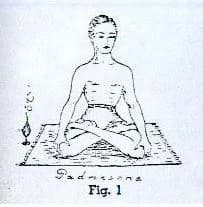
It must not be forgotten that the principal accomplishments for the attainment of Yoga are: YAMA: to kill nor destroy no manifestation of life, to be truthful, and not to squander the sexual forces for the mere pleasure of sensuality. This is the first stage of RAJA YOGA.
Show
Posture 1 of 1
VARIANTS OF PADMASANA. — The PADMASANA posture may be performed with variants. Based upon them there exist more than ten different postures, which will be made known in this course.
Its library entry and plates open with a membership.
We shall now study the second and most important ASANA, called SARVANGASANA (the posture of all the limbs). This Asana, if it is practised constantly, is extraordinary in its results for its enormous benefits, physical as well as mental and spiritual. It was given the name SARVANGASANA because in…
Its library entry and plates open with a membership.
SALABHASANA — The third Asana we are going to describe is called SALABHASANA, or “posture of the locust”, because it resembles the posture the locust adopts when it is ready to spring. SALABHASANA is practised in the following manner: Lie with the front surface of the body on the ground and place…
Its library entry and plates open with a membership.
The fourth Asana has been given the name HALASANA, or “posture of the plough”, because it has all the characteristics of a plough, as readers will be able to verify in Fig. 7. Indeed, HALA in Sanskrit means “plough”.
Its library entry and plates open with a membership.
The fifth Asana has been given the name DHANURASANA, or “posture of the bow”, because when it is performed it has all the aspect of a bow. DHANURA in Sanskrit means “bow”.
Its library entry and plates open with a membership.
Savasana — the Corpse posture (revitalisation)
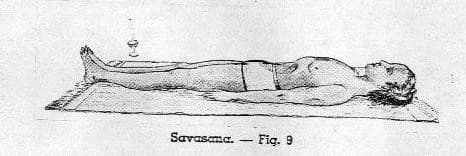
The sixth Asana we shall describe bears the name SAVASANA, and may be practised either after intense work, physical or mental, or on finishing other Asanas, for this one is known as the “posture of revitalisation”. TECHNIQUE. – Lie on the floor, on the back, keeping the legs together and the heels…
Show
Posture 1 of 1
Paschimottanasana — seated forward bend
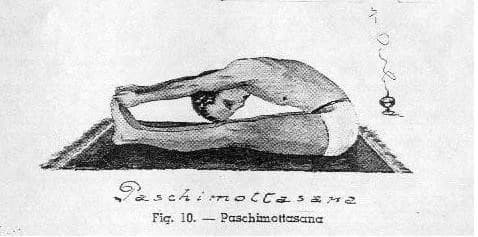
Paschimottanasana. — The seventh Asana bears the name Paschimottanasana.
Show
Posture 1 of 3
Janusirasana. The eighth Asana we are going to study is called JANUSIRASANA, or “posture of the head and knee”, because it is these parts of the body that play the principal part. Technique. — Sit, as usual, on the floor; bend the left leg and, with the heel, press gently on the region of the right…
Its library entry and plates open with a membership.
Having reached this point in our “Progressive Course of Asana Yoga”, before going forward with the publication of further Asanas we wish to give our readers some advice which we believe will be of great use to those who wish to devote themselves to the study and practice of Asana Yoga. This advice…
DIFFERENT WAYS OF PRACTISING PRANAYAMA. It has seemed useful to us, before continuing with other Asanas, to make known to those who not only study but above all practise the exercises we have published so far, some different methods of breathing with which Pranayama is concerned. Indeed, of what…
Its library entry and plates open with a membership.
PADANGUSTHASANA — Our dear readers having now had sufficient time to practise all the Asanas published in earlier numbers of LA INICIACIÓN, we present to them again a new Asana, known by the name of PADANGUSTHASANA, which means "to balance upon the heels". TECHNIQUE. — First movement: standing…
Its library entry and plates open with a membership.
SUPTA VAJRASANA — The asana we present to our readers in this number is called SUPTA VAJRASANA. The peoples of the East consider it a posture of great efficacy — especially the Muslims, who practise it daily in their prayers. Figure 13!
Its library entry and plates open with a membership.
Trikonasana — the Triangle posture
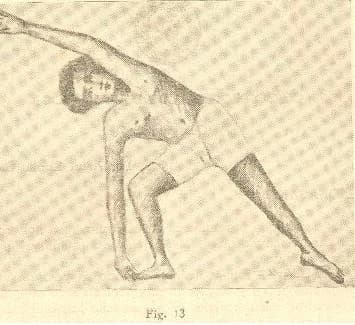
TRIKONASANA — The asana we present to our readers in this number is called TRIKONASANA, which means "posture of the three angles". TECHNIQUE.- First movement: standing vertical, feet together and arms naturally extended at the sides of the body, move the right foot sideways to a distance of sixty…
Show
Posture 1 of 3
PADAHASTHASANA — This asana, whose name means "posture of the foot and the hand", is identical to PASCHIMOTTASANA (published in Nº 10 of LA INICIACIÓN), with the sole difference that, while the latter is performed lying down, this one is performed standing. TECHNIQUE — First movement: standing…
Its library entry and plates open with a membership.
GARBHASANA: This asana, rather difficult to perform owing to the complicated position of hands and legs, bears the name GARBHASANA because it resembles the position of the foetus in the maternal womb. TECHNIQUE. — Seated on the floor, cross the legs as in Padmasana; then pass the arms between…
Its library entry and plates open with a membership.
MAHA-SURYA-PRANASANA — After the publication of a series of Asanas, some easy, others difficult to perform, we now think it opportune to make known to the readers of LA INICIACIÓN a marvellous exercise which may be considered a true "synthesis of asanas" and which bears the name…
Its library entry and plates open with a membership.
MAHA-SURYA-PRANASANA — The benefits obtained by the practice of that first posture may be summed up in an increase of the circulation of "prana" in the whole organism. TECHNIQUE OF THE 2nd POSTURE: HASTA-AGNITEJAS-ASANA.— This second posture, whose name means "position of the hands touching the…
Its library entry and plates open with a membership.
MAHA-SURYA-PRANASANA — TECHNIQUE OF THE SIXTH POSTURE: NAGA-ASANA.— The sixth posture, whose name means "posture of the serpent", is practised in the following manner: Being in the fifth posture, extend the arms while inhaling slowly and deeply, then throw the head back as if wishing to look at the…
Its library entry and plates open with a membership.
ADHIRATHASANA — This asana, whose literal meaning is "lying upon the chariot", is practised in the following manner: Lie on the floor on the back with the legs well stretched and the arms naturally extended at the sides of the body. Contract and relax several times all the muscles of the body.…
Its library entry and plates open with a membership.
PRANA-JUJ-ASANA. This beautiful asana is named Prana-Juj-Asana (from Prana: vital energy; Juj: to unite; Asana: posture) — that is, the posture that permits attracting to oneself and fixing in the Chakras the vital energy or Prana. TECHNIQUE.— Standing, with the chest bare and the arms naturally…
Its library entry and plates open with a membership.
CONSIDERATIONS ON THE PRANA-JUJ-ASANA. On the physical plane the Prana-Juj-Asana is the ideal posture for those who devote themselves to perfecting the forms of the body, and especially for women, to whom it gives harmony and elasticity in the limbs. On the mental plane this asana is also the ideal…
Its library entry and plates open with a membership.
MAHA-ASANA — This Asana (from the Sanskrit Maha-Great and Asana-Posture) means etymologically Great Asana, and is also named "bridge posture". TECHNIQUE. It is performed as follows: 1) Kneel with the trunk well erect, the arms naturally extended at the sides of the body, and looking forward.
Its library entry and plates open with a membership.
MULA UDDIYANA JALANDHARA BHANDHAS. This posture is one of the most secret of Asana Yoga; it is practised as follows: 1) Sit on the floor in Padmasana. 2) Exert a light pressure with the left heel upon the generative organ, at the same time contracting the anus.
Its library entry and plates open with a membership.
Principles of the Yoga Mudra. The mysterious, mystical and mute language of the Spirit and of the Exalted Beings who dwell in the invisible planes superior to our physical world. This brief article on Yoga Mudra ought not to be brought to light, since these subjects form a very advanced part of the…
Its library entry and plates open with a membership.
MAHA SAKTI ASANA. — This asana, whose meaning is “Great Energetic Posture”, is practised as follows. 1) Standing, with the body well erect, the arms extended naturally at the sides of the body, the heels together and the toes turned somewhat outward. 2) Throw the head backward and, while breathing…
Its library entry and plates open with a membership.
BADDHA PADMASANA. — This asana (which is a variant of the Padmasana published in No. 3 of La Iniciación) is practised as follows: 1) Sit in Padmasana, endeavouring to bring the heels up to the inguinal regions.
Its library entry and plates open with a membership.
67 more library entries open at Practitioner. Practitioner · $9 a month — see what it adds →
2 more library entries open at Scholar. Scholar · $27 a month, by application — see what it adds →