Le Phénomène humain — Pierre Teilhard de Chardin (1955)
FOREWORD
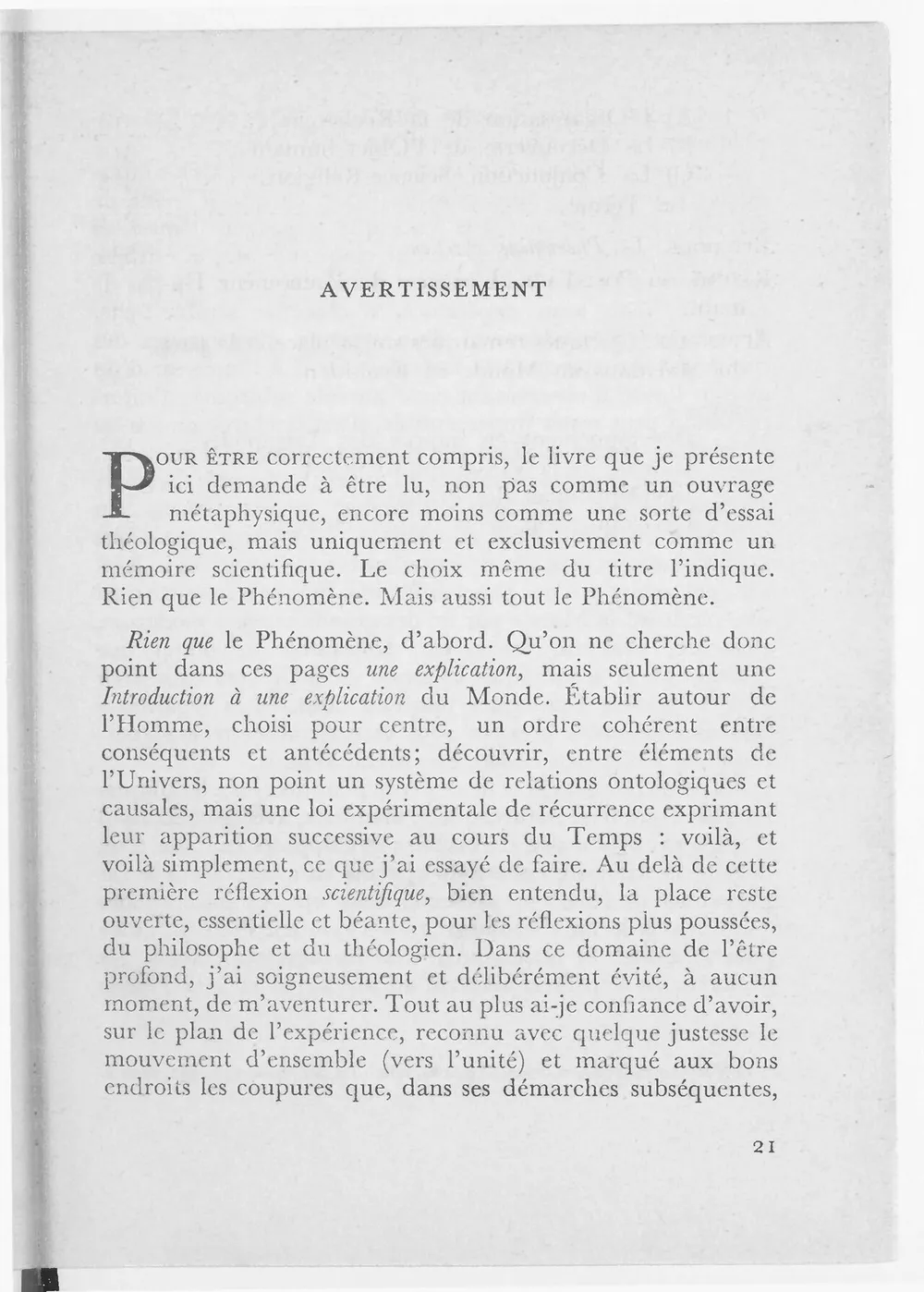
If it is to be understood correctly, the book I present here asks to be read not as a work of metaphysics, still less as a kind of theological essay, but solely and exclusively as a scientific treatise. The very choice of title says so. Only the Phenomenon. But also the whole Phenomenon.
Only the Phenomenon, first. Let no one, then, look in these pages for an explanation, but only for an Introduction to an explanation of the World. To establish around Man, chosen as the centre, a coherent order between consequents and antecedents; to discover among the elements of the Universe not a system of ontological and causal relations, but an experimental law of recurrence expressing their successive appearance in the course of Time: that, and simply that, is what I have tried to do. Beyond this first scientific reflection, of course, the field remains open, essential and gaping, for the more searching reflections of the philosopher and the theologian. Into that domain of deep being I have carefully and deliberately avoided, at any moment, venturing. At most I am confident that, on the plane of experience, I have recognised with some accuracy the overall movement (towards unity) and marked in the right places the breaks which, in its subsequent steps and for reasons of a higher order, philosophical and religious thought would be entitled to demand[1].
But the whole Phenomenon, too. And this is what, without contradicting (however it may seem) what I have just said, risks giving the views I suggest the appearance of a philosophy. For some fifty years the critique of the Sciences has demonstrated it more than amply: there is no pure fact; every experience, however objective it may seem, is inevitably wrapped in a system of hypotheses as soon as the scientist tries to formulate it. Now if, within a limited field of observation, this subjective halo of interpretation can remain imperceptible, it is bound, in the case of a vision extended to the Whole, to become almost dominant. As happens to the meridians as they approach the pole, Science, Philosophy and Religion necessarily converge in the neighbourhood of the Whole. They converge, I say; but without merging, and without ceasing, right to the end, to attack the Real from different angles and on different planes. Take any book written about the World by one of the great modern scientists, Poincaré, Einstein, Jeans, and so on. It is impossible to attempt a general scientific interpretation of the Universe without seeming to want to explain it to the very end. But only look more closely, and you will see that this “Hyperphysics” is not yet a Metaphysics.
In the course of any effort of this kind to describe the Whole scientifically, it is natural that there should appear, at its fullest extent, the influence of certain initial presuppositions on which the entire structure of the system going forward depends. In the particular case of the Essay presented here, two primordial options (I wish to point this out) are added one to the other to support and govern all the developments. The first is the primacy accorded to the psychic and to Thought in the Stuff of the Universe. And the second is the “biological” value attributed to the Social Fact around us.
The pre-eminent significance of Man in Nature, and the organic nature of Humanity: two hypotheses that one may try to refuse at the outset; but without which I do not see how one could give a coherent and complete representation of the Human Phenomenon.
Paris, March 1947
So for the moment I am putting all the strength and leisure I have into advancing the book you know of. If it succeeds, perhaps it will be the gesture that other gestures will follow. Pray that I manage to find the words I wanted in order to express and make others see what I believe I see. In strict truth, I am aware that I am not writing for myself, but with a desire (such as I have never felt) to make Him appear greater, as He must be. But it is so hard to translate into sentences a vision, however clear, of an ideal… One would need the thought and the style of Plato himself… In the end, I shall have done what I can. I expect to finish before the end of the summer. And then it is next year that the question of publication will have to be taken up, by me in Europe, if possible.
Keep me informed of what you are doing and seeing.