Le Milieu divin — Pierre Teilhard de Chardin (1957)
FOREWORD
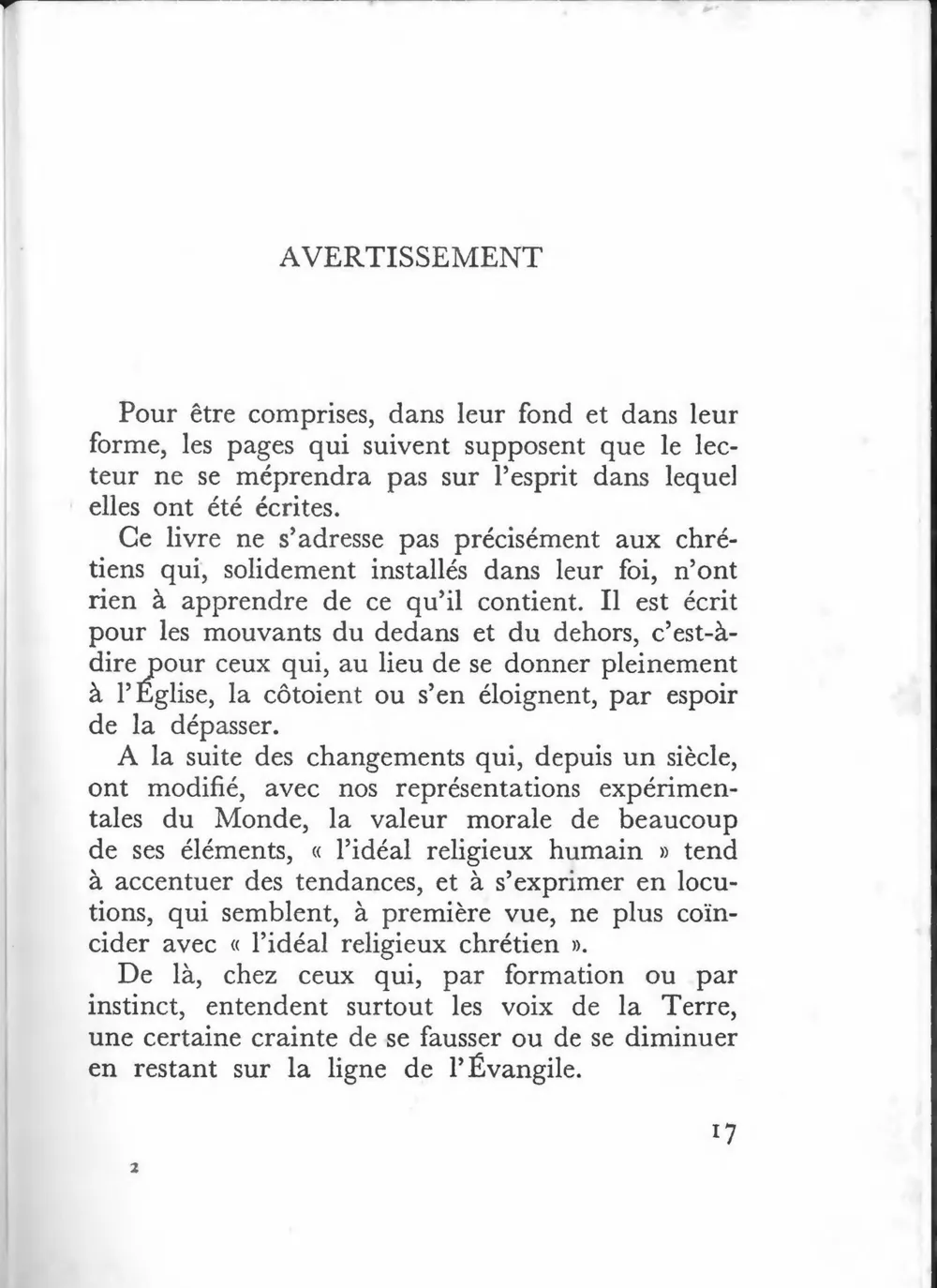
To be understood, in their substance and in their form, the pages that follow assume that the reader will not mistake the spirit in which they were written.
This book is not addressed, strictly speaking, to those Christians who, firmly settled in their faith, have nothing to learn from what it contains. It is written for the waverers, within and without: that is, for those who, instead of giving themselves wholly to the Church, skirt along its edge or drift away from it, in the hope of going beyond it.
Following the changes that, over the past century, have altered, together with our experimental representations of the World, the moral value of many of its elements, “the human religious ideal” tends to stress certain tendencies, and to express itself in turns of phrase, that seem at first sight no longer to coincide with “the Christian religious ideal”.
Hence, among those who, by training or by instinct, hear above all the voices of the Earth, a certain fear of distorting or diminishing themselves by staying on the line of the Gospel.
To prove, by a kind of tangible verification, that this anxiety is groundless, since the most traditional Christianity, that of Baptism, of the Cross and of the Eucharist, can be translated into terms that carry the best of the aspirations proper to our time: such is the aim of this Essay on life, or on inward vision.
May it help to show that, ever ancient and ever new, Christ has never ceased to be “the first” in Humanity.
An important observation.
These pages should not be read as a complete treatise of ascetic theology, but as the simple description of a psychological evolution observed over a well-defined interval. A possible series of inner perspectives, gradually opening to the mind in the course of a modest “illuminative” ascent: that is all we have set out to record here.
Let no one be surprised, then, if so small a place, to all appearances, is given to moral evil, to sin: the soul with which we are concerned is assumed to have already turned away from the paths of guilt.
Nor let anyone be troubled if the action of grace is not invoked more often, explicitly. The subject studied here is present-day Man, concrete, “supernaturalized”, taken solely in the domain of his conscious psychology. Nature and Supernature, divine influence and human operation, did not therefore need to be explicitly distinguished. But if the words are missing, the thing is implied, everywhere. Not merely as an entity admitted in theory, but as a living reality, the notion of Grace pervades the whole atmosphere of the account.
Indeed, the Divine Milieu would lose all its grandeur and all its savour for the “mystic” if, through his whole “participated” being, through his whole soul freely justified, through his whole will called upon and strengthened, he did not feel himself so completely losing his footing in the divine Ocean that, in the end, no first point of support would be left to him, to himself in the depths of himself, for his action.
INTRODUCTION
“In eo vivimus.”
The enrichment and the unrest of religious thought in our time are no doubt due to the revelation taking place, around us and within us, of the greatness and the unity of the World. Around us, the Sciences of the Real are extending the abysses of time and space beyond all measure; and they are constantly uncovering new links between the elements of the Universe. Within us, under the exhilaration of these discoveries, a whole world of unitary affinities and sympathies, as old as the human soul, but dreamed of until now rather than lived, is awakening and taking on substance. Learned and nuanced in true thinkers, naive or pedantic in the half-educated, the same aspirations towards a vaster and better organized One, the same presentiments of unknown energies put to use in new domains, are appearing everywhere at once. It is almost commonplace today to meet the man who, without affectation, quite naturally, lives with the explicit awareness of being an atom or a citizen of the Universe.
This collective awakening, like the one that one fine day makes each individual aware of the true dimensions of his life, necessarily has a profound religious repercussion on the human mass, either to cast down or to exalt.
For some, the World proves too great. In such a whole, Man is lost; he does not count: there is nothing left for us but to be ignored and to disappear. For others, on the contrary, the World is too beautiful: it is the World, and the World alone, that must be adored.