Legge calls Yang (the speaker in Lieh-ȝze) ‘that heretic’, the label of the Confucian tradition that opposed him. In a note on a Taoist text it takes one school’s verdict as settled. The point Legge makes with the passage is sound, that the sentences were current sayings and that Lieh-ȝze introduces one with ‘according to an old saying’, and it stands without the epithet.
The Tâo Teh King — Sacred Books of China Part I, SBE Vol. 39 (trans. James Legge, 1891)
Open to all
page 85
No image is selected for this page; its own page image is shown.
page 85
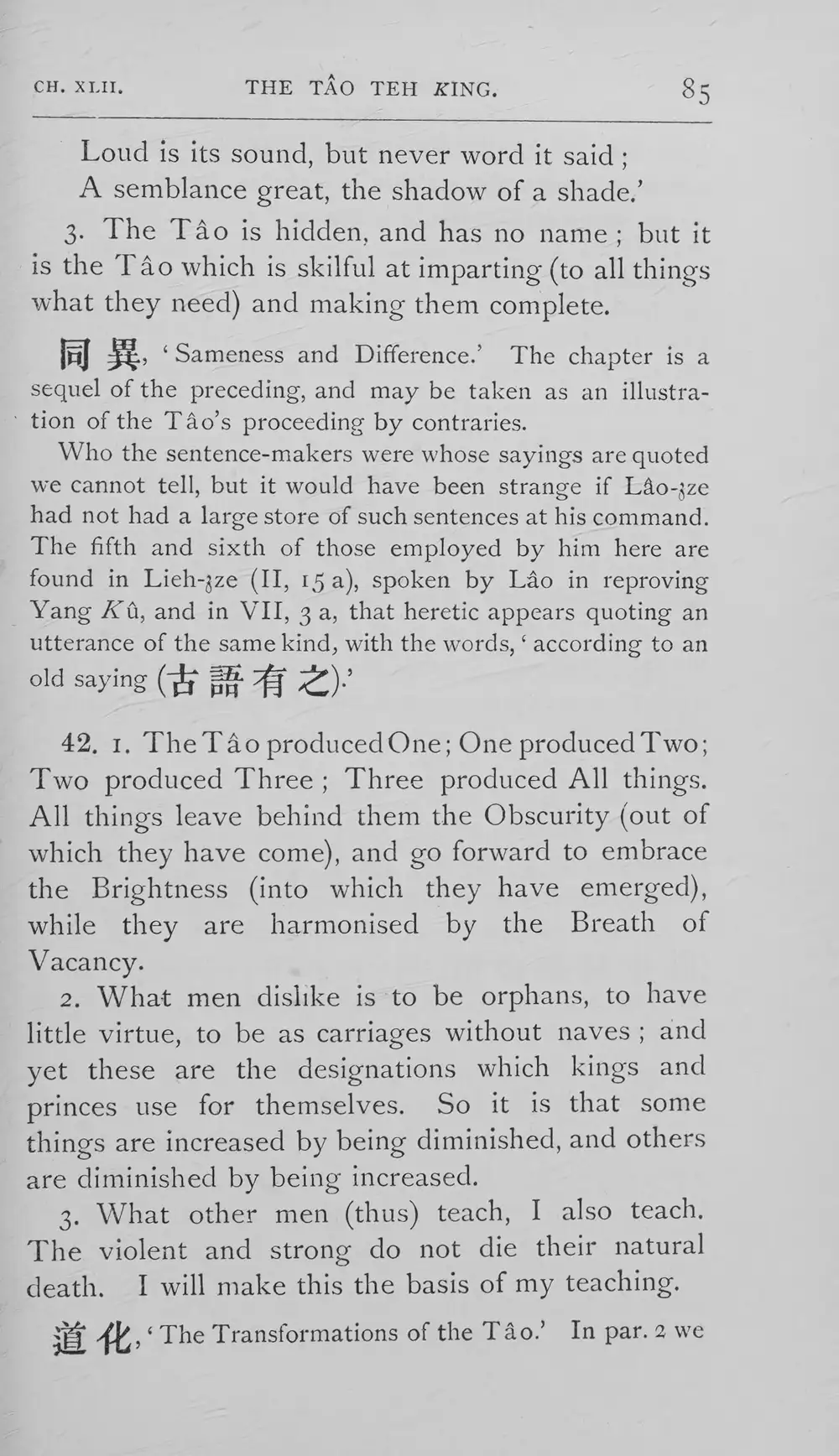
3. The Tâo is hidden and has no name; but it is the Tâo which is skilled at imparting (to all things what they need) and making them complete.
同異, ‘Sameness and Difference.’ The chapter is a sequel to the preceding one, and may be taken as an illustration of the Tâo’s proceeding by contraries.
Who the sentence-makers were whose sayings are quoted we cannot tell, but it would have been strange if Lâo-ȝze had not had a large store of such sentences at his command. The fifth and sixth of those he uses here are found in Lieh-gze (II, 15a), spoken by Lao in reproving Yang X 4; and in VII, 3a, that heretic appears quoting a saying of the same kind, with the words ‘according to an old saying (古語有之)’.
42. 1. The Tâo produced One; One produced Two; Two produced Three; Three produced All things. All things leave behind them the Obscurity (out of which they have come), and go forward to embrace the Brightness (into which they have emerged), while they are harmonised by the Breath of Vacancy.
2. What men dislike is to be orphans, to have little virtue, to be like carriages without naves; and yet these are the names which kings and princes use for themselves. So it is that some things are increased by being diminished, and others are diminished by being increased.
3. What other men (thus) teach, I also teach. The violent and the strong do not die a natural death. I will make this the basis of my teaching.
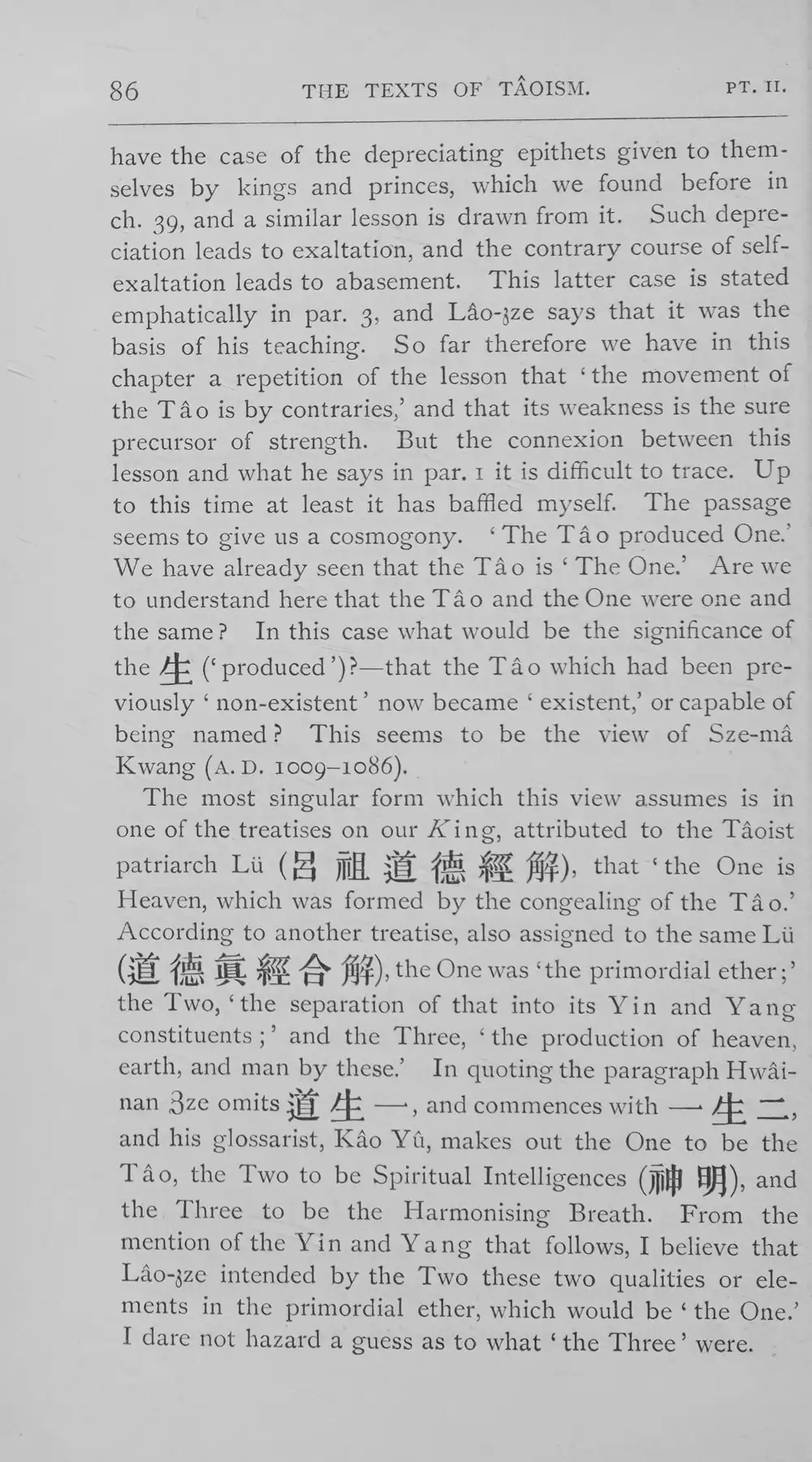
道化, ‘The Transformations of the Tâo.’ In par. 2 we have the case of the disparaging names given to themselves by kings and princes, which we found before in ch. 39, and a similar lesson is drawn from it. Such self-depreciation leads to exaltation, and the contrary course of self-exaltation leads to abasement. This latter case is stated emphatically in par. 3, and Lâo-ȝze says that it was the basis of his teaching. So far, then, we have in this chapter a repetition of the lesson that ‘the movement of the Tâo is by contraries,’ and that its weakness is the sure forerunner of strength.
But the connection between this lesson and what he says in par. 1 is difficult to trace. Up to now, at least, it has baffled me. The passage seems to give us a cosmogony. ‘The Tâo produced One.’ We have already seen that the Tâo is ‘The One.’ Are we to understand here that the Tâo and the One were one and the same? In that case, what would be the significance of the 生 (‘produced’)?—that the Tâo, which had previously been ‘non-existent,’ now became ‘existent,’ or capable of being named? This seems to be the view of Sze-ma Kwang (A.D. 1009-1086).