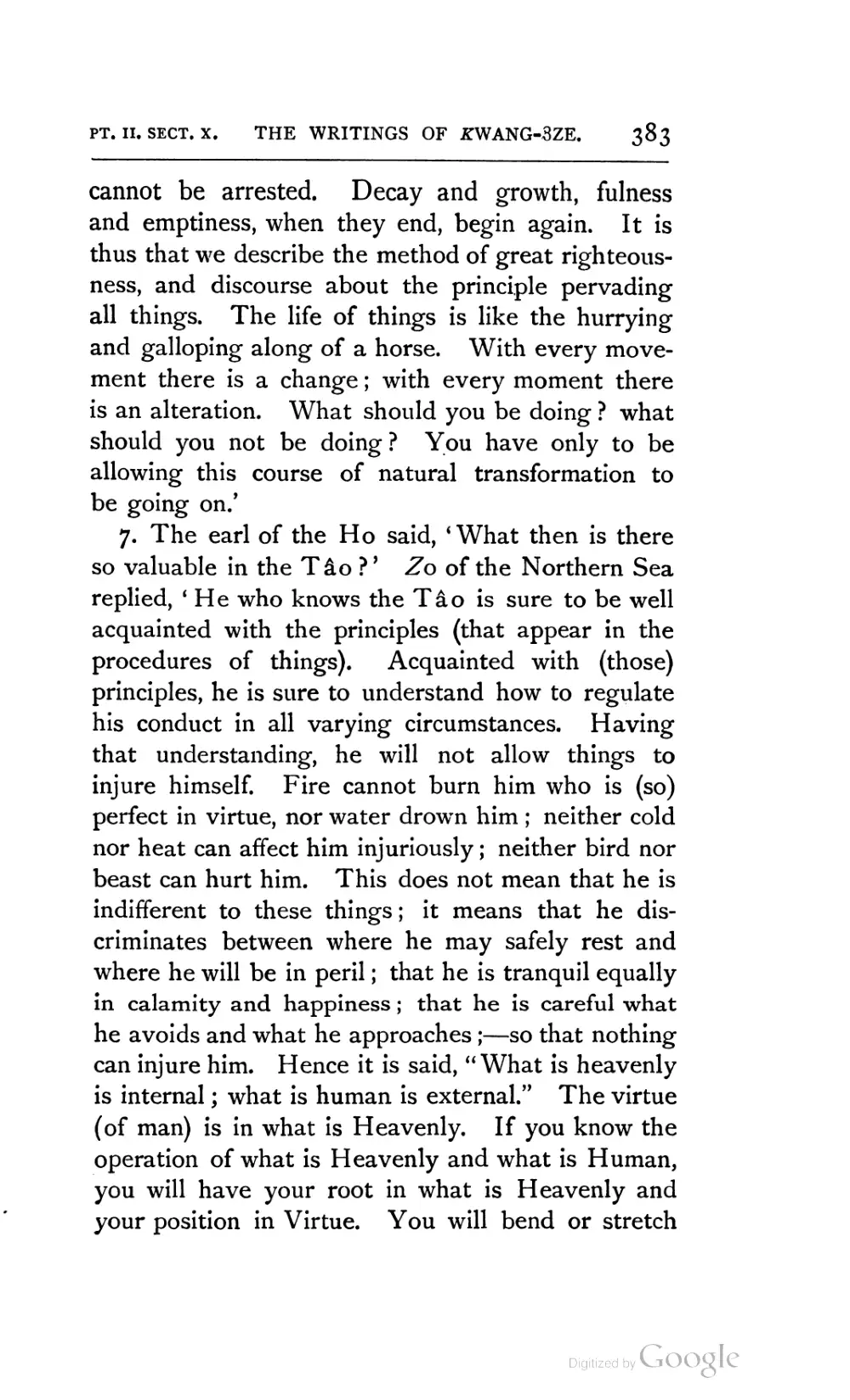
The claim that fire cannot burn the perfect man is explained on the spot: "This does not mean that he is indifferent to these things," but that he discriminates between safety and danger. The passage turns the invulnerability of earlier Books, where the spirit-like man is beyond fire and flood, into prudence. Whether that deepens the image or softens it, it is the text's own gloss on its own figure.
The Tâo Teh King — Sacred Books of China Part I, SBE Vol. 39 (trans. James Legge, 1891)
Open to all
page 383
No image is selected for this page; its own page image is shown.
page 383
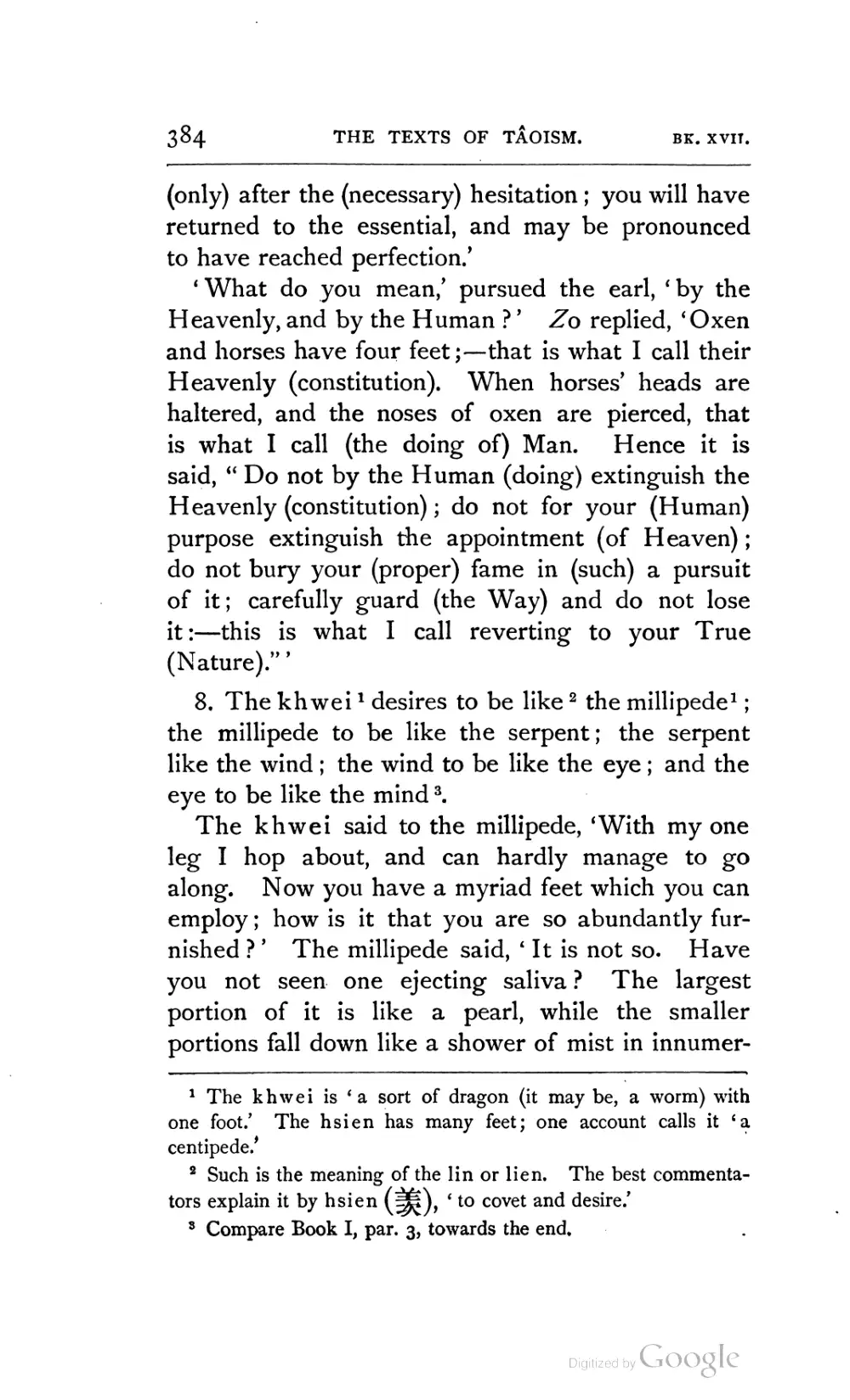
7. The earl of the Ho said, ‘What, then, is there so valuable in the Tâo?’ Zo of the Northern Sea replied, ‘He who knows the Tâo is sure to be well acquainted with the principles (that appear in the workings of things). Acquainted with (those) principles, he is sure to understand how to regulate his conduct in all changing circumstances. Having that understanding, he will not allow things to injure him. Fire cannot burn him who is (so) perfect in virtue, nor can water drown him; neither cold nor heat can harm him; neither bird nor beast can hurt him. This does not mean that he is indifferent to these things; it means that he discerns where he may rest safely and where he will be in danger; that he is equally tranquil in calamity and in happiness; that he is careful about what he avoids and what he approaches;—so that nothing can injure him. Hence it is said, “What is heavenly is internal; what is human is external.” The virtue (of man) is in what is Heavenly. If you know the working of what is Heavenly and what is Human, you will have your root in what is Heavenly and your position in Virtue. You will bend or stretch (only) after the (necessary) hesitation; you will have returned to the essential, and may be said to have reached perfection.’