Legge admits he renders one character, 喪, two ways in this sentence. The cost is a symmetry: the text says the world has lost the Way and the Way has lost the world, a mirror the next clause draws out when the two are "lost to each other." Rendering one half "only led it further astray" breaks the mirror and makes the Way an agent of error, which the passage does not say.
The Tâo Teh King — Sacred Books of China Part I, SBE Vol. 39 (trans. James Legge, 1891)
Open to all
page 371
No image is selected for this page; its own page image is shown.
page 371
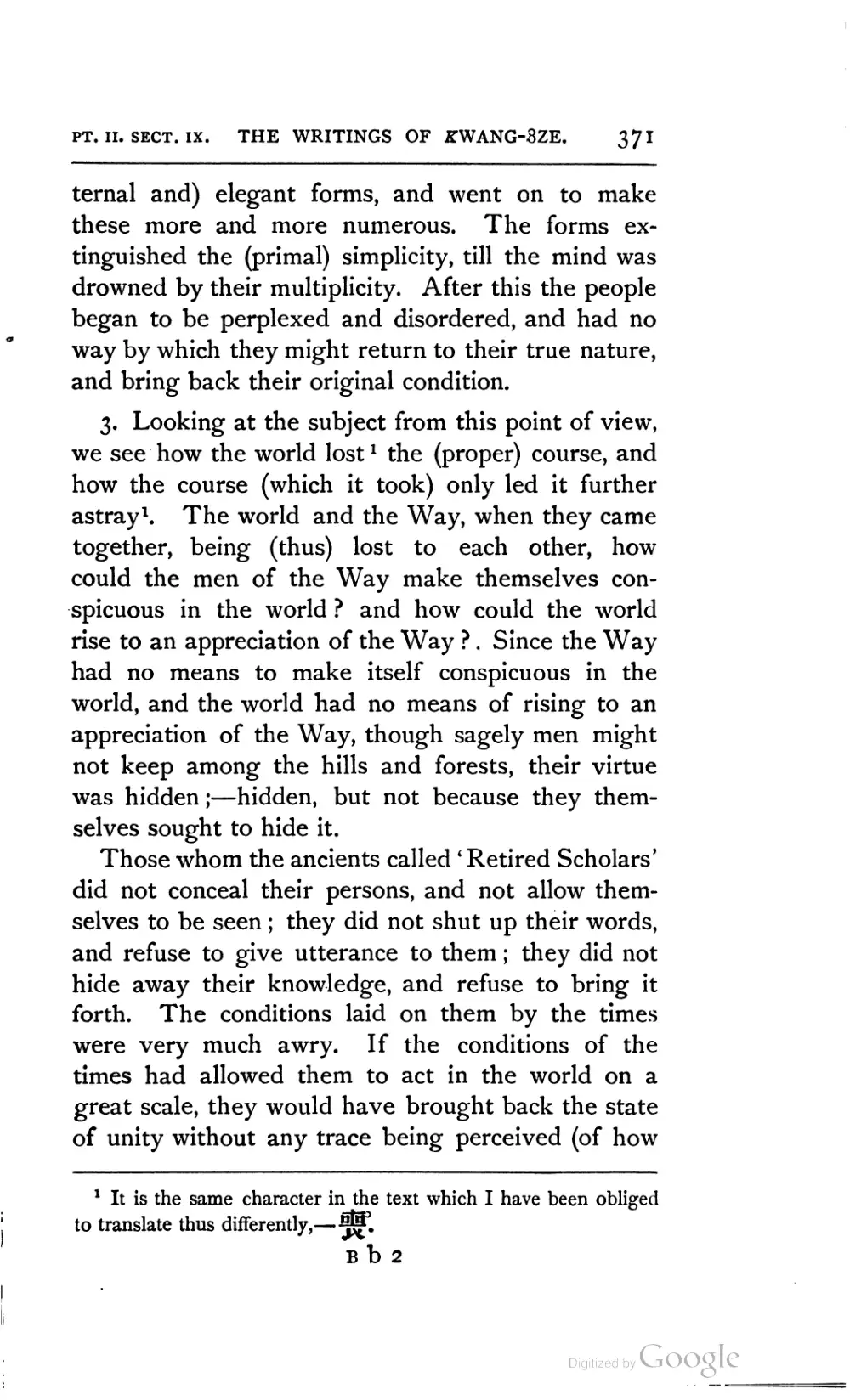
3. Looking at the subject from this point of view, we see how the world lost1 the (proper) course, and how the course (which it took) only led it further astray1. The world and the Way being (thus) lost to each other when they came together, how could the men of the Way make themselves conspicuous in the world? And how could the world rise to an appreciation of the Way? Since the Way had no means of making itself conspicuous in the world, and the world had no means of rising to an appreciation of the Way, though sagely men might not keep among the hills and forests, their virtue was hidden;—hidden, but not because they themselves sought to hide it.
Those whom the ancients called ‘Retired Scholars’ did not conceal their persons and refuse to let themselves be seen; they did not shut up their words and refuse to utter them; they did not hide away their knowledge and refuse to bring it forth. The conditions laid on them by the times were very much awry. If the conditions of the times had allowed them to act in the world on a great scale, they would have brought back the state of unity without any trace being perceived (of how they did so). When those conditions shut them off entirely from such action, they struck their roots deeper (in themselves), were perfectly still, and waited. It was thus that they preserved (the Way in) their own persons.
1 It is the same character in the text which I have had to translate so differently,—喪 [Press: to lose (read in the departing tone)]. Bb 2
The Retired Scholars are defended against the charge Book XV brought against recluses: they "did not conceal their persons" by choice; the times shut them out. Withdrawal becomes a response to circumstance, not a stance. Their virtue was "hidden, but not because they themselves sought to hide it," and that line separates them from the proud men of the hills who open the previous Book.