Legge calls this "A very remarkable use of Tî (帝) for the human spirit in the sense of God." The words "(in man)" in his rendering are his own, added to fit the term to the spirit. Reading Tî as God is his settled theological frame; here the word may mean no more than the spirit's sovereignty over the person. He is right, though, that the subject is the spirit and not the Tâo, and right to tell the reader to observe it.
The Tâo Teh King — Sacred Books of China Part I, SBE Vol. 39 (trans. James Legge, 1891)
Open to all
page 367
No image is selected for this page; its own page image is shown.
page 367
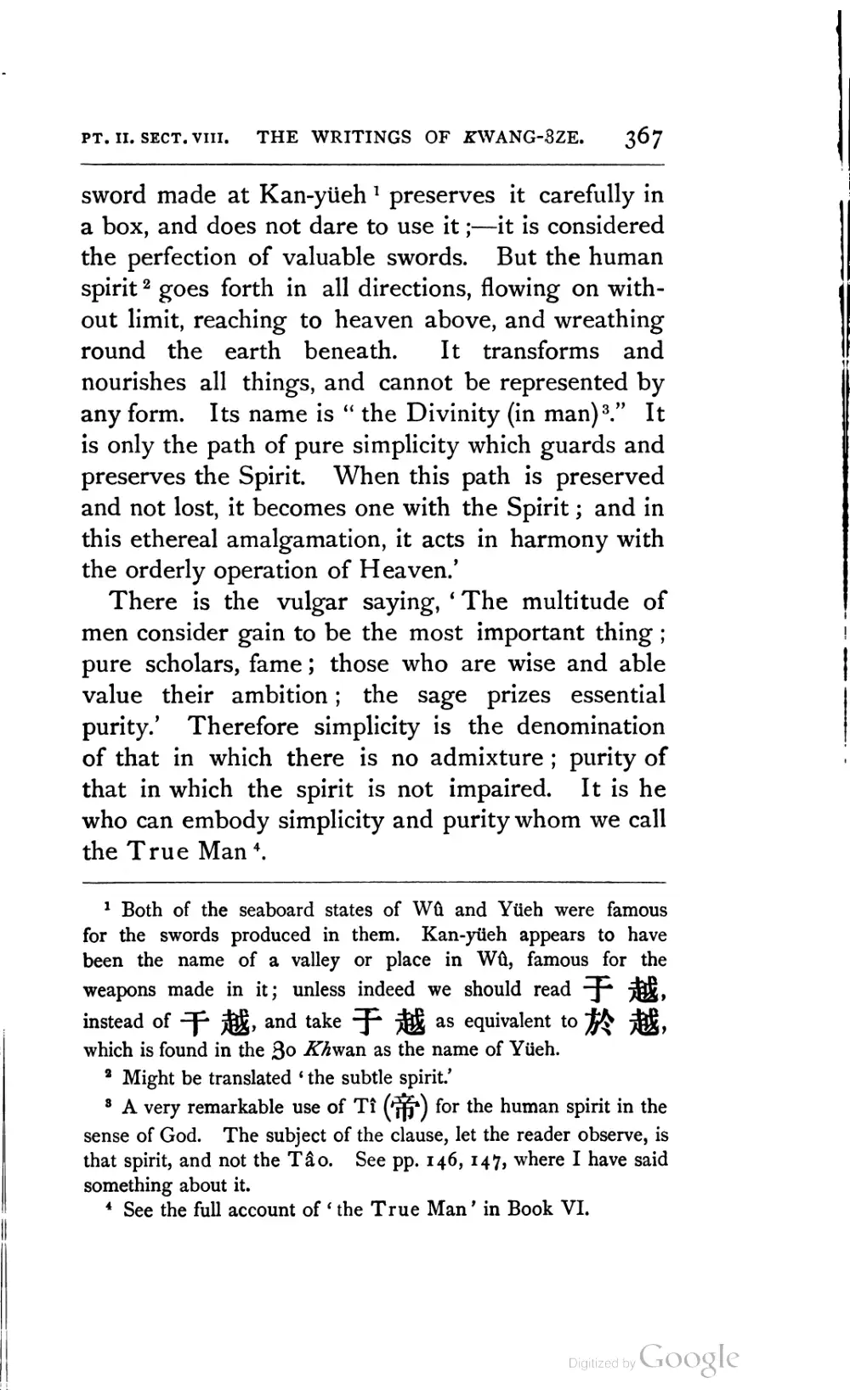
There is the common saying, ‘The multitude of men consider gain the most important thing; pure scholars, fame; those who are wise and able value their ambition; the sage prizes essential purity. Therefore simplicity is the name for that in which there is no admixture; purity, for that in which the spirit is not impaired. It is he who can embody simplicity and purity whom we call the True Man4.
1 Both of the seaboard states of Wa and Yiieh were famous for the swords made in them. Kan-yiieh appears to have been the name of a valley or place in Wa, famous for the weapons made there; unless indeed we should read 于越 instead of 干越, and take 于越 as equivalent to 於越, which is found in the 80 Khwan as the name of Yiieh.
2 Might be translated ‘the subtle spirit.’
3 A very remarkable use of Tî (帝) for the human spirit in the sense of God. The subject of the clause, let the reader note, is that spirit, and not the Tâo. See pp. 146, 147, where I have said something about it.
4 See the full account of ‘the True Man’ in Book VI.