The soldiers who said they were "killing thieves and not killing other men" are quoting a formula of the disputers: the Mohist canons argue that killing a thief is not killing a man. Lao Tan sets the phrase just before the rise of "the Literati and (the followers of) Mo," so the logic of the schools appears as a symptom of the disorder it claims to remedy.
The Tâo Teh King — Sacred Books of China Part I, SBE Vol. 39 (trans. James Legge, 1891)
Open to all
page 360
No image is selected for this page; its own page image is shown.
page 360
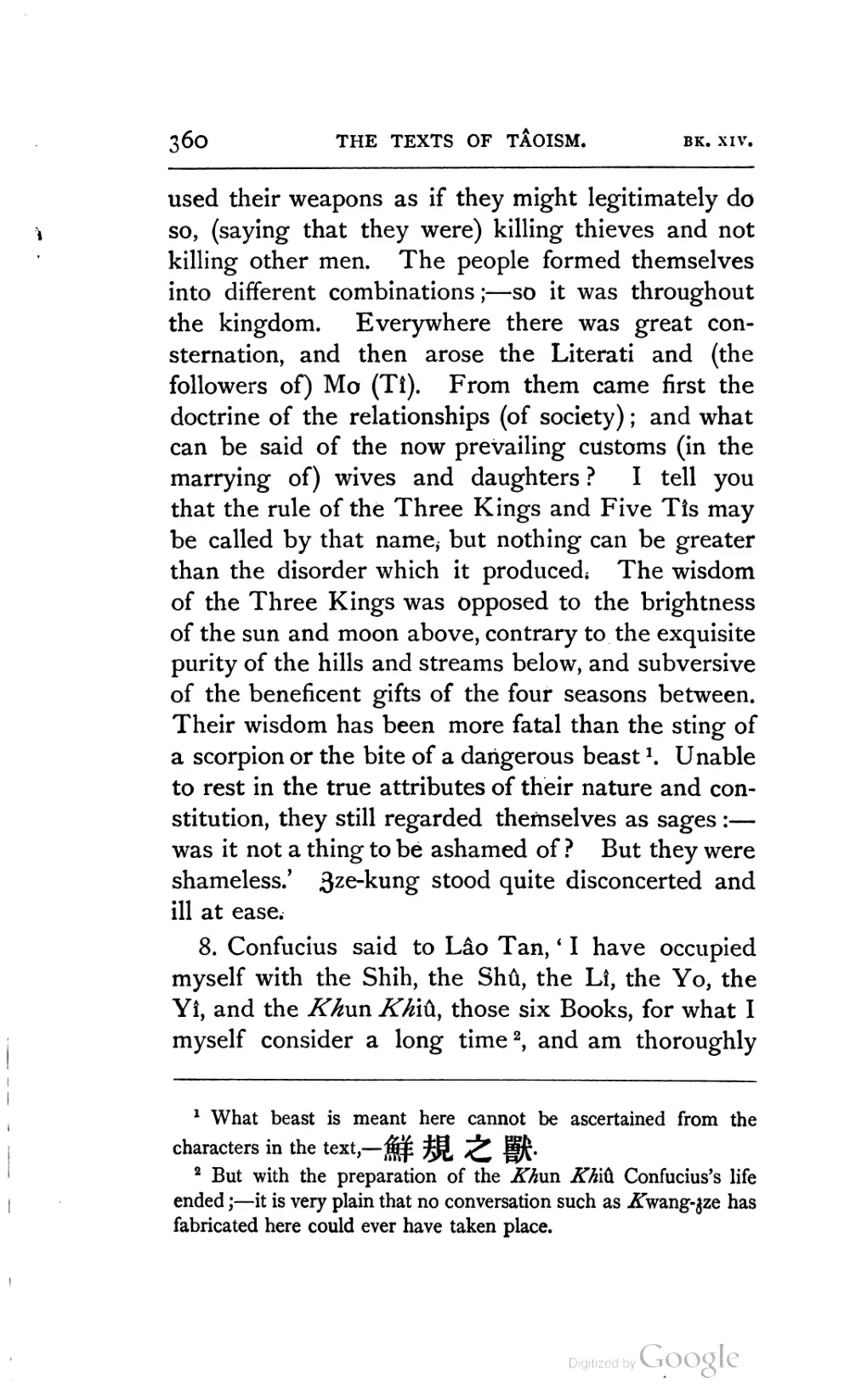
used their weapons as if they might legitimately do so, (saying that they were) killing thieves and not killing other men. The people formed themselves into different combinations;—so it was throughout the kingdom. Everywhere there was great consternation, and then arose the Literati and (the followers of) Mo (Ti). From them came first the doctrine of the relationships (of society); and what can be said of the customs now prevailing (in the marrying of) wives and daughters? I tell you that the rule of the Three Kings and Five Tis may be called by that name, but nothing can be greater than the disorder it produced.
The wisdom of the Three Kings was opposed to the brightness of the sun and moon above, contrary to the exquisite purity of the hills and streams below, and subversive of the beneficent gifts of the four seasons between. Their wisdom has been more deadly than the sting of a scorpion or the bite of a dangerous beast1. Unable to rest in the true attributes of their nature and constitution, they still regarded themselves as sages:—was it not a thing to be ashamed of? But they were shameless.’ Ȝze-kung stood quite disconcerted and ill at ease.
8. Confucius said to Lâo Tan, ‘I have occupied myself with the Shih, the Shû, the Lî, the Yo, the Yî and the Khun Khiû, those six Books, for what I myself consider a long time2, and am thoroughly acquainted with their contents. With seventy-two rulers, all offenders against the right, I have discoursed about the ways of the former kings and set out the examples of (the dukes of) Kâu and Shâo; and not one of them has adopted (my views) and put them into practice:—how very difficult it is to prevail on such men, and to make clear the path to be followed!’
1 What beast is meant here cannot be determined from the characters in the text,—鮮規之獸 [Press: the beast called xian-gui].
2 But Confucius’s life ended with the preparation of the Khun Khiû;—it is very plain that no conversation such as Kwang-ȝze has invented here could ever have taken place.
Legge proves the meeting impossible from chronology: Confucius's work on the Spring and Autumn closed his life, so he could not have discussed all six Books with Lao Tan. The proof is valid but answers a claim the text hardly makes. The speech's "seventy-two rulers, all offenders against the right" is a round, emblematic number, and the scene is built to let the Six Books be called vestiges, not to record an interview.