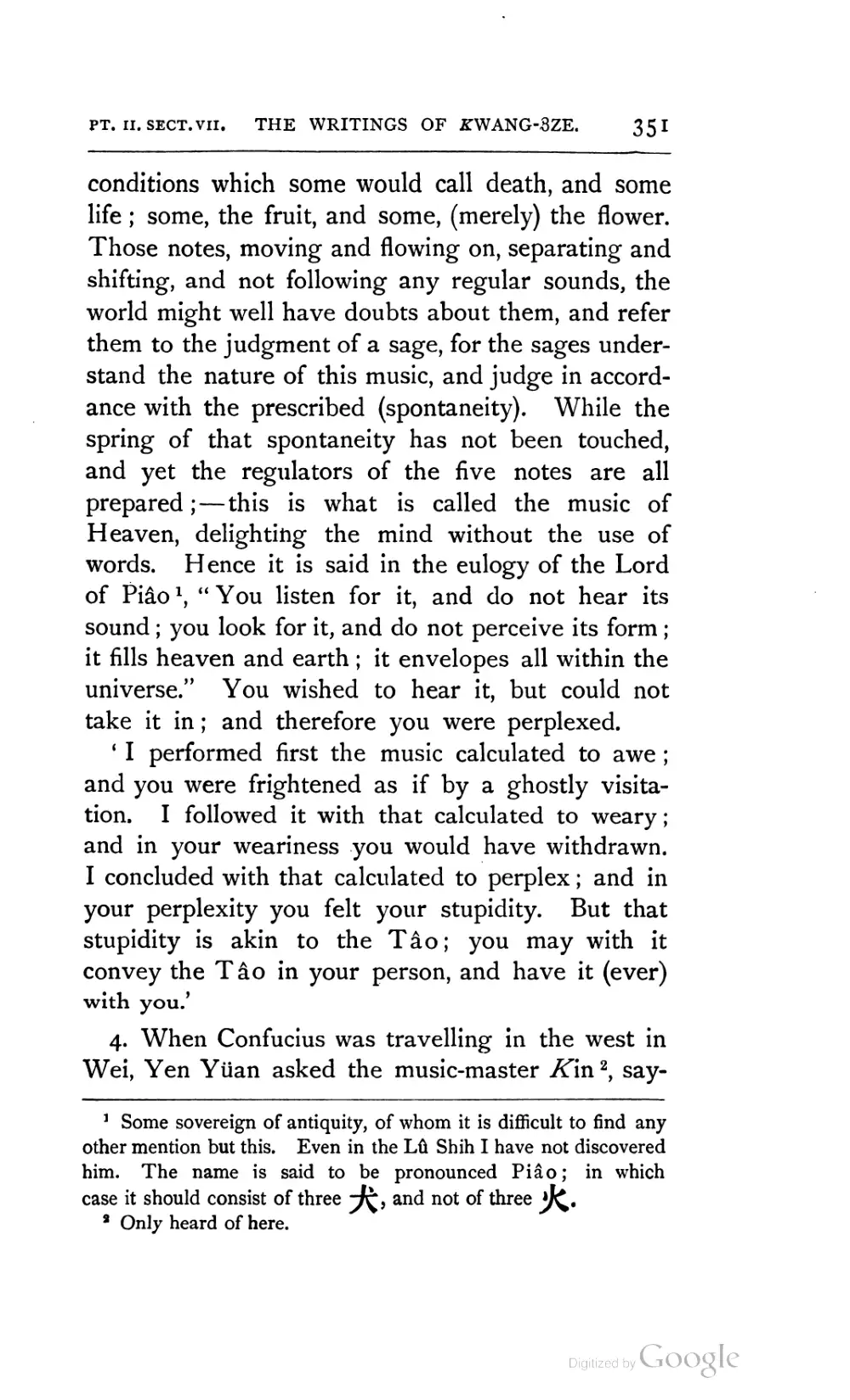
The "eulogy of the Lord of Piao" is quoted as saying, "You listen for it, and do not hear its sound," and that it cannot be seen. The formula is close to chapter 14 of the Tâo Teh King in this same volume, where the Tâo is looked at and not seen, listened to and not heard. Legge cannot find this sovereign anywhere else, which suggests the words circulated as a saying before they were given an author.
The Tâo Teh King — Sacred Books of China Part I, SBE Vol. 39 (trans. James Legge, 1891)
Open to all
page 350
No image is selected for this page; its own page image is shown.
page 350
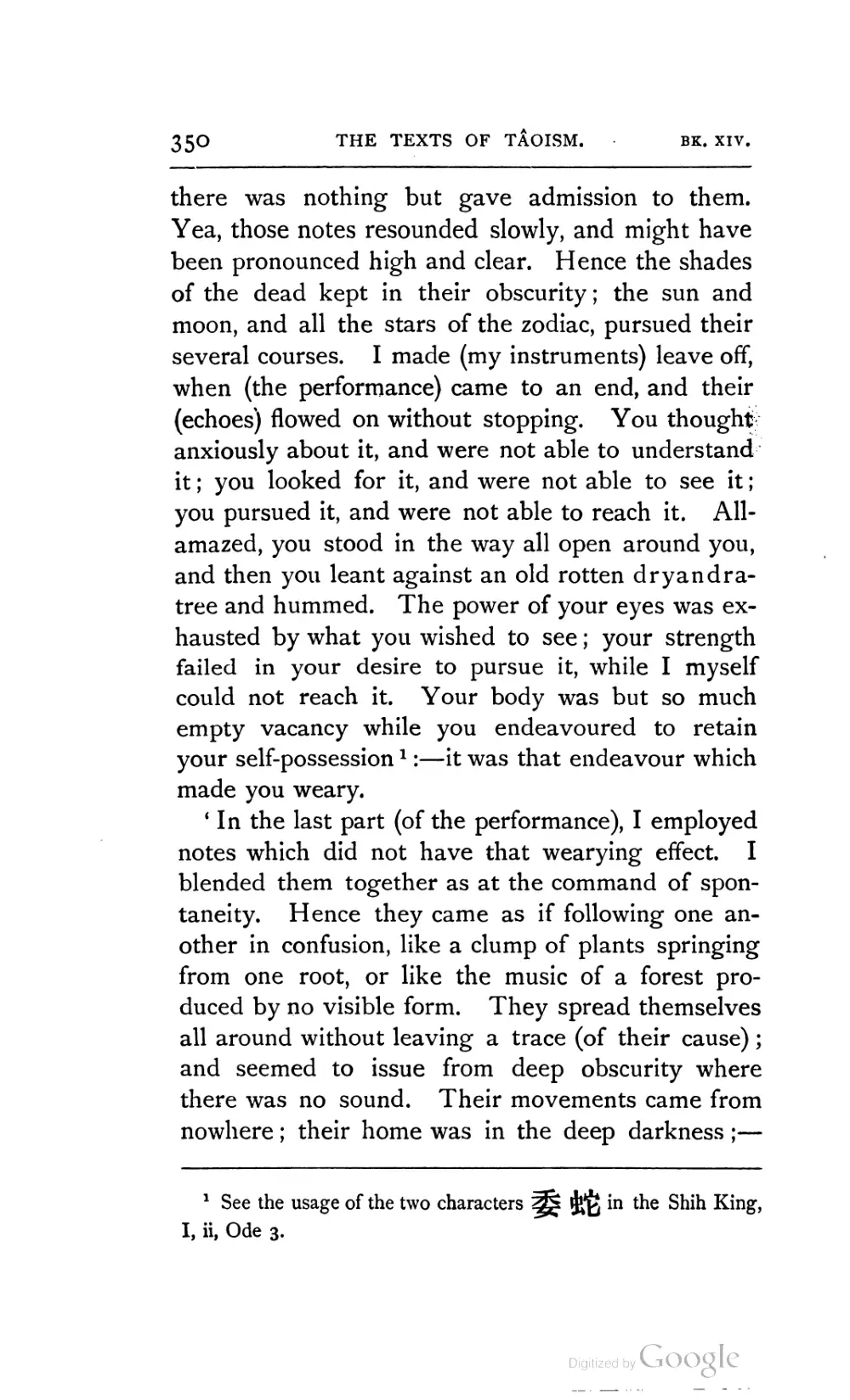
‘In the last part (of the performance) I used notes that did not have that wearying effect. I blended them together as at the command of spontaneity. Hence they came as if following one another in confusion, like a clump of plants springing from one root, or like the music of a forest produced by no visible form. They spread all around without leaving a trace (of their cause), and seemed to issue from deep obscurity where there was no sound. Their movements came from nowhere; their home was in the deep darkness;—conditions which some would call death and some life; some the fruit, and some (merely) the flower. Those notes, moving and flowing on, separating and shifting, and following no regular sounds, the world might well have doubts about, and refer to the judgment of a sage, for the sages understand the nature of this music and judge in accordance with the prescribed (spontaneity). While the spring of that spontaneity has not been touched, and yet the regulators of the five notes are all prepared;—this is what is called the music of Heaven, delighting the mind without the use of words. Hence it is said in the eulogy of the Lord of Piâo1, “You listen for it, and do not hear its sound; you look for it, and do not see its form; it fills heaven and earth; it enfolds all within the universe.” You wished to hear it, but could not take it in; and so you were perplexed.
1 See how the two characters 委蛇 [Press: easy and compliant (literally, winding)] are used in the Shih King, I, ii, Ode 3.