Legge gives the opening questions to Kwang-ȝze himself because no speaker is named. That is a fair inference, but notice what answers them: Wu-hsien Thiao's appeal to the six Extreme Points and the five Elements, a theory of good government, not a reply to "some secret spring." The Book leaves the cosmological question standing and approaches it only sideways, through Hwang-Ti's music and Lao Tan's rebukes.
The Tâo Teh King — Sacred Books of China Part I, SBE Vol. 39 (trans. James Legge, 1891)
Open to all
page 345
No image is selected for this page; its own page image is shown.
page 345
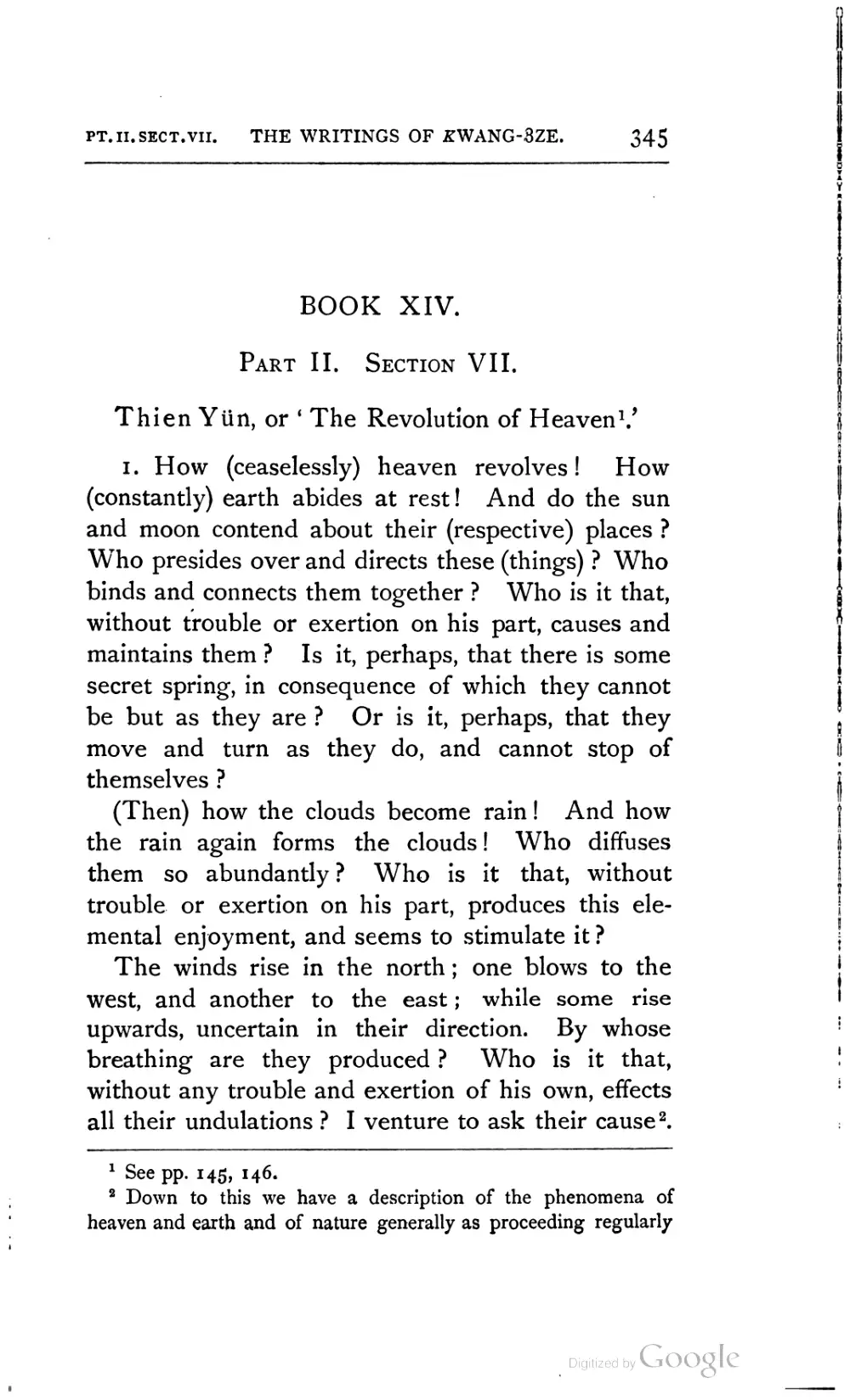
p. 345BOOK XIV.
Part II. Section VII.
Thien Yün, or ‘The Revolution of Heaven1.’
1. How (ceaselessly) heaven revolves! How (constantly) earth abides at rest! And do the sun and moon contend over their (respective) places? Who presides over and directs these (things)? Who binds and connects them together? Who is it that, without trouble or exertion on his part, causes and maintains them? Is it, perhaps, that there is some secret spring, in consequence of which they cannot be other than they are? Or is it, perhaps, that they move and turn as they do and cannot stop of themselves?
(Then) how the clouds become rain! And how the rain again forms the clouds! Who spreads them so abundantly? Who is it that, without trouble or exertion on his part, produces this elemental enjoyment and seems to stimulate it?
The winds rise in the north; one blows to the west and another to the east, while some rise upwards, uncertain in their direction. By whose breathing are they produced? Who is it that, without any trouble or exertion of his own, brings about all their undulations? I venture to ask their cause2.
1 See pp. 145, 146.
2 Down to this point we have a description of the phenomena of heaven and earth, and of nature generally, as proceeding regularly and noiselessly without any apparent cause; this is the chief subject of the Book. As the description is not assigned to anyone, we must suppose it to be from Kwang-ȝze himself, and that it is he who asks the question in the last three characters.
The parentheses in the first line are Legge's: "(ceaselessly)" and "(constantly)" supply a contrast of motion and rest that the bare Chinese leaves to the verbs. They make the line state a regularity before it asks its question, which suits his footnote's reading of the Book's subject as nature proceeding "regularly and noiselessly." The regularity is partly the translator's frame, and a reader should know it.