Legge puts ‘mankind’ in the text and keeps the literal phrase, ‘men with their cross eyes’, for the note, where he explains that human eyes are set across the face. The division is right. In English ‘cross eyes’ names a squint, and in the text it would have made Yüan Fung sound insulting; the note keeps what the commentator called ‘an extraordinary application of the characters’ without letting it mislead.
The Tâo Teh King — Sacred Books of China Part I, SBE Vol. 39 (trans. James Legge, 1891)
Open to all
page 323
No image is selected for this page; its own page image is shown.
page 323
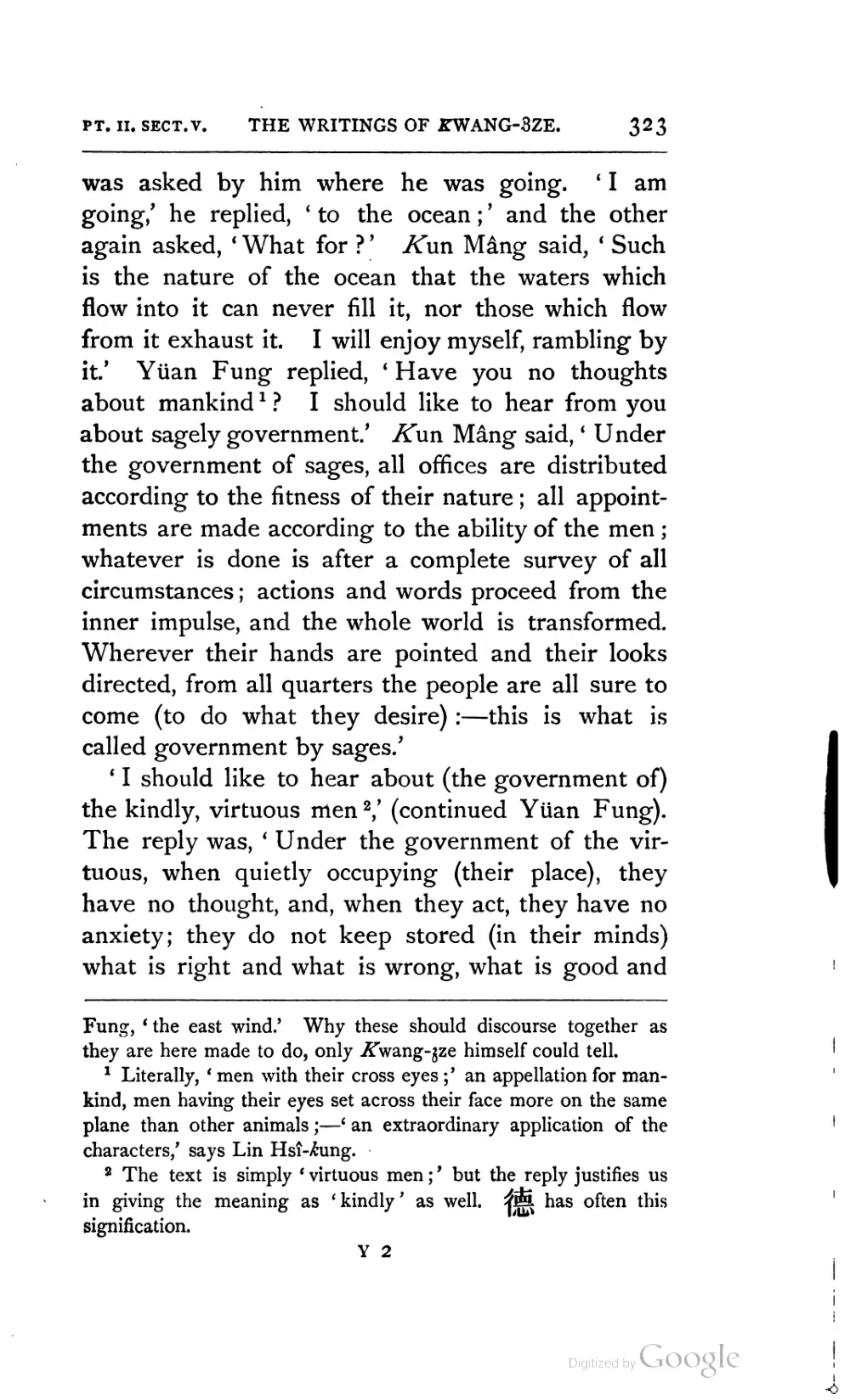
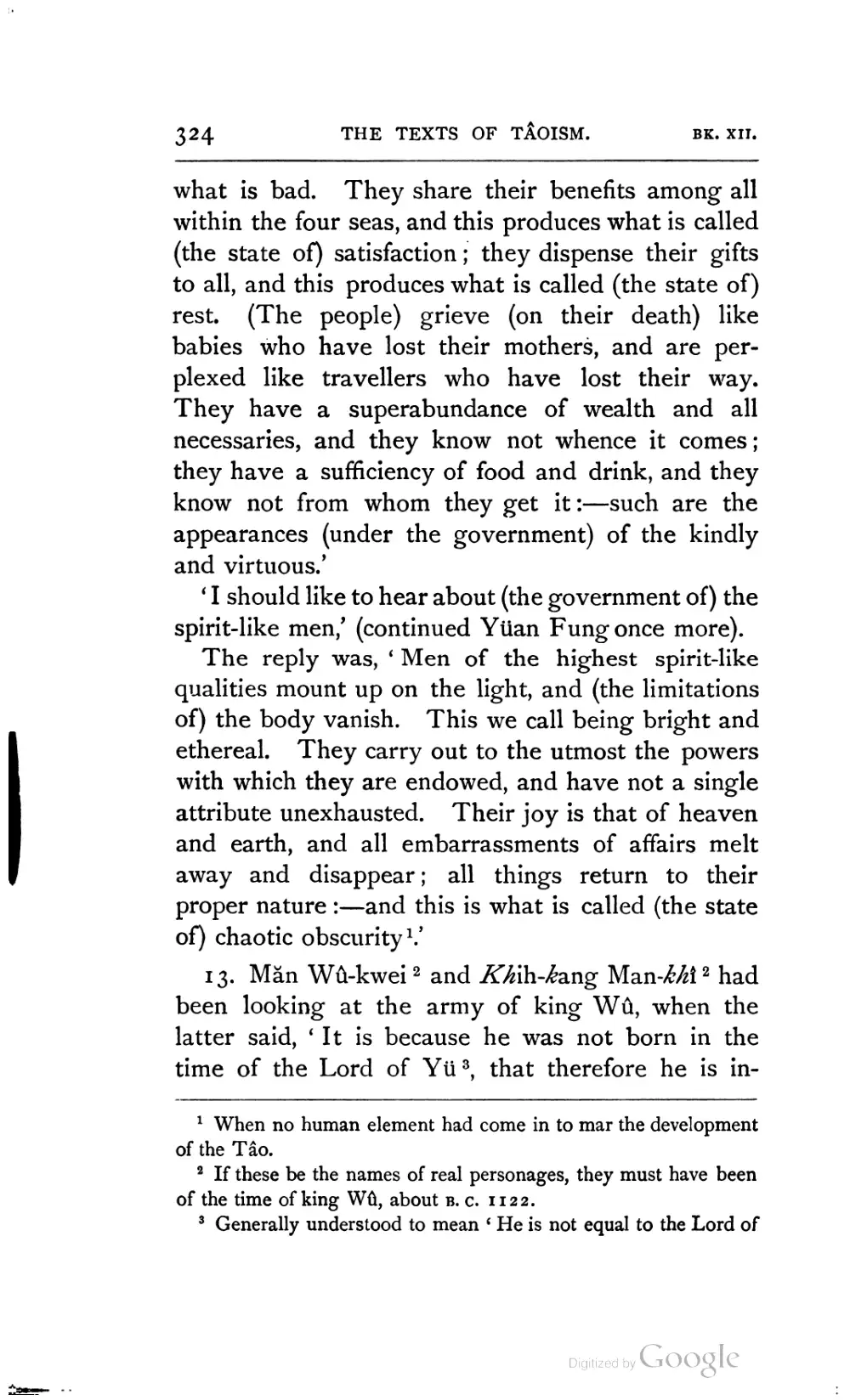
‘I should like to hear about (the government of) the kindly, virtuous men2,’ (continued Yüan Fung). The reply was, ‘Under the government of the virtuous, when quietly occupying (their place), they have no thought, and when they act, they have no anxiety; they do not keep stored (in their minds) what is right and what is wrong, what is good and what is bad.
They share their benefits among all within the four seas, and this produces what is called (the state of) satisfaction; they dispense their gifts to all, and this produces what is called (the state of) rest. (The people) grieve (at their death) like babies who have lost their mothers, and are perplexed like travellers who have lost their way. They have a superabundance of wealth and all necessaries, and they do not know where it comes from; they have enough food and drink, and they do not know from whom they get it:—such are the appearances (under the government) of the kindly and virtuous.’
1 Literally, ‘men with their cross eyes;’ an appellation for mankind, men having their eyes set across their face more on the same plane than other animals;—‘an extraordinary application of the characters,’ says Lin Hsî-kung.
2 The text is simply ‘virtuous men;’ but the reply justifies us in giving the meaning ‘kindly’ as well. 德 often has this sense.