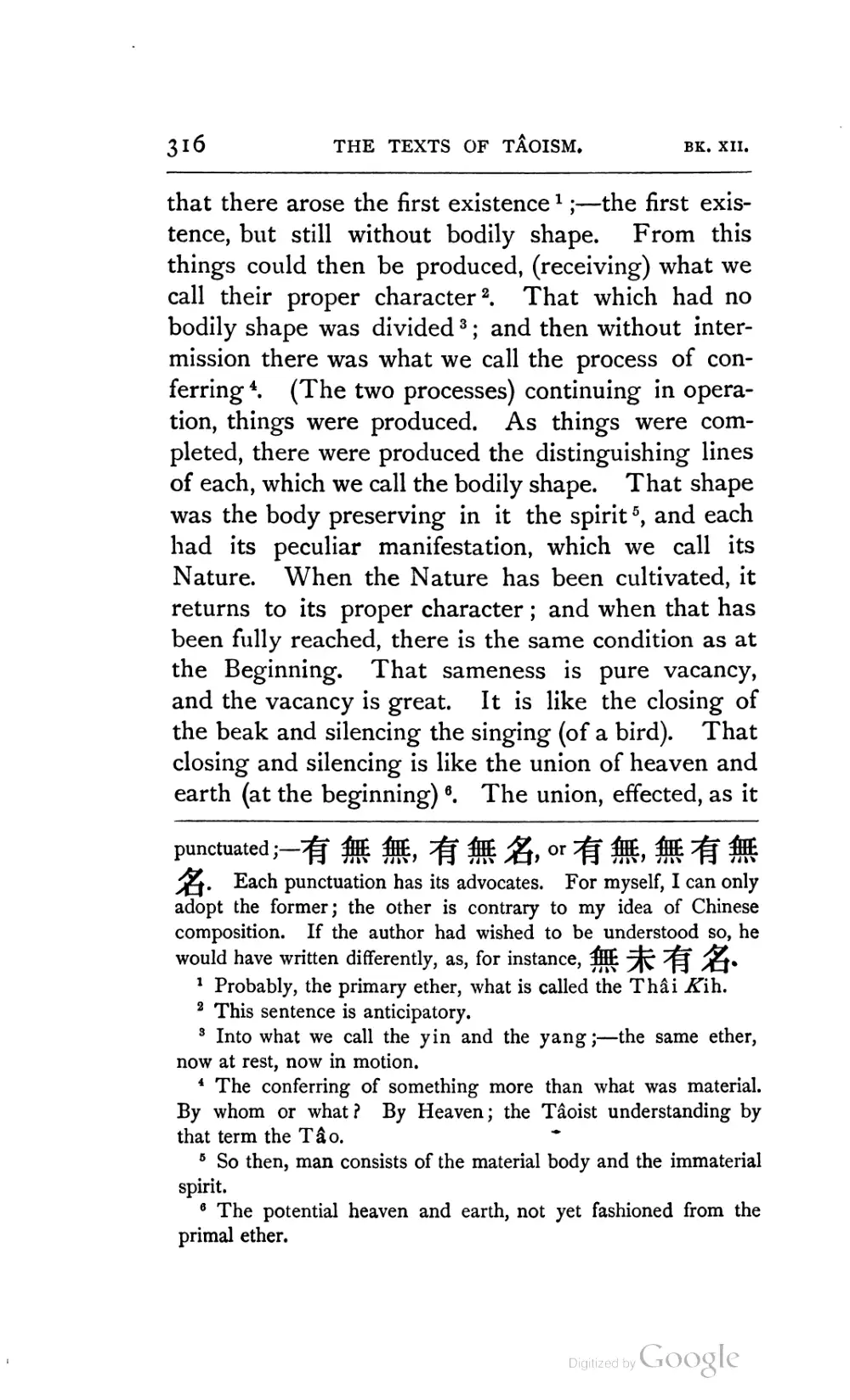
Legge concludes that ‘man consists of the material body and the immaterial spirit.’ The text is less dualist than his summary. Its body is ‘the body preserving in it the spirit’, and his own notes make the whole process one ether, ‘now at rest, now in motion’, from which shape and nature arise in stages. Material and immaterial are his categories, a nineteenth-century frame laid over a picture of one substance growing more defined.
The Tâo Teh King — Sacred Books of China Part I, SBE Vol. 39 (trans. James Legge, 1891)
Open to all
page 316
No image is selected for this page; its own page image is shown.
page 316
1 Probably the primary ether, what is called the Thai Kih.
2 This sentence is anticipatory.
3 Into what we call the yin and the yang;—the same ether, now at rest, now in motion.
4 The conferring of something more than what was material. By whom or what? By Heaven; the Taoist understanding by that term the Tâo.
5 So, then, man consists of the material body and the immaterial spirit.
6 The potential heaven and earth, not yet fashioned from the primal ether.