“Man exists under a law of progress” is the assumption of Legge's century, stated as settled. His verdict that Taoism “was wrong in its opposition to the increase of knowledge” measures chapter 19 by a standard the chapter rejects; its complaint, as he quoted it on the previous page, is against contrivance and scheming and their effects on conduct. The disagreement is real, but it is a disagreement of premises, not a refutation.
The Tâo Teh King — Sacred Books of China Part I, SBE Vol. 39 (trans. James Legge, 1891)
Open to all
page 29
No image is selected for this page; its own page image is shown.
page 29
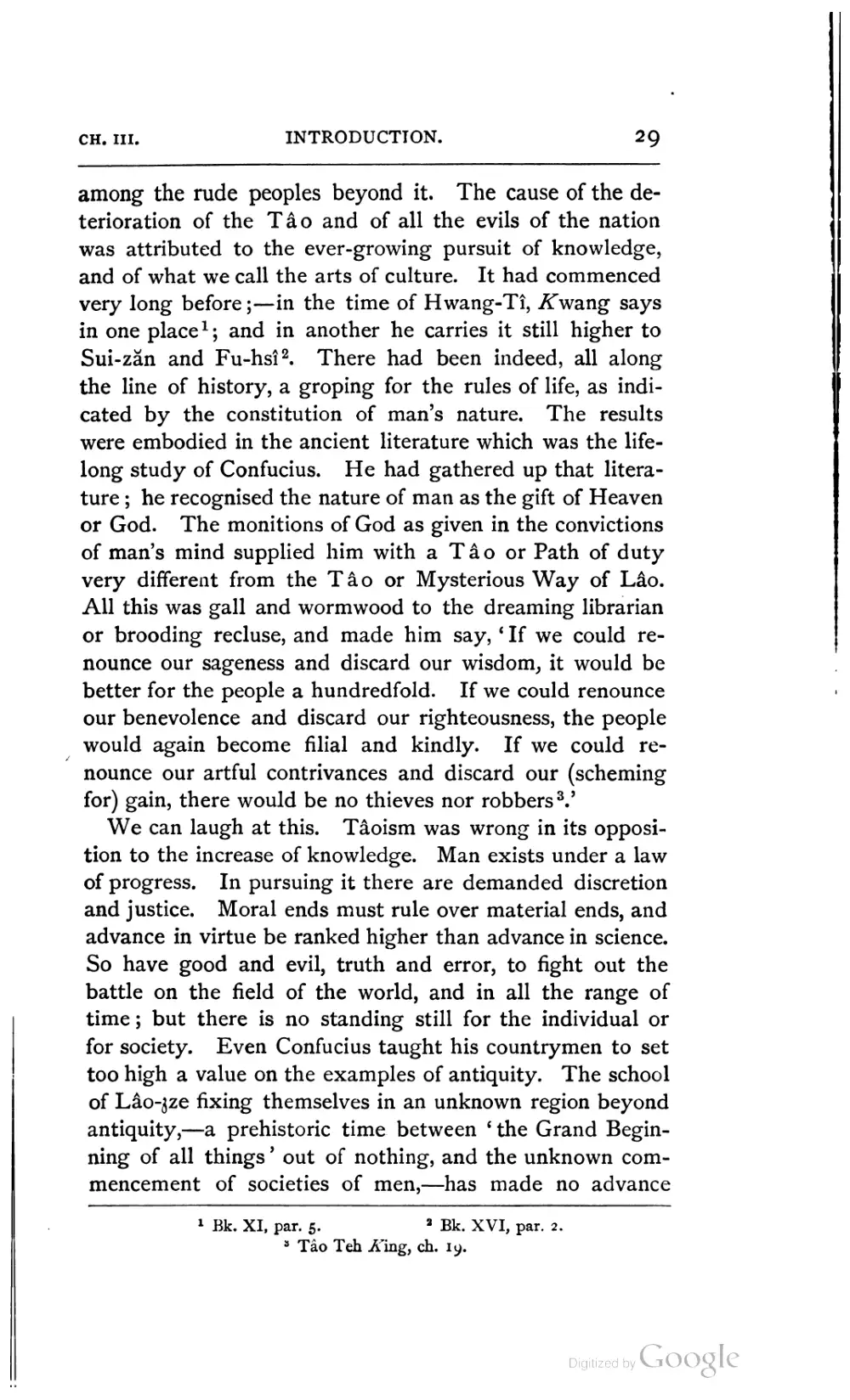
We can laugh at this. Taoism was wrong to oppose the growth of knowledge. Man lives under a law of progress, and pursuing it demands discretion and justice. Moral ends must govern material ends, and advance in virtue must rank above advance in science. So good and evil, truth and error, have to fight out their battle on the field of the world and through the whole span of time; but there is no standing still for the individual or for society.
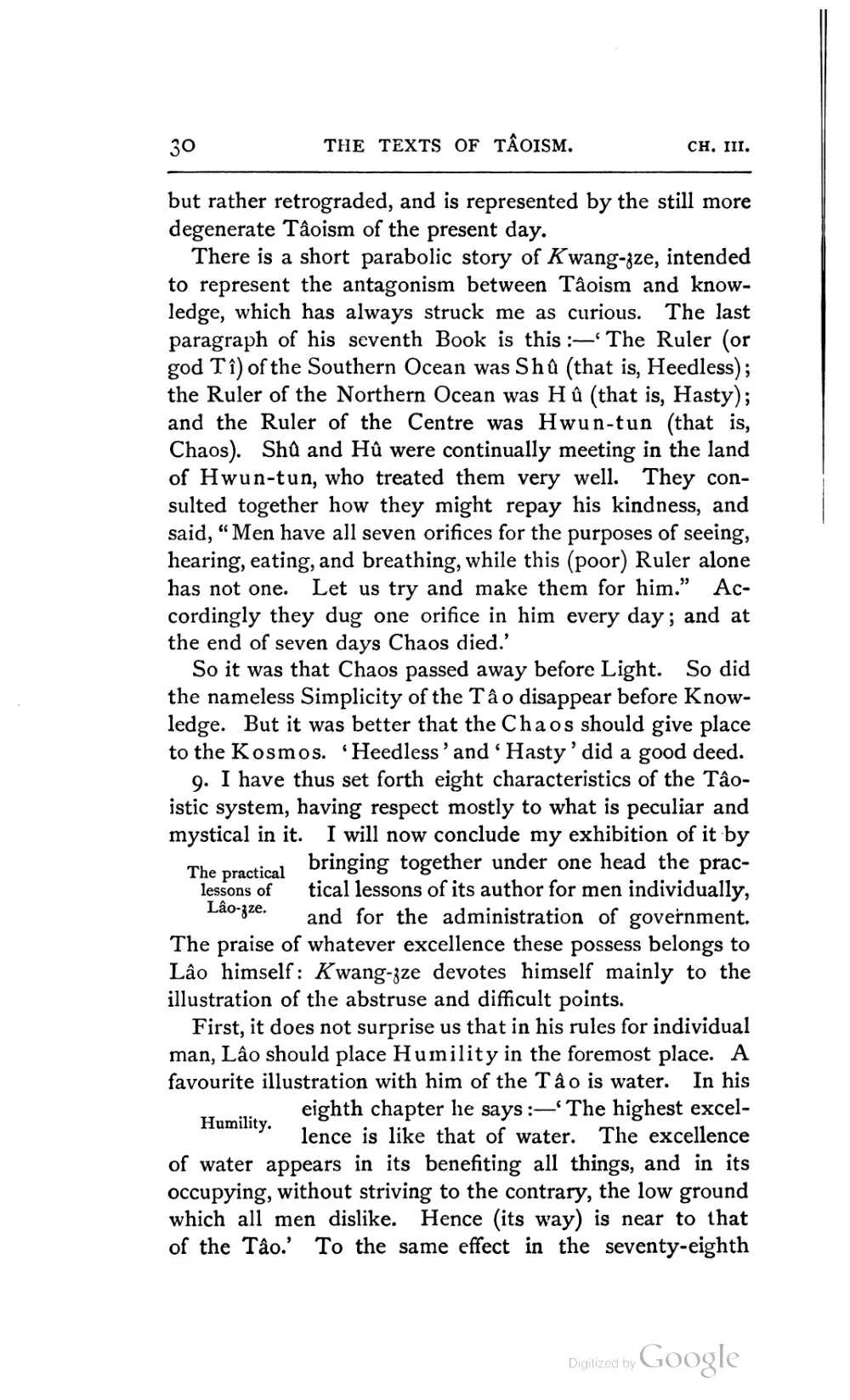
Even Confucius taught his countrymen to set too high a value on the examples of antiquity. The school of Lâo-ȝze, fixing itself in an unknown region beyond antiquity—a prehistoric time between ‘the Grand Beginning of all things’ out of nothing and the unknown beginning of human societies—has made no advance but has rather gone backwards, and is represented by the still more degenerate Tâoism of the present day.
to sect
1 Book XI, paragraph 5. 2 Book XVI, paragraph 2.
5 Tao Teh King, ch. 19.