Legge treats Confucius’s request to follow Yen Hui as ‘another testimony’ to which the sage ‘would, no doubt, have taken exception.’ That reads a dramatic device as a claim of fact. The force of the scene is the reversal of master and pupil after three stages of forgetting, benevolence and righteousness first, then ceremonies and music, then everything, and it works whether or not Confucius ever said anything like it.
The Tâo Teh King — Sacred Books of China Part I, SBE Vol. 39 (trans. James Legge, 1891)
Open to all
page 257
No image is selected for this page; its own page image is shown.
page 257
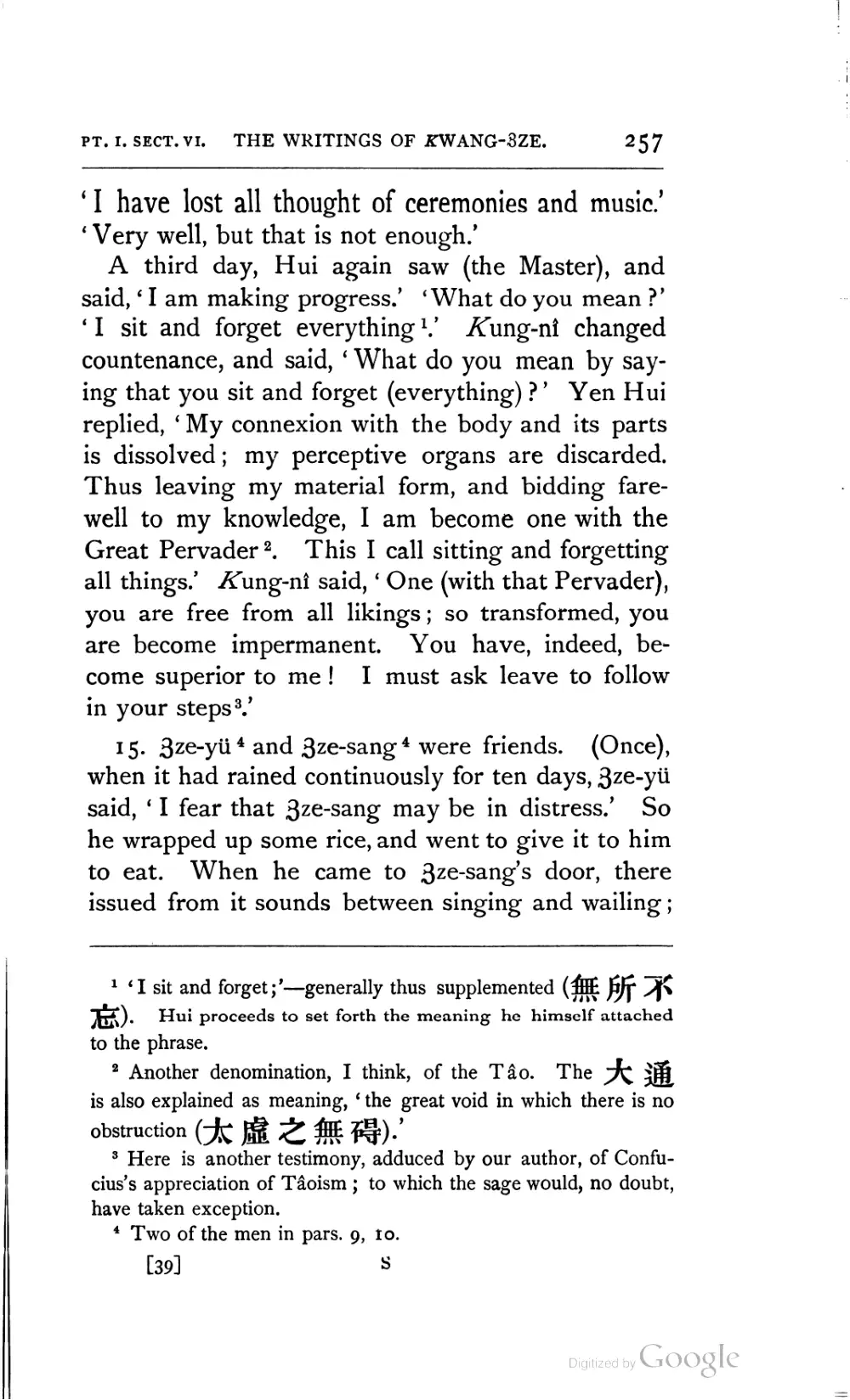
‘I have lost all thought of ceremonies and music.’ ‘Very well, but that is not enough.’
On a third day Hui again saw (the Master), and said, ‘I am making progress.’ ‘What do you mean?’ ‘I sit and forget everything1.’ Kung-nî changed countenance, and said, ‘What do you mean by saying that you sit and forget (everything)?’ Yen Hui replied, ‘My connection with the body and its parts is dissolved; my perceptive organs are discarded. Thus leaving my material form, and bidding farewell to my knowledge, I have become one with the Great Pervader2. This I call sitting and forgetting all things.’ Kung-nî said, ‘One (with that Pervader), you are free from all likings; so transformed, you have become impermanent. You have, indeed, become superior to me! I must ask leave to follow in your steps3.’
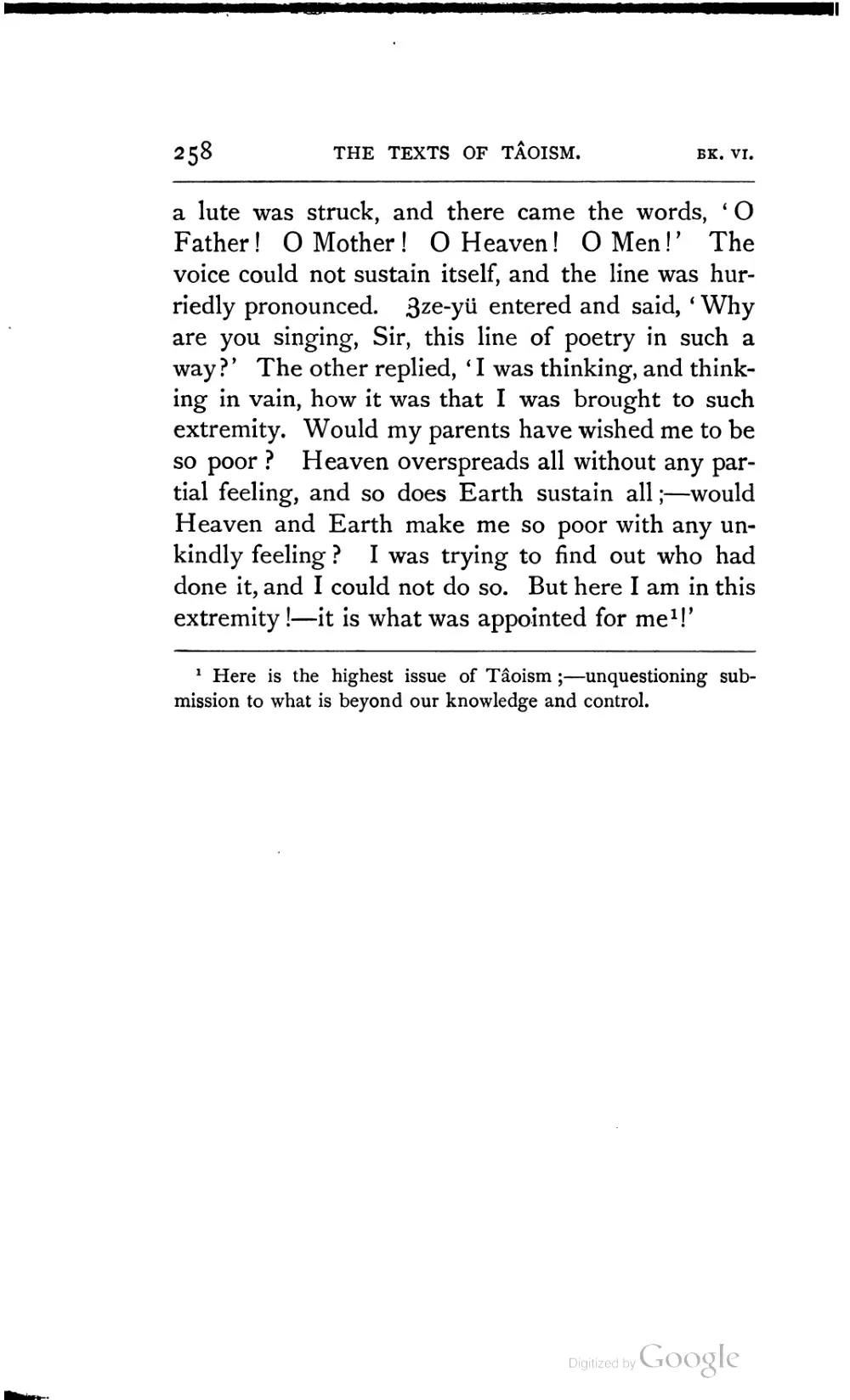
15. Ȝze-yü4 and Ȝze-sang4 were friends. (Once), when it had rained continuously for ten days, Ȝze-yü said, ‘I fear that Ȝze-sang may be in distress.’ So he wrapped up some rice, and went to give it to him to eat. When he came to Ȝze-sang’s door, there issued from it sounds between singing and wailing; a lute was struck, and there came the words, ‘O Father! O Mother! O Heaven! O Men!’ The voice could not sustain itself, and the line was hurriedly pronounced.
Ȝze-yü entered and said, ‘Why are you singing this line of poetry in such a way, Sir?’ The other replied, ‘I was thinking, and thinking in vain, how it was that I was brought to such extremity. Would my parents have wished me to be so poor? Heaven overspreads all without any partial feeling, and so Earth sustains all;—would Heaven and Earth make me so poor out of any unkind feeling? I was trying to find out who had done it, and I could not. But here I am in this extremity!—it is what was appointed for me1!’
1 ‘I sit and forget;’—generally supplemented thus (無所不 [Press: there is nothing that (I do) not] 忘 [Press: to forget]). Hui goes on to set out the meaning he himself attached to the phrase.
2 Another name, I think, for the Tâo. The 大通 is also explained as meaning ‘the great void in which there is no obstruction (太虛之無碍).’
3 Here is another testimony, adduced by our author, to Confucius’s appreciation of Taoism; one to which the sage would, no doubt, have taken exception.
4 Two of the men in pars. 9 and 10.