Confucius calls himself one ‘killed and exposed to public view by Heaven,’ and Legge finds it ‘a strange description of himself by the sage.’ Read with the earlier image of the life suspended by a cord (pp. 247–249), it is consistent: the Taoists have loosed the cord, while Confucius knows he is still bound by the duties of the common ways. The author has the sage diagnose his own condition, not merely praise his rivals, which gives the scene more weight than flattery would.
The Tâo Teh King — Sacred Books of China Part I, SBE Vol. 39 (trans. James Legge, 1891)
Open to all
page 252
No image is selected for this page; its own page image is shown.
page 252
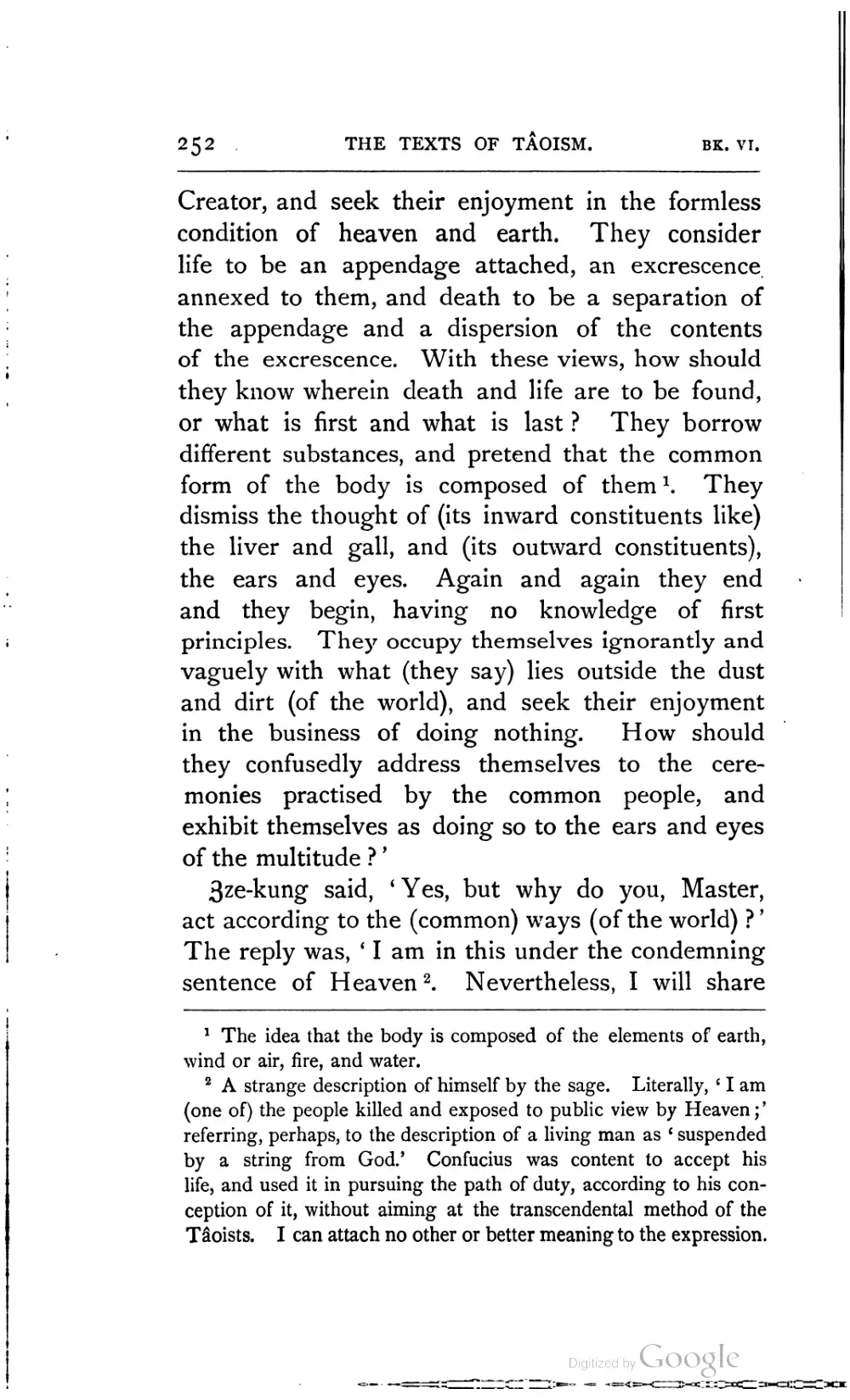
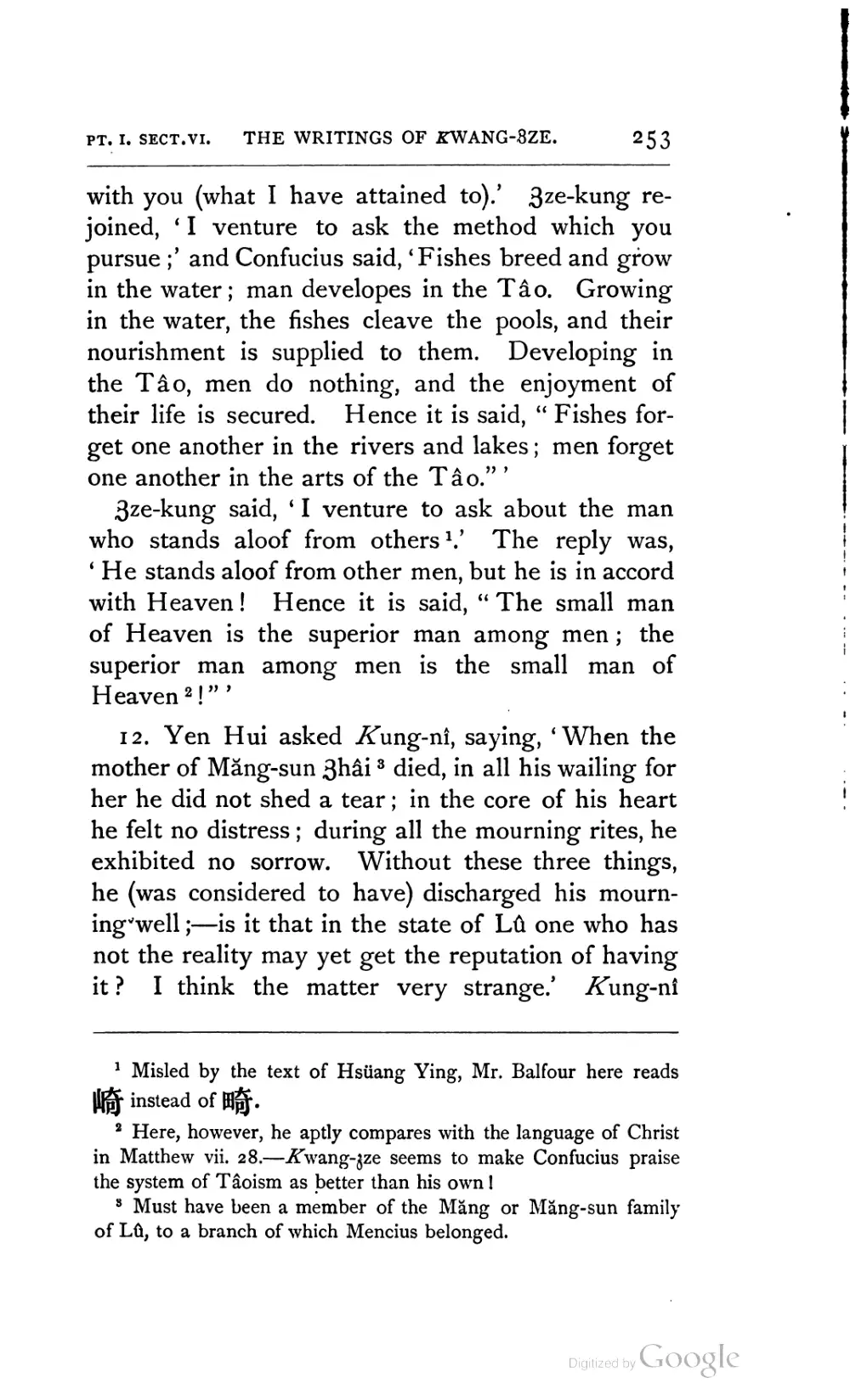
Ȝze-kung said, ‘Yes, but why do you, Master, act according to the (common) ways (of the world)?’ The reply was, ‘I am in this under the condemning sentence of Heaven2. Nevertheless, I will share with you (what I have attained to).’ Ȝze-kung rejoined, ‘I venture to ask the method you pursue;’ and Confucius said, ‘Fish breed and grow in the water; man develops in the Tao. Growing in the water, the fish cleave the pools, and their nourishment is supplied to them. Developing in the Tao, men do nothing, and the enjoyment of their life is secured. Hence it is said, “Fish forget one another in the rivers and lakes; men forget one another in the arts of the Tâo.”’
1 The idea that the body is made up of the elements of earth, wind or air, fire, and water.
2 A strange description of himself by the sage. Literally, ‘I am (one of) the people killed and exposed to public view by Heaven;’ referring, perhaps, to the description of a living man as ‘suspended by a string from God.’ Confucius was content to accept his life, and used it in pursuing the path of duty as he conceived it, without aiming at the transcendental method of the Taoists. I can attach no other or better meaning to the expression.