The sentence derives both the spirits and God from the Tâo, which makes the Supreme Ruler an effect rather than a source. Legge’s note softens this into a claim about belief: men ‘came to believe’ in spirits and God, and ‘It was to the Tâo that those concepts were owing.’ That turns a ranking of beings into a history of ideas, a move a Christian translator had reason to make. The reader should keep the text’s own claim, that the Tâo is prior to God, apart from the note’s gentler version.
The Tâo Teh King — Sacred Books of China Part I, SBE Vol. 39 (trans. James Legge, 1891)
Open to all
page 243
No image is selected for this page; its own page image is shown.
page 243
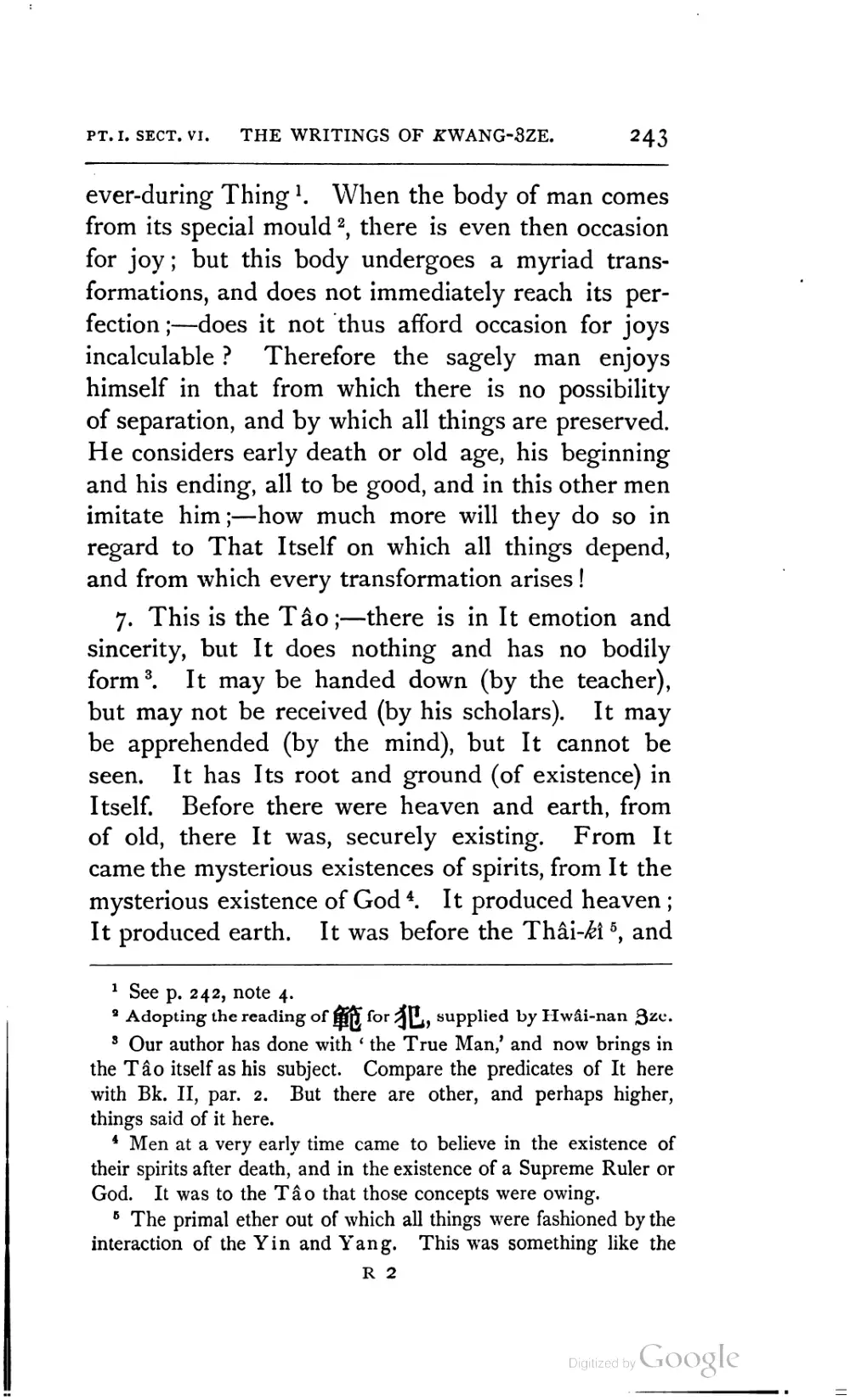
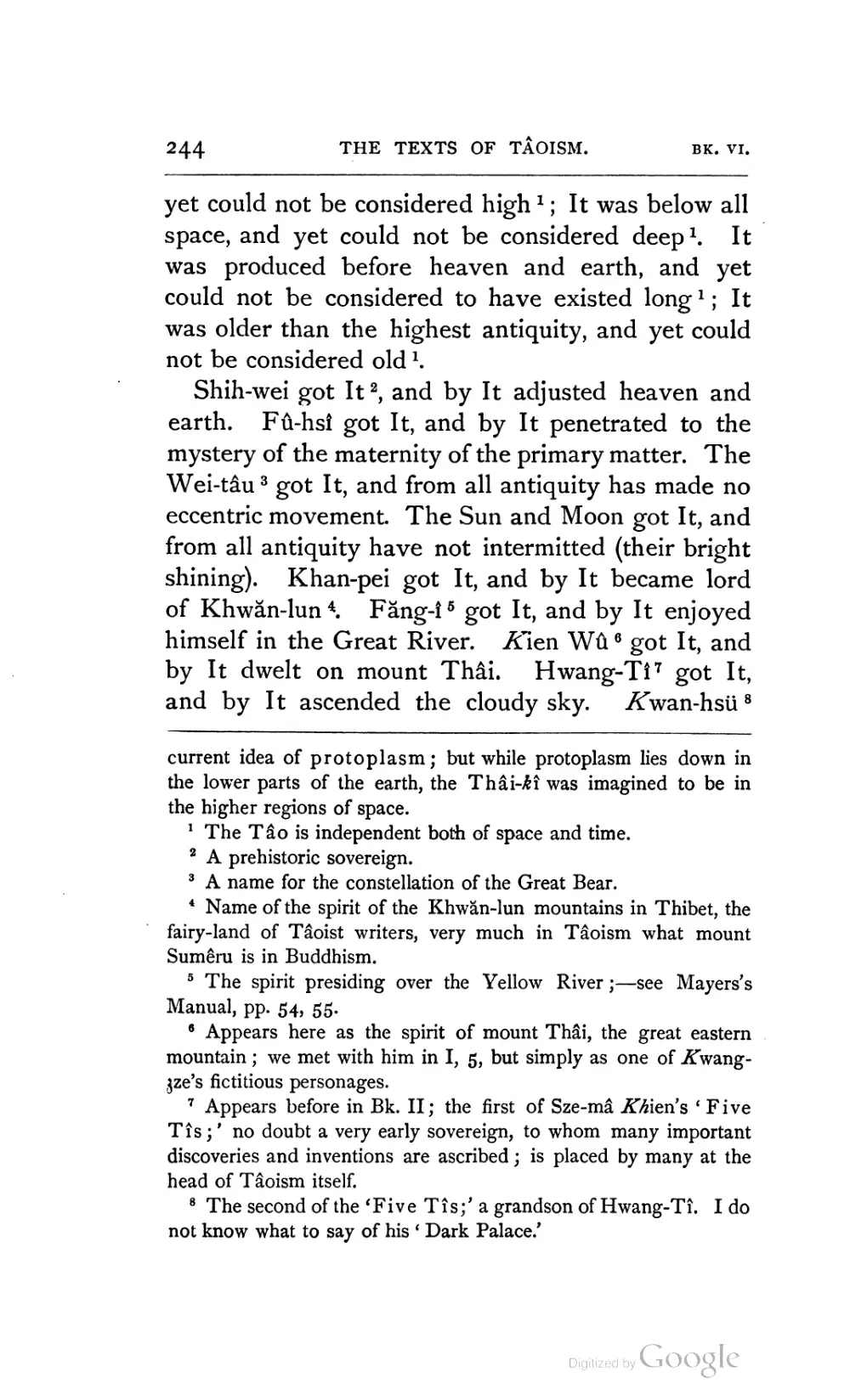
7. This is the Tâo;—there is in It emotion and sincerity, but It does nothing and has no bodily form3. It may be handed down (by the teacher), but may not be received (by his scholars). It may be apprehended (by the mind), but It cannot be seen. It has Its root and ground (of existence) in Itself. Before there were heaven and earth, from of old, there It was, securely existing. From It came the mysterious existences of spirits, from It the mysterious existence of God4. It produced heaven; It produced earth. It was before the Thâi-kî⁵, and yet could not be considered high; It was below all space, and yet could not be considered deep. It was produced before heaven and earth, and yet could not be considered to have existed long; It was older than the highest antiquity, and yet could not be considered old1.
1 See p. 242, note 4.
2 Adopting the reading of 範 [Press: a mould, pattern; to fashion] for 犯 [Press: to transgress; to encounter], which Hwâi-nan ȝze supplies.
3 Our author has done with ‘the True Man,’ and now brings in the Tâo itself as his subject. Compare the predicates of It here with Bk. II, par. 2. But other, and perhaps higher, things are said of it here.
4 Men came very early to believe in the existence of their spirits after death, and in the existence of a Supreme Ruler or God. It was to the Tâo that those concepts were owing.
5 The primal ether out of which all things were fashioned by the interaction of the Yin and Yang. This was something like the current idea of protoplasm; but while protoplasm lies down in the lower parts of the earth, the Thai-kî was imagined to be in the higher regions of space.
Legge glosses the Thâi-kî as the primal ether and likens it to ‘the current idea of protoplasm,’ a comparison drawn from the biology of his own day. The likeness misleads more than it helps. The passage uses the Thâi-kî only as the highest point of reference and then says the Tâo, though before it, ‘could not be considered high.’ The argument is that spatial and temporal predicates fail, not that the Tâo is a kind of primordial matter.